The Cheapside Explosion of 1890
The Cheapside Explosion of 1890
The Halifax factory disaster that destroyed a family business's workshop
On the morning of Thursday, 11 September 1890, a tremendous explosion shattered a building in Cheapside, Halifax.
The blast tore through the premises of C. Worsnop & Sons, an electroplating works situated in an enclosed yard behind the shops. Walls were left dangerously unstable, windows were blown out in neighbouring buildings and debris was scattered across the surrounding area.
Three people lost their lives.
The explosion was heard across Halifax and brought crowds into the streets. Among those waiting anxiously for news were relatives of the people working inside the building.
It was one of the town's most serious industrial accidents of the period. Yet the disaster also opens a window onto a much less familiar part of Halifax's commercial history: the Worsnop family, their lamp-making and electroplating business, and the products they manufactured for Victorian homes.

An A.I. image of Cheapside
The Worsnop business
The Worsnop name was associated with Halifax trade for several decades.
Charles Henry Porter Worsnop, born in 1839, had worked as a joiner and carpenter before establishing himself as a general dealer. He married Susannah Ruth Lister at Halifax Parish Church on Christmas Eve 1860.
The family business developed into the manufacture and sale of lamps, oil goods, smallwares and fancy goods.
By 1865, C. Worsnop & Co. was listed at 17 Russell Street. Later premises included Cheapside, where the firm operated as a lamp and oil merchant and electroplater.
The business was not simply a shop selling other people's products. It manufactured and finished goods itself, including lamps and electroplated articles.
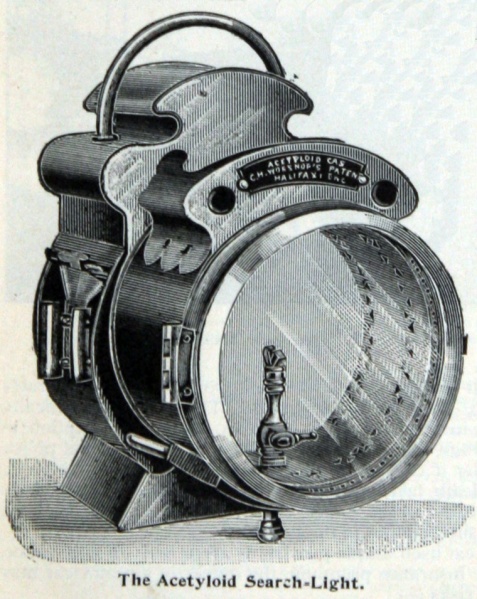
The family also developed products of its own. One was the Sun central-draught lamp. Another was a laundry preparation sold under the name Lavolio.
The latter was sufficiently distinctive to be registered as a trade mark. The Chemist and Druggist recorded the registration of Lavolio as a preparation for laundry purposes, naming Charles Henry Worsnop of Cheapside, Halifax, as its proprietor.
This is a useful reminder that Victorian Halifax businesses were not all textile manufacturers. Some were developing consumer products and competing in specialist markets.

The building behind the shops
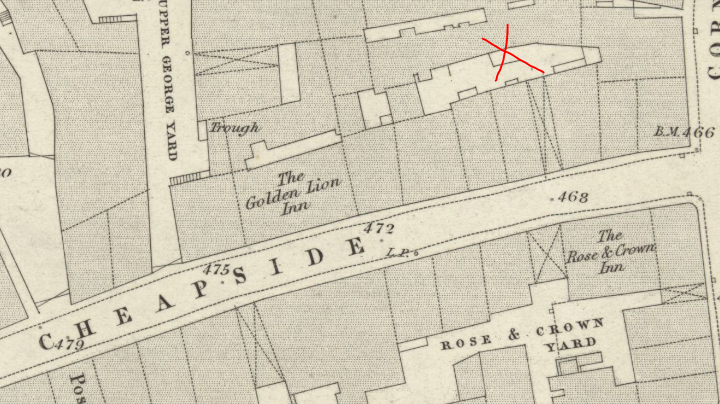
The explosion occurred in a three-storey building in an enclosed yard behind the Cheapside shopfronts.
The building was used for electroplating. A gas engine was installed in the lower room.
The contemporary report in the Manchester Courier described the premises as being occupied by C. and H. Worsnop. It was a working industrial building tucked away behind the street's commercial frontage.
That arrangement was not unusual in Victorian towns. Shops could face the street while workshops and manufacturing rooms occupied yards and buildings behind them.
The location meant that the explosion affected more than the people inside the works. Nearby workrooms, warehouses and the public house opposite were also damaged.
The morning of the explosion
There were six people working inside the building when the explosion happened.
Two young men in the upper room escaped. One climbed through a skylight onto the roof, while another clung to a window frame until he could be rescued by ladders.
Two workers in the lower room also managed to get out, although both were knocked down by falling stones and timber.
The two people in the middle room were not so fortunate.
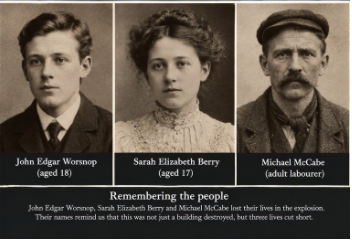
They were John Edgar Worsnop, aged 18, and a young woman whose identity was reported inconsistently in the newspapers.
The Manchester Courier identified her as Miss Hartley, of Crossley Terrace. The later inquest account identifies her as Sarah Elizabeth Berry, aged 17. The surviving local-history research notes that the identification as Hartley may have been a mistake. Until the original inquest papers or a reliable civil registration record are checked, it is safest to retain both versions rather than pretend the discrepancy has been resolved.
A fire broke out following the explosion. Firemen eventually recovered the young woman's body from the wreckage, while Worsnop's body remained buried beneath debris until around one o'clock.
The newspaper described the destruction as extensive. The interior of the building had been completely wrecked, and the surrounding walls were left in a perilous condition.
The third victim
A labourer named Michael McCabe had been working in the yard, where excavation was taking place.
He was struck by falling masonry and suffered a fractured skull. He was taken to Halifax Infirmary, where he remained unconscious.
The first newspaper report said he was not expected to recover. He died at the infirmary approximately three hours after the explosion.
The disaster therefore claimed three lives: John Edgar Worsnop, the young woman working in the building and Michael McCabe.
The tragedy affected people from different parts of the workforce: a member of the business family, a young female employee and a labourer working outside the building.
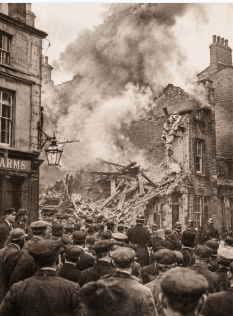
An A.I. generated scene
Was it a bomb?
In the immediate aftermath, the cause was uncertain.
The explosion was so violent that the possibility of a deliberate act was considered. The Home Office was informed, and officials examined whether a bomb might have been responsible.
The inquest account, however, records that Home Office officials did not intend to send an inspector because there was no apparent reason to believe the incident was anything other than a gas explosion.
There were no explosives on the premises.
The suspected cause was an escape of gas in the lower room, where the gas engine was situated. One possible explanation was that a gas pipe or joint had been damaged by the recent collapse of an adjoining building.
This remains a suggested explanation rather than a proven account of the precise failure. The evidence available in the contemporary report does not establish exactly what broke or how the gas ignited.
The distinction matters. The explosion was initially alarming enough to prompt questions about a bomb, but the available evidence pointed towards an accidental gas explosion.
The damage to Cheapside
The force of the blast extended beyond the factory.
The Manchester Courier reported that scores of windows in the surrounding yard had been blown out. Workers in nearby rooms and warehouses were injured or badly shaken.
The Foresters' Arms, directly opposite the works and only a few feet away, suffered considerable damage. Its windows were blown in and debris covered the floors.
A large crowd gathered as news spread through the town.
For people living and working around Cheapside, this was not a distant industrial accident. It had happened in the middle of a busy commercial district, behind the ordinary shopfronts of Halifax.
The full financial cost was not established in the initial newspaper report.

A later scene in Cheapside
What became of the business?
The explosion did not mark the end of the Worsnop family's commercial activities.
The family continued to trade in lamps, oil goods and electroplated products. A notice in the London Gazette dated 5 October 1894 records the dissolution of the partnership between Charles Henry Worsnop and Jean Jacques Forrer.
Their business had been conducted at Cheapside and Carlton Place under the name Worsnop and Co., making petroleum lamps and stoves, electroplating, and dealing in glass and hardware. They also traded in tobacco and cigars under a separate partnership name.
This notice is useful because it shows the range of activities associated with the Worsnop name just four years after the disaster.
The business's later history included lamp manufacturing at Savile Park Road. The Worsnop name remained associated with Halifax industry into the twentieth century.
Charles Henry Worsnop, the younger member of the family, became involved in electrical and battery technology. His later patent work included a composition for producing illuminating gas, patented in the United States in 1900.
The family story therefore extended beyond the Victorian lamp and electroplating trade into the developing electrical age.
Remembering the people, not just the explosion
It is easy to remember the Cheapside disaster simply as a dramatic explosion: a building destroyed, a public house damaged and crowds gathering in the street.
But the records give us the names of the people who died.
John Edgar Worsnop was only 18. Sarah Elizabeth Berry, if that is indeed the correct identification of the young woman reported as Miss Hartley, was just 17. Michael McCabe was an older labourer who had been working outside the building.
Their deaths were not simply a statistic in a list of Victorian industrial accidents. They were three lives lost in a workplace tucked behind the familiar shops of Halifax town centre.
The Worsnop business itself is also worth remembering. Its lamps, electroplated goods and laundry products show the variety of manufacturing that once took place in Halifax's smaller workshops.
The explosion of September 1890 exposed the dangers hidden behind those shopfronts. It also left a detailed contemporary record of a family business, its employees and a moment when an ordinary working morning turned into a catastrophe.
This is an AI-generated historical illustration, not genuine 1890 photograph.
If you have enjoyed your visit to this website, please spread the word by clicking the 'like' and 'share' buttons below. Thank you