Copley Blog

WundaNumba 777-545 - What's behind your WundaNumba.com
Copley, Halifax — the story behind the photographs
Copley lies in the Calder Valley south-west of Halifax, beside the River Calder and the historic Calder and Hebble Navigation. Although the village is now best known for its Victorian terraces and railway viaduct, its history stretches back much further. Malcolm Bull’s Calderdale Companion records Adam de Copley in connection with events in 1070, while the name itself has several possible interpretations. The settlement’s modern character, however, was shaped above all by the growth of textile manufacturing and an ambitious experiment in workers’ housing.
Edward Akroyd’s model village
Copley became one of Halifax’s most distinctive industrial communities during the 1840s. The Akroyd family had acquired the mill and surrounding land, and after Jonathan Akroyd’s death in 1847, his son Edward Akroyd developed a planned village for the mill workforce. Building began in 1847 and the main housing scheme was completed in 1849. The terraces were designed to provide workers with homes close to their employment, rather than requiring them to travel long distances to the mill.
Copley was more than a row of factory houses. The village included shops, a school, a library, a dining shed and allotments, helping to create a self-contained community around the works. The architectural design is associated with William Henry Crossland and the influence of Sir George Gilbert Scott, with Gothic and “Old English” features giving the terraces a distinctive appearance. Copley became an early example of the planned industrial village in the Halifax area, preceding better-known developments such as Akroydon and Saltaire.
Copley Mills and the railway viaduct
The mill was the economic heart of the village. Jonathan Akroyd acquired the earlier mill in the nineteenth century, and it was rebuilt in 1847 as the business expanded. The works became associated with worsted production and provided employment for generations of local people. After the mills closed in 1968, the industrial buildings were demolished during the 1970s, and housing later occupied the site. The loss of the mill was a major change in Copley’s landscape, but many of the original workers’ houses survived.
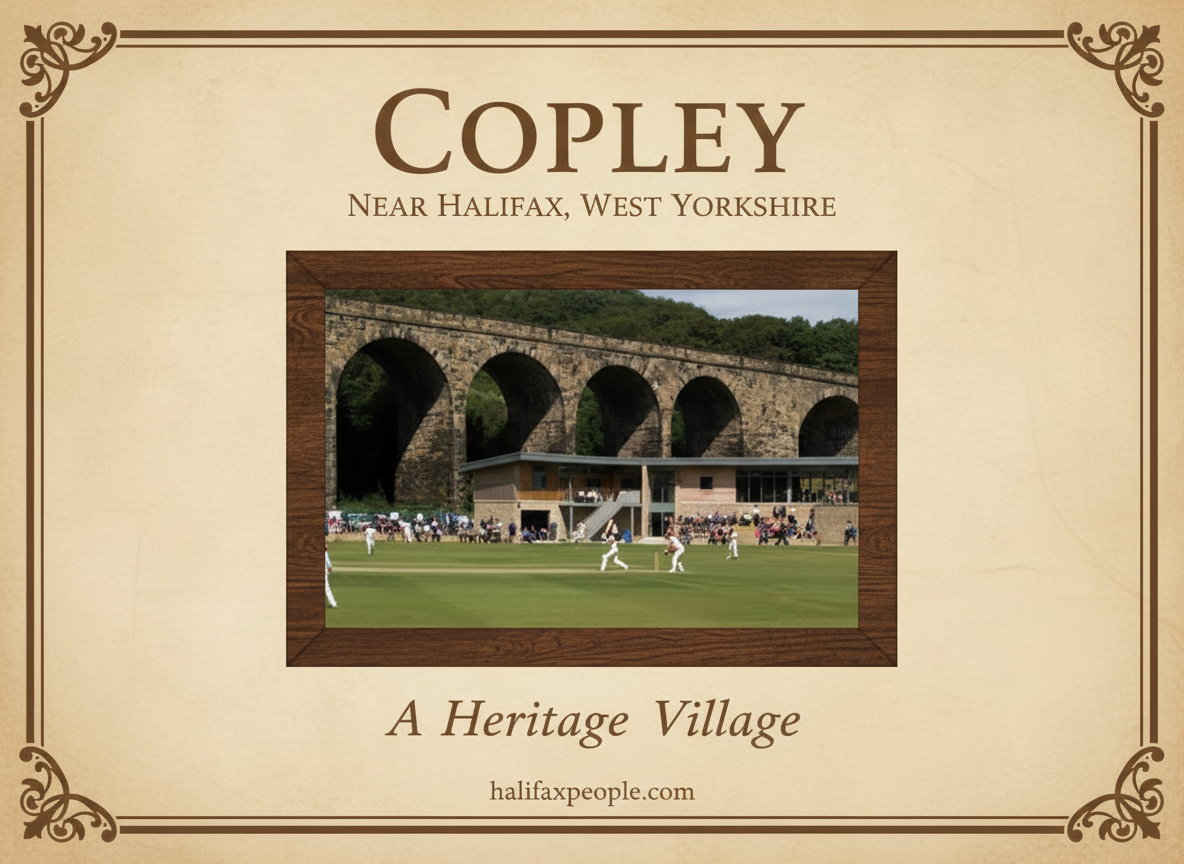
Another landmark is the impressive Copley Viaduct, which carries the railway across the River Calder, the Calder and Hebble Navigation and Wakefield Road. Built for the Lancashire and Yorkshire Railway around 1851–52, it is constructed from sandstone and has 23 arches supported by tall piers. The Sowerby Bridge to Halifax branch opened on 1 January 1852, improving railway access to Halifax and linking the town more directly with the wider regional network. The viaduct remains one of the most striking reminders of the engineering that transformed the Calder Valley during the railway age.
Shops, school and everyday village life
Historic photographs of Copley reveal the everyday details of the planned community: rows of stone houses, local shops, school buildings and the streets that connected residents with the mill. The village had its own library by 1850 and a co-operative society that continued until 1968. A railway station opened in 1856 to serve the growing settlement, but it closed in July 1931 and was later demolished. The station’s history reflects how transport facilities rose and fell with changes in travel patterns and local industry.
Copley also had an important network of bridges and river crossings. The former toll bridge at Copley was built in 1831 for Richard Kennett-Dawson, and the toll was removed in 1856. The original stone bridge collapsed during the severe floods of December 2015. A replacement was subsequently built using some stone from the earlier structure and named Wilson Bridge, commemorating local resident Graham Wilson. This episode shows how Copley’s historic transport infrastructure continues to shape the village, even as floods and modern engineering alter the landscape.
The village today — heritage and change
Copley’s mills and some community buildings have disappeared, but its workers’ terraces, shops, church and railway viaduct preserve much of the character of the original model village. The area is recognised as a conservation area, reflecting the architectural and historic importance of its surviving buildings. The remaining streets tell the story of a settlement planned around industrial employment, where housing, education, shopping and recreation were brought together within walking distance of the mill.
Copley’s story is therefore both industrial and social. It records the ambition of the Akroyd family, the lives of the people who worked in the mills, and an early attempt to improve workers’ housing through a planned village. The historic photographs help recover the details of a community whose mill has vanished, but whose distinctive built environment still offers a visible connection to Halifax’s textile past.
 |
 Random Copley |
The Bus That Could Barely Turn
 |
 |
Copley village route, circa 1950 — Enhanced by halifaxpeople.com
The modern bus goes everywhere — there's scarcely a hill-top hamlet in Calderdale it hasn't reached. But getting there wasn't always straightforward.
Take the Copley village route. Before coming up to Wakefield Road, drivers faced a notorious right-angle bend that caused problems on every single visit and return. Along one side, a fence pressed in close. On the other, narrow stone setts left barely enough room for the bus to squeeze through and make a decent turn.
It was one of those corners every driver dreaded and every passenger held their breath on.
The fix, when it finally came, was simple — the fence was removed and the road widened considerably. What had been a daily battle became a straightforward journey, and Copley's residents could finally rely on a bus service that didn't risk scraping the paintwork every trip.
Do you remember the Copley bus? Did you ever hold your breath on that corner? Share your memories below.


Copley Toll

Copley flooding

Copley Cricket
 |
Airport Transfers car or 8 seater minibus 07810 077766 |
Explore More:-
🔹 Sowerby Bridge — Down the valley
🔹 Elland — Neighbouring town
🔹 Halifax Villages — All 59 villages