Daniel Defoes Visit to Halifax
Daniel Defoes Visit to Halifax — The Parish in 1747
Introduction
In about the year 1747, the famous writer and traveller Daniel Defoe — best known as the author of Robinson Crusoe — visited Halifax. His journey through England took him deep into the West Riding of Yorkshire, where he spent considerable time observing Halifax, which he described as "the most populous parish in England." His account remains one of the most vivid and important descriptions of Halifax and its people in the eighteenth century.

The Journey to Halifax
Defoe approached Halifax from the western boundaries of the parish, and was immediately struck by the dramatic landscape. He wrote:
"The nearer we came to Halifax we found the houses thicker and the villages greater in every bottom; and not only so, but the sides of the hills, which are very steep every way, were spread with houses."
The land was divided into tiny enclosures — many just two to seven acres in size — with nearly every small plot holding a house. After climbing three steep hills, Defoe realised he had entered one continued village: a vast, sprawling settlement that seemed to stretch endlessly across the valleys, where scarcely a house stood out of sight of another.
The People at Work
What impressed Defoe most was the industry and activity visible everywhere:
"As the day cleared up, we could see at every house a tenter, and on almost every tenter a piece of cloth, kersie, or shalloon."
These were the three great articles of Halifax’s labour — cloth, kersey, and shalloon — produced in almost every home. Alongside weaving, the work of the dyers, scourers, and dressers filled the valley. Every stream was put to use: water was channelled and guided by gutters and pipes from house to house, so that not one house wanted its own supply.
Defoe noted that every family kept a horse to carry wool to spinners, cloth to the market, and provisions home. Most also kept a cow or two. The land itself, though seemingly barren and rocky, was enriched beyond belief by the constant careful use of every stream and scrap of fertile soil.
Coal and Running Water on the Hills
Defoe observed that Halifax possessed two great blessings of nature: plenty of running water and abundant coal, even on the very highest hilltops. Springs emerged everywhere, and coal could be dug close at hand — making it easy to carry fuel uphill. He saw this as a special provision of Providence, perfectly suited to manufacturing, which could not otherwise be so easily supplied.
The Town of Halifax
Crossing the River Calder at Sorby Bridge, Defoe entered the town itself. He described Halifax as the most populous parish or vicarage in England, stretching some 12 or 13 miles across. In the year 1443, he noted, there were only 30 houses here; yet by Defoe’s time the population had grown enormously. In the reign of Queen Elizabeth I, the inhabitants had shown their loyalty by sending no fewer than 1,200 young men to fight against the Spanish Armada in the Earl of Westmorland’s rebellion of 1569.
Halifax had become so populous, Defoe remarked, that the trade in kerseys alone had increased by a quarter in just fifty years — with cloth being made not just for Britain, but to supply armies abroad.
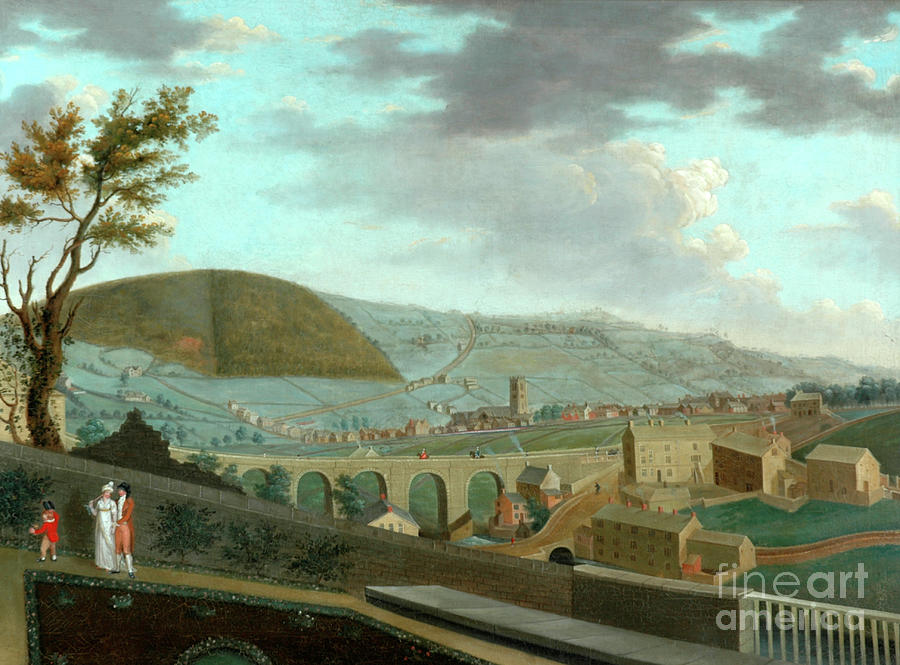
Market Day and the Parish Church
Defoe described Market Day in Halifax as an extraordinary sight: people flocked in from every direction to buy provisions and sell their goods. The town itself produced little food — the land was given over almost entirely to manufacture — so grain came from Lincolnshire, Nottinghamshire, and the East Riding, and cattle from Cheshire, Warwickshire, and the north. Yet the market was equal to any in the North of England, save only Leeds and Wakefield.
He also admired Halifax Parish Church: old, stately, and venerable, filled with monuments of great antiquity. Beside it stood a hospital, a workhouse, and several charities — all well-established and well-conducted.
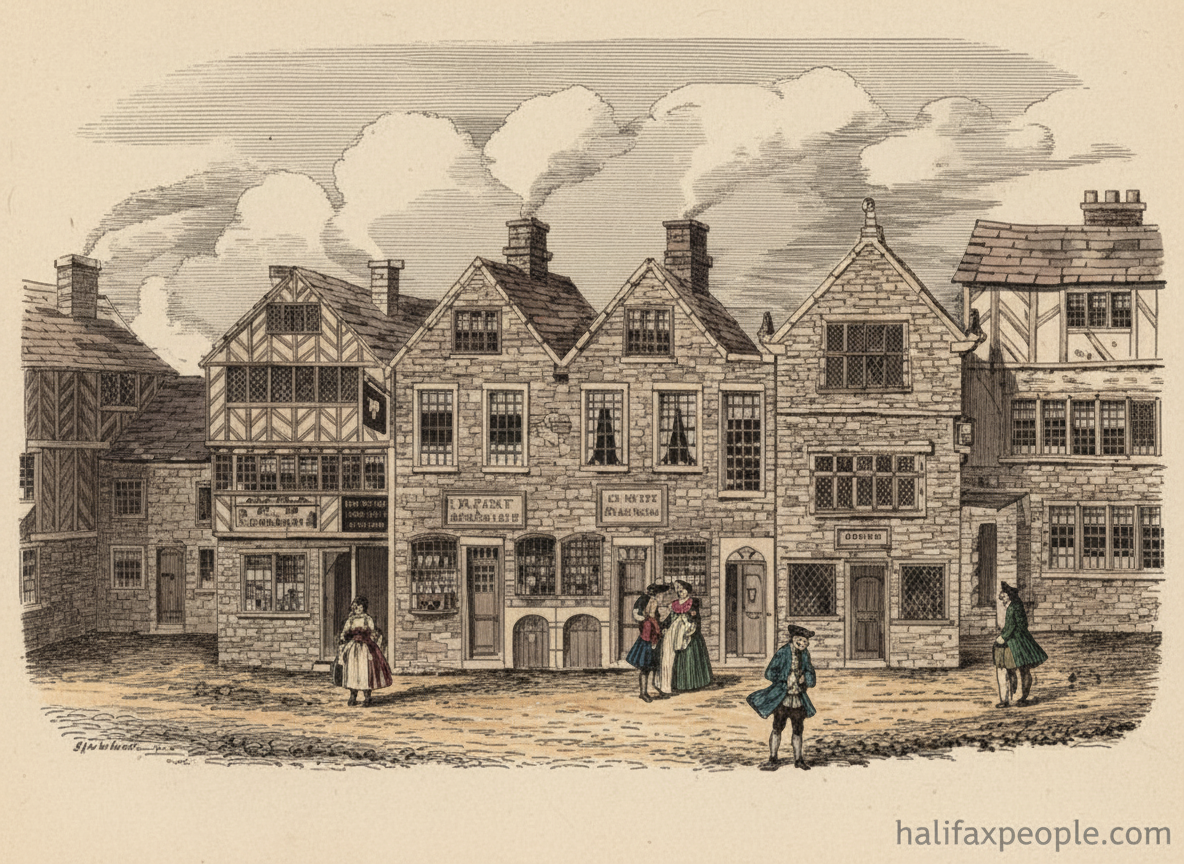
Conclusion
Defoe’s visit in 1747 captured Halifax at the height of its early prosperity — a place of steep hills, rushing streams, and ceaseless industry, where almost every house was a workshop and the whole parish was one continued village. He saw a community that was hard-working, healthy, and long-lived, sustained by the natural gifts of water and coal, and enriched by the skill and diligence of its people.
"The people live long; they enjoy good air; and under such circumstances hard labour is naturally attended with the blessing of health, if not riches."
Halifax’s Landscape, Rivers and Water Power
From Daniel Defoe’s observations, c.1747
Introduction
When Daniel Defoe travelled through Halifax in about 1747, what struck him more than anything was the extraordinary landscape — steep hills, deep valleys, and an abundance of flowing water. He saw immediately that Halifax’s geography was not just a feature of the scenery, but the very foundation of its prosperity. The rivers and streams that tumbled down every hillside provided the power, the fuel, and the fresh water that turned this scattered hill-parish into one of England’s most important manufacturing centres.
A Land of Hills and Valleys
Defoe described how every approach to Halifax led through deep valleys and steep slopes. The land was divided by countless ridges, so that travelling from one place to another meant constantly descending into a hollow and climbing the opposite bank. Yet scattered across every slope, perched in every nook, were houses, cottages, and workshops — so thickly settled that it seemed one continued village, stretching mile after mile along the hillsides.
"Every way you had mountains, hardly an house standing out of a speaking distance from another."
What looked like wild, difficult country to a stranger was, in fact, densely populated and industrious — every available patch of ground occupied, and every stream put to work.
The River Calder and Its Tributaries
Before reaching the town itself, Defoe followed the land down to the River Calder, which he described as the great waterway of the district. He noted how the Calder gathered its strength from innumerable smaller streams — each one tumbling down from the high ground, fed by springs and rainfall.
He observed that every valley he crossed held a little brook or beck, which had carved its way deep into the hillsides. These gathered into larger streams until, at Sorby Bridge, they joined the Calder itself — a stately river flowing over a stone bridge of several great arches. Defoe recognised this as the head of the Calder’s navigation, the point where the river became broad and deep enough to carry boats downstream to Wakefield and beyond.
"All the rills of water which we crossed went away to the left or north side of us… following those little brooks with one eye, we could observe that at some distance to the left there appeared a larger valley than the rest, into which not only all the brooks which we passed emptied themselves, but abundance more from the hills beyond it."
Every one of these streams was precious — they were the lifeblood of Halifax’s industry.
Water Power — The Gift of the Hills
Defoe identified two great blessings of nature that had made Halifax famous: plenty of running water and plenty of coal — both found, remarkably, even on the tops of the highest hills.
Water was everywhere. Every house had its own supply, channelled in gutters and pipes from one building to the next, so that no dwelling wanted its own stream. The water turned mills, drove machinery, powered fulling-stocks, and served the dye-vats — essential for every stage of cloth-making. There was scarcely a stream so small that it was not pressed into service.
"The little streams were so parted and guided by gutters or pipes, that not one of the houses wanted its necessary appendage of a rivulet."
This ready supply of water, combined with coal close at hand, meant that manufacturing could be carried on cheaply and efficiently — right across the parish, not just in the town centre. Defoe believed this happy arrangement was "designed by Providence" for trade, enabling people to work where they lived, without needing to import fuel or haul water from miles away.
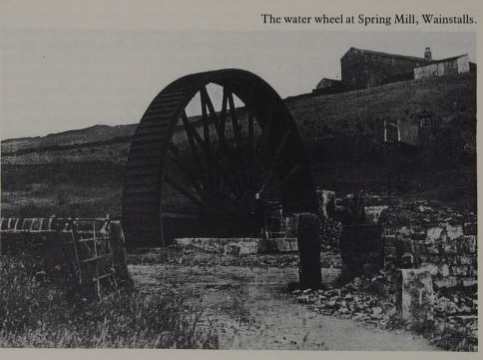
Rivers, Trade and Transport
The Calder was more than just water power — it was Halifax’s highway to the world. From the bridge at Sorby, the river flowed eastward, broad and navigable, carrying goods to Wakefield and beyond. Cloth, kerseys, and shalloons could be loaded onto boats and sent to markets across the country, while coal, wool, and provisions came upstream in return.
Defoe marvelled that a place so far inland and so high in the hills should enjoy such advantages — water for power, coal for fuel, and a navigable river for trade. It was this rare combination that had allowed Halifax to grow from a scattering of hill farms into the most populous parish in England.
Conclusion
Halifax’s landscape was both difficult and generous — steep, rugged, and hard to traverse, yet rich in the very things industry needed. The hills held the coal; the springs fed the streams; the rivers carried the trade. Defoe saw clearly that the people of Halifax had not conquered their environment — they had worked with it, turning every stream, every slope, and every seam of coal into prosperity.
"This place, then, seems to have been allotted for carrying on a manufacture which can nowhere be so easily supplied with the conveniences necessary for it."
Cloth, Trade and Markets — The Business of Halifax
From Daniel Defoe’s observations, c.1747
Introduction
When Daniel Defoe visited Halifax in about 1747, he found a parish entirely given over to one great industry: the making of cloth. From the smallest cottage to the largest market hall, every person and every stream seemed employed in spinning, weaving, dyeing, or finishing. Halifax’s prosperity was built on wool — and the skill of its people turned that wool into goods that were traded across England and far beyond.
The Three Great Products
Defoe observed that almost every household in Halifax was busy making three principal types of cloth:
- Cloth — the broad, standard woollen fabric
- Kerseys — a narrower, durable cloth, famously associated with Halifax
- Shalloons — a lighter, tightly woven cloth used for linings and garments
"At every house a tenter, and on almost every tenter a piece of cloth, kersie, or shalloon — and these are the three articles of this country’s labour."
He calculated that 100,000 pieces of shalloon alone were being produced each year in the parish — a truly astonishing output. Yet he noted that fewer kerseys were being made than in the past, because trade had shifted: Halifax kerseys were now being sold directly to merchants in Holland and Hamburg, rather than passing through middlemen elsewhere. Even so, one dealer alone handled £60,000 worth of kerseys annually — an immense sum in those days. Around 4,000 Irish cloth-workers had also settled in the district, bringing their skills and swelling the workforce to nearly 6,000 newcomers.

Every Home a Workshop
There was no single great factory. Instead, manufacturing was scattered across the whole parish:
"One trading manufacturing part of the country, in a barren soil, gives and receives support from all the countries round it."
Families worked together: men wove and fulled; women and children carded and spun. Even the youngest were put to work — Defoe saw children scarcely four years old helping to prepare the wool. There were no idle people to be seen, except occasionally in the almshouses. The industry was woven into daily life itself — carried on in cottages, beside streams, from one hillside to the next.
Halifax Market — The Gathering Place
Everything came together on Market Day. Defoe described it as a spectacle unmatched almost anywhere in the North of England:
"The multitude of people who resort to it on a market day, as well to sell their manufactures as to buy provisions, is prodigious. In this respect no places equal it in all the north part of England, except Leeds and Wakefield."
The town made almost no food of its own — every acre was needed for workshops, wool storage, and drying grounds. So provisions arrived from far and wide:
- Grain from Lincolnshire, Nottinghamshire, and the East Riding
- Cattle and meat from Lancashire, Cheshire, Warwickshire, and the North Riding
- Salt, kelp, and other supplies brought in by merchants
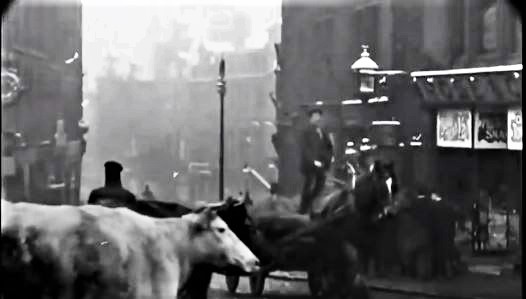
Defoe noted that in September and October, farmers flocked in to sell oxen — which Halifax families bought and salted, smoked, and hung to dry as their winter provision. What had once been a simple market town had become the commercial heart of a vast manufacturing region.
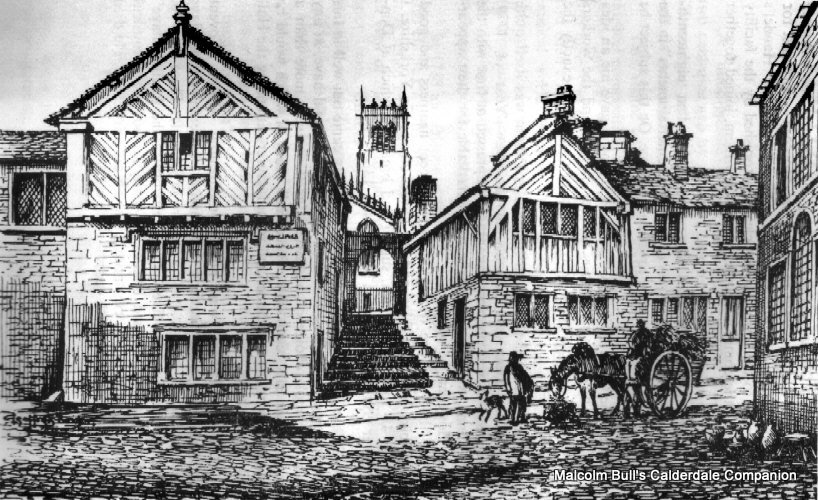
Rose and Crown, Cheapside where Daniel Defoe is alleged to have stayed
Trade Reaches Across Europe
Halifax cloth did not stay in Halifax. Defoe recorded that kerseys were shipped directly to Holland, Hamburg, and beyond. So great was the demand that Halifax was said to supply armies abroad with clothing — trade that had grown by one quarter in just fifty years.
"If they be so populous, what must be their trade… Some maintain that it is increased a fourth at least within these 50 years, from their having entered upon a manufacture for the armies abroad."
Halifax cloth was known everywhere — durable, reliable, and made in huge quantities. The parish had turned itself into the workshop of the North.
Conclusion
Defoe saw clearly that Halifax’s strength lay not in its soil or its situation, but in the industry and enterprise of its people. On poor, stony land, they had built a mighty trade — turning wool into wealth, and water into power. They fed themselves from distant counties, and sent their cloth to distant lands.
"Thus one trading manufacturing part of the country… gives and receives support from all the countries round it."
Halifax was not merely a town — it was a vast, scattered workshop, alive with the clatter of looms and the bustle of trade, sustained by the rivers, the coal, and above all, the skill and diligence of its people.
Halifax — Growth, Loyalty and Early History
From Daniel Defoe’s observations, c.1747
Introduction
When Daniel Defoe visited Halifax in about 1747, he saw a thriving, populous manufacturing parish that had grown from humble beginnings into one of the most important districts in the North of England. He traced its remarkable rise from a tiny scattering of dwellings to a sprawling community of industry and trade — and noted, too, the loyalty and courage of its people in times of national crisis.
From Thirty Houses to a Great Parish
Defoe recorded a striking fact about Halifax’s early size:
"In the year 1443, this town of Halifax contained only thirty houses."
From those modest beginnings, growth had been steady and extraordinary. By Defoe’s day, Halifax had become the most populous parish in England, stretching across twelve or thirteen miles of hills and valleys. What had once been isolated farmsteads and woodland clearings had become one continued village, where houses stood almost within speaking distance of one another, and the sound of the loom could be heard echoing across the valleys.
This growth was not driven by fertile soil or easy living — the land was steep, rocky, and difficult to farm. Instead, it sprang from the people’s industry and their natural advantages: flowing water, coal, and a determination to work with what they had.
Loyalty in Times of Trouble
Defoe also recounted a memorable moment in Halifax’s history — a demonstration of the inhabitants’ loyalty to the Crown during the Rebellion of 1569, when the Earl of Westmorland rose against Queen Elizabeth I. When called upon, Halifax responded with remarkable strength:
"In the year 1569, upon the Earl of Westmorland’s rebellion, the inhabitants of Halifax sent no less than twelve hundred men well-armed to join the Earl of Sussex against the rebels."
Twelve hundred men — from a single parish — was a contribution of which Defoe noted the people were justly proud. It spoke not only of their loyalty, but of their numbers, their organisation, and their readiness to defend the peace of the realm. Halifax may have been remote and rugged, but it was neither isolated nor indifferent to the nation’s affairs.
The Parish Church and Ancient Foundations
Defoe found visible proof of Halifax’s long history in its Parish Church, which he described as:
"An ancient, large, and stately building, filled with monuments of great antiquity."
The church stood as a witness to the community’s deep roots — centuries of worship, burial, and public gathering. Beside it, Defoe noted, stood a hospital, a workhouse, and several well-endowed charities — signs that as Halifax grew wealthy, its people remembered their duty to care for the poor, the aged, and the vulnerable. Prosperity, it seemed, was accompanied by responsibility.
A People Prosperous and Proud
By the mid‑1700s, Halifax had earned its reputation. Defoe noted that trade in kerseys alone had increased by a quarter within fifty years — a measure of how rapidly the cloth industry was expanding. The parish was supplying armies abroad and sending goods across the North Sea to Holland and beyond.
Yet the people remained connected to their roots. They lived long, healthy lives — Defoe attributed this to the purity of the air and the wholesomeness of their labour. They were hard‑working, orderly, and proud of their community — a people who had built greatness not from riches inherited, but from industry, loyalty, and steady perseverance.
Conclusion
Halifax’s story, as Defoe told it, was one of growth from small beginnings and loyalty through generations. From just thirty houses in 1443 to a population that could send twelve hundred men to the Queen’s aid in 1569, and then to the sprawling, industrious parish he saw in 1747 — it was a place built not by kings or conquerors, but by ordinary people working together.
"They live long, they enjoy good air, and under such circumstances hard labour is naturally attended with the blessing of health, if not riches."
The Ancient Gibbet Law of Halifax
From Daniel Defoe’s observations, c.1747
Introduction
Of all the customs and laws Defoe encountered in his travels through Britain, none struck him as more remarkable — or more distinctive — than the Gibbet Law of Halifax. It was a law unique to this parish, devised to protect the cloth trade upon which the town’s livelihood depended. Defoe described it with care, recording both its provisions and the solemn ceremony by which it was carried out — a practice still remembered and talked about in his day.
Why the Law Was Made
In the early days of the cloth trade, when goods were left out to dry on tenters across every hillside, theft became a serious threat. Pieces of cloth, kerseys, and shalloons were often stolen — and because the industry was scattered across miles of parish, detection was difficult. To protect the livelihood of thousands, the people of Halifax secured a special ancient privilege:
"If a felon be taken within the liberty of Halifax, stolen goods being found upon him, to the value of thirteen pence half‑penny, he shall be executed in the same manner as if he had been convicted of felony at common law."
The value — thirteen pence half‑penny — was a very small sum, yet it was the threshold that brought the law into force. It showed how seriously Halifax took the protection of property, and how determined they were that no one should grow rich at the expense of the industrious.
How the Law Worked
The process was swift and formal. When a person was caught with stolen goods worth the required amount, the matter was brought before the Bailiff of Halifax, who acted as both judge and administrator.
Defoe recorded the procedure:
- The accused was brought before the Bailiff
- The facts were examined: was the person caught? Were the goods found? Did their value meet the threshold?
- If proved, the Bailiff gave judgement — sentence of death
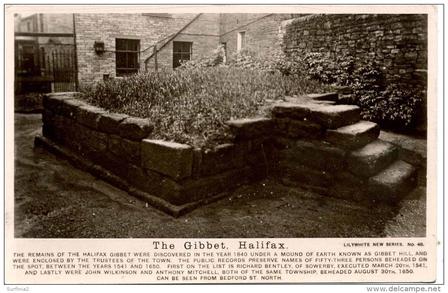
- The execution was carried out at the Gibbet, a prominent landmark on the outskirts of the town
"The Bailiff of Halifax, for the time being, is the judge; and the execution is performed in a most solemn manner."
There was no long delay, no distant court. Justice was done locally, openly, and speedily — a warning to all that Halifax would not suffer its trade to be plundered.
The Gibbet — A Remarkable Engine
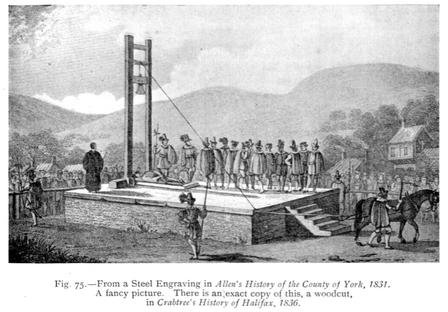
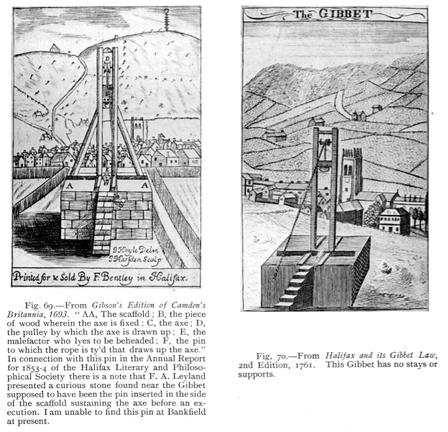
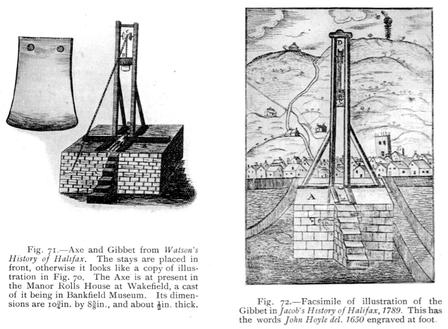
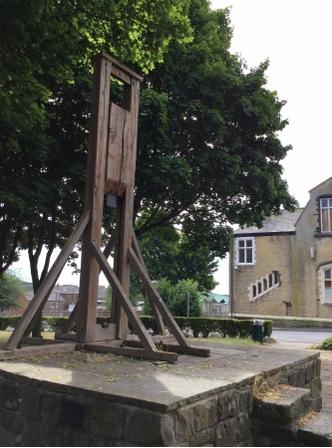
Defoe was particularly struck by the method of execution. Halifax did not use the common gallows — instead, it possessed a machine of wood, known as the Halifax Gibbet.
"It is an engine of great antiquity, called the Halifax Gibbet, consisting of two upright pillars of wood, with a cross‑beam at the top; underneath which runs a heavy weight, fastened to a strong cord, and a sharp axe is fixed to the weight."
The condemned person stood beneath the beam, their head placed upon a block. The cord was cut — and gravity did the rest. The heavy axe fell, and the sentence was carried out instantly. It was, Defoe noted, a grim but efficient device, said to have been in use for centuries.
The Law in Defoe’s Time
By the time Defoe visited in 1747, the Gibbet Law had fallen out of regular use, though it had never been formally repealed. The last recorded execution had taken place in 1650, nearly a hundred years before. Yet the people of Halifax still spoke of it with pride — not as a cruel custom, but as an ancient privilege and a defence of their industry.
Defoe concluded that the law had served its purpose well: it had preserved order, protected trade, and made Halifax famous throughout the kingdom. Though no longer put into practice, it remained a powerful symbol — a reminder that this was a place where property was respected, industry honoured, and the law executed without fear or favour.
Conclusion
The Gibbet Law was Halifax’s most distinctive institution — born of necessity, maintained by resolve, and remembered long after it ceased to be used. Defoe presented it not as barbarism, but as a practical defence of the people’s livelihood, devised in rougher times to protect the honest work of the parish.
"This privilege is said to have been granted to the town for the encouragement of trade, and for the better securing the woollen manufacture, which was then and is still the principal employment of the inhabitants."
📚 Source Note
Compiled from Daniel Defoe’s A Tour Through Great Britain, c.1747, drawing on his full description of the Halifax Gibbet Law, its origin, value threshold, procedure, and the famous machine itself.
If you have enjoyed your visit to this website, please spread the word by clicking the 'like' and 'share' buttons below. Thank you