Dean Clough Blog


WundaNumba 777-545 - What's behind your WundaNumba.com
Dean Clough, Halifax — From Carpet Empire to Creative Quarter
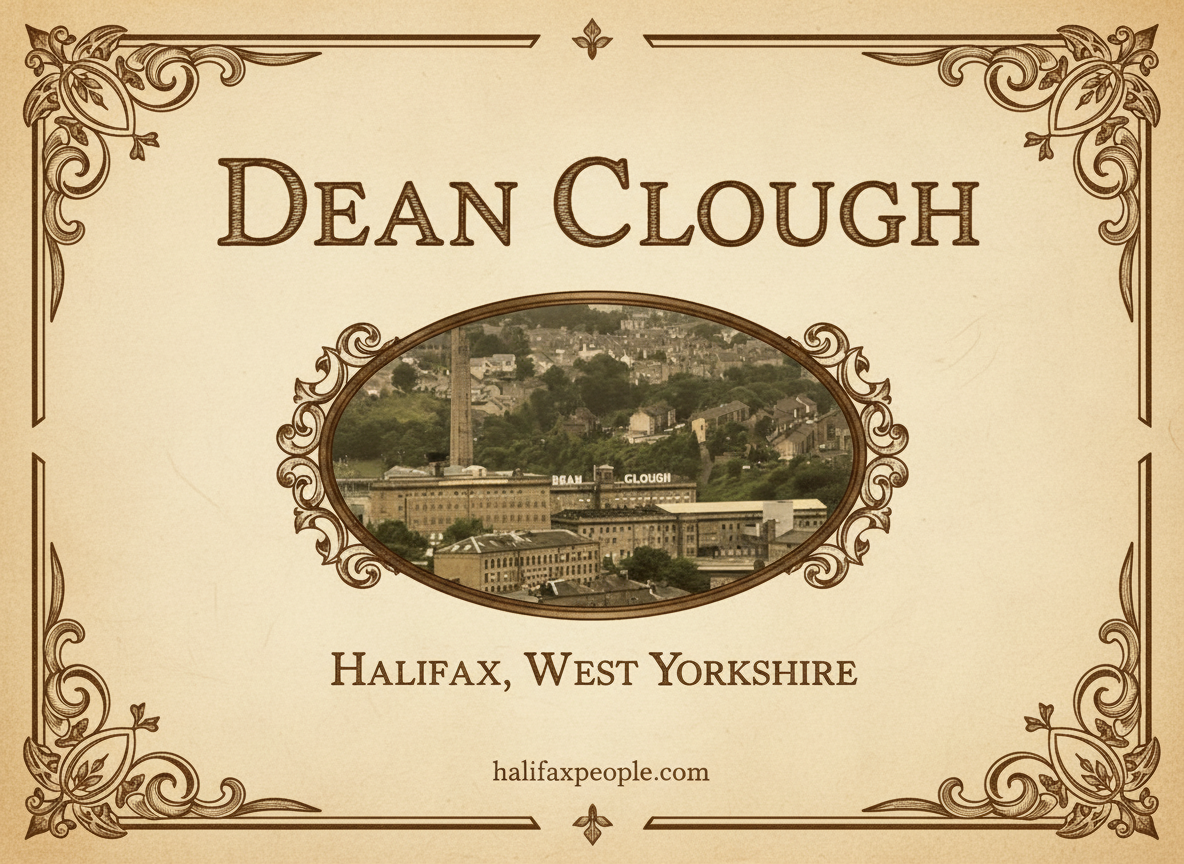
Dean Clough is one of Halifax’s most recognisable industrial landmarks. Stretching along the valley beside North Bridge, its immense stone mills tell the story of a small textile business that grew into a carpet-making empire known around the world. The name combines Dean, meaning valley, and Clough, meaning ravine, reflecting the steep landscape in which the mills were built. What began with modest textile production became a vast Victorian factory complex that helped shape Halifax’s economy, skyline and working-class communities.
The Crossley family and the rise of the carpet industry
The story of Dean Clough is closely connected with John Crossley, who began using a small mill beside Hebble Brook in the early nineteenth century. The Crossley family’s carpet business is generally dated to 1803, although John Crossley and his brothers had been involved in worsted spinning at the site earlier. In 1822, Crossley leased a water-powered mill from the Waterhouse family, establishing the foundations for the huge industrial complex that followed.
From 1841 onwards, the Crossleys developed engine-powered spinning mills and weaving sheds, gradually transforming Dean Clough into a major manufacturing centre. Architect Roger Ives designed several of the principal buildings, including D Mill and E Mill. Built in stages through the nineteenth century, the complex eventually contained large mills, weaving sheds, dyehouses, engine houses and other facilities required to manufacture carpets on an industrial scale. At its height, the business employed thousands of people and became one of the world’s largest carpet manufacturers.
A world of work inside the mills
Dean Clough was more than a collection of impressive buildings. It was a workplace where successive generations of Halifax residents earned their living in spinning, weaving, dyeing, finishing and the many supporting trades needed to produce carpets. The mills’ scale reflected the increasingly mechanised nature of Victorian manufacturing, while their proximity to Halifax’s streets and transport links tied the factory closely to the town’s daily life.
Historic photographs can reveal the complex’s changing appearance: tall chimneys, long rows of windows, loading entrances, railway connections and the dense industrial landscape around North Bridge. The buildings were designed to serve a demanding manufacturing process, and surviving features such as cast-iron columns, taking-in doors and brick-arched floors still offer clues to how the mills operated. E Mill, completed in 1857, replaced an earlier mill on the site and remains one of the most imposing structures in the complex.
Closure and the end of an industrial era
After more than a century of expansion, the carpet industry faced changing markets and growing pressures during the twentieth century. The Crossley business went through mergers and a gradual reduction in production, and carpet manufacturing at Dean Clough ended in 1982. The closure was a major blow to Halifax, marking the end of an industrial enterprise that had helped define the town for generations. The mills’ future was uncertain, and their enormous size made reuse a significant challenge.
Yet the buildings were not abandoned to disappear. In 1983, Sir Ernest Hall and his partners began the work of bringing Dean Clough back into use. Instead of demolishing the complex, the redevelopment adapted its historic spaces for offices, businesses, galleries, theatres and other activities. The scale of the site and the need to preserve its industrial character made the project a major example of heritage-led regeneration in Halifax.
Dean Clough today — heritage with a new purpose
Today, Dean Clough covers approximately 22 acres and includes 16 significant Grade II-listed Victorian mill buildings, stretching for around half a mile. The complex is home to businesses, restaurants, shops, art galleries and performance spaces, including the Viaduct Theatre. The buildings remain recognisable as a connected industrial landscape, but their interiors now accommodate a very different mix of work and cultural life.
The site continues to evolve. Recent proposals have included adapting parts of D Mill for art teaching and studio space, demonstrating how the old factory buildings can continue to serve new generations while retaining their historic structure. Dean Clough’s story is therefore not simply about the rise and fall of the Crossley carpet empire. It is also about the reuse of industrial heritage, the preservation of Halifax’s architectural identity and the transformation of a former factory into a place for business, creativity and community.
 |
 Random Dean Clough |

|

|

 |
If you have enjoyed your visit to this website, please spread the word by clicking the 'like' and 'share' buttons below. Thank you