The Halifax Balloon Disaster of 1863
The Balloon That Never Flew Away
A Victorian spectacle, a mill chimney and the death of Charles Rawson — Halifax, 1863
On Saturday 12 September 1863, spectators gathered at Halifax Piece Hall for an entertainment that promised one of the great thrills of the Victorian age: a balloon ascent.
The balloon had a suitably patriotic name — Volunteer — and its pilot was a man recorded as Mr Youings, although his surname appears in several forms in later accounts.
For a town that had only recently celebrated the opening of its magnificent new Town Hall, another public spectacle was an attractive prospect. But this particular afternoon would be remembered for something very different.
Instead of sailing over the rooftops, the Volunteer became entangled above the town. Its flight ended at a mill chimney, and an attempt to recover it cost a Halifax man his life.

Piece Hall in 1890
A town looking upwards
Ballooning was not new to Halifax in 1863, but it was still capable of drawing considerable crowds.
On 19 April 1824, the celebrated aeronaut Charles Green had ascended from the Piece Hall. Anne Lister witnessed the event and recorded both the flight and the extraordinary number of people making their way through the town.
Her diary describes the difficulty of getting home afterwards, with people streaming back from the hills where they had gathered to watch.
Thirteen years later, on 31 October 1837, Anne and Ann Walker watched another ascent, this time by Margaret Graham. Anne recorded seeing the balloon from Shibden, high above the direction of Hipperholme.
These were not simply amusements for those able to buy tickets. A balloon could turn the whole surrounding landscape into a viewing gallery. People watched from streets, rooftops, fields and hillsides.
By September 1863, Halifax had another reason to be in a celebratory mood.
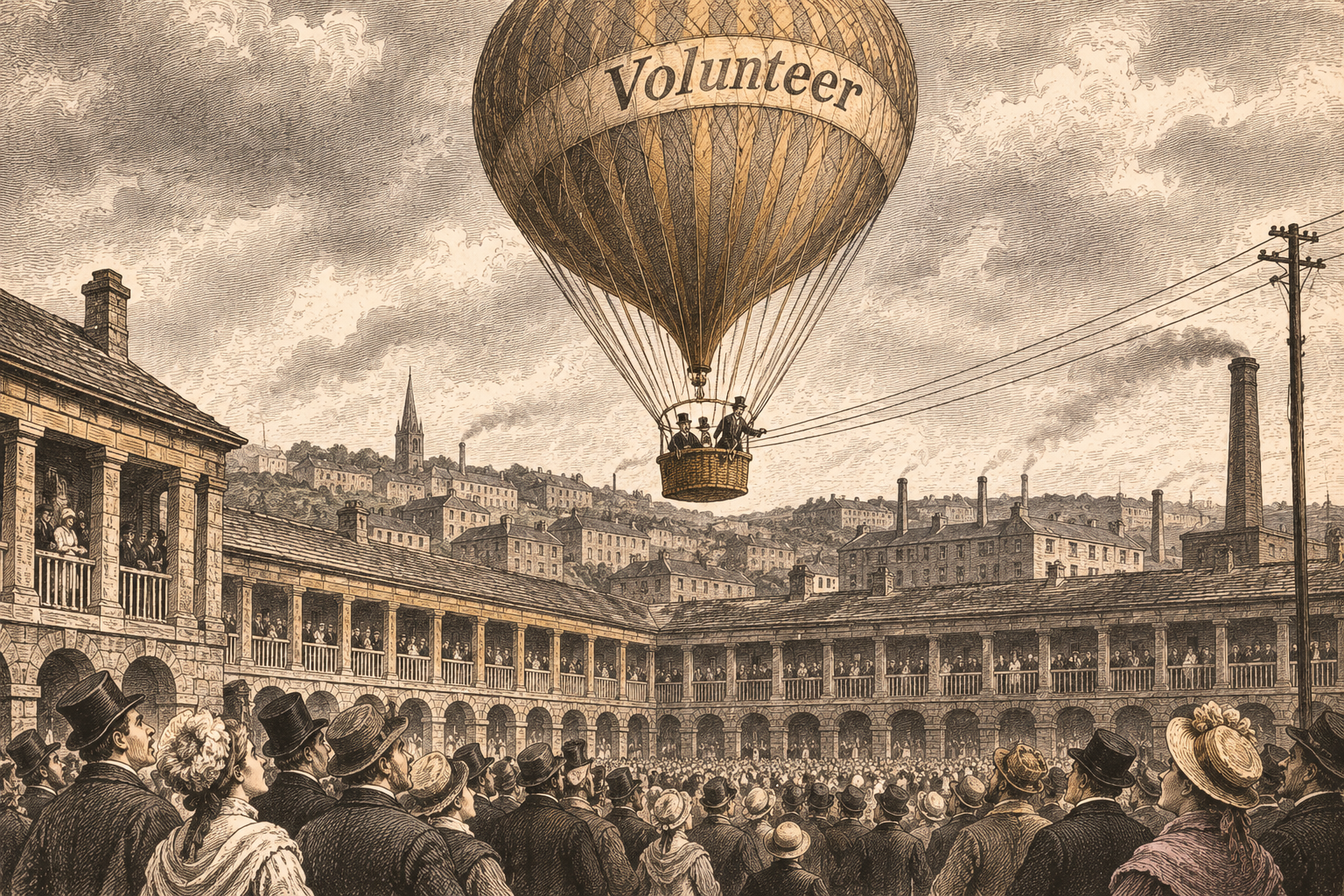
AI-generated illustration inspired by the Halifax balloon incident of September 1863. Not a contemporary image.
The summer of the Town Hall
The Prince of Wales had officially opened Halifax Town Hall on 4 August 1863. His visit brought crowds, decorations, railway excursions and an ambitious programme of public entertainment.
Ballooning was part of those celebrations too, with an ascent arranged from West Hill Park.
The Volunteer ascent came several weeks later. It should not be confused with the balloon display during the royal visit: the September event was associated with Mr Winsland's gala at the Piece Hall.
It was a different occasion, and one that would have a tragic outcome.

Piece Hall 1863 during another celebration. This was for the Royal visit of the Prince of Wales
The Volunteer gets into trouble
The surviving local-history accounts agree on the central sequence.
The balloon rose from the Piece Hall on Saturday 12 September. During its ascent, it became caught in telegraph wires.
That was serious trouble for a balloon. Unlike a modern powered aircraft, it could not steer itself clear of an obstruction. Its progress depended on wind, altitude and the aeronaut's limited ability to control ascent and descent.
The Volunteer subsequently became caught against the chimney of Square Road Mill.
The situation was dangerous not only for the pilot but for anyone attempting to reach the balloon from the building.
One account places Mr Youings approximately 150 feet above the watching crowd. That figure needs confirmation from a contemporary report, but it conveys the height at which the rescue was said to have taken place.
The balloon eventually collapsed.
What had begun as an entertainment had become an emergency high above the streets of Halifax.
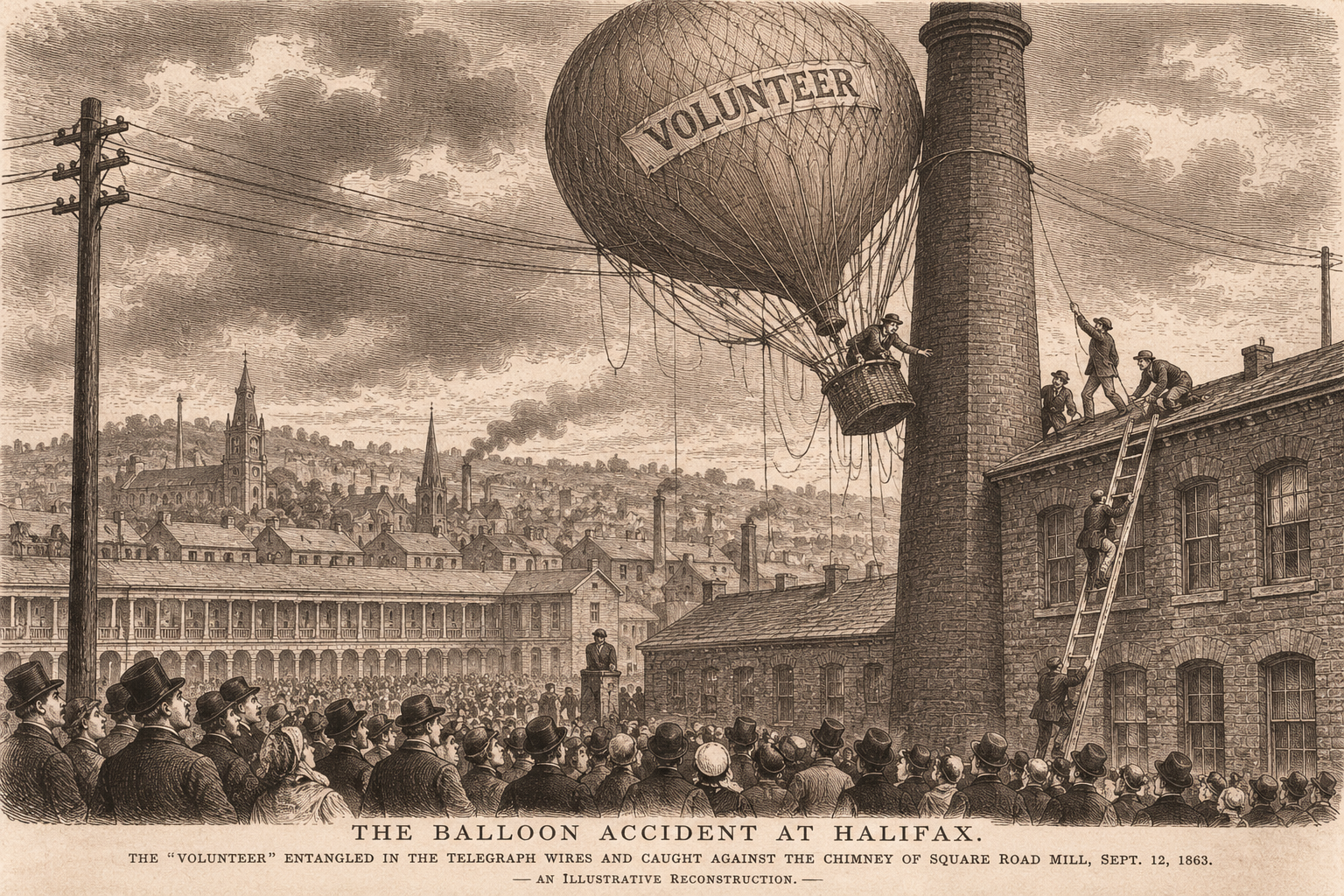
AI-generated illustration inspired by the Halifax balloon incident of September 1863. Not a contemporary image.
Charles Rawson
Among those who became involved was Charles Rawson.
Later biographical records identify him as a Halifax plasterer and decorator, born around 1826. They also describe him as a member of the Leeds and Yorkshire Fire Brigade.
He was associated with Cross Street, off Horton Street.
Rawson was therefore not simply an anonymous figure in a crowd. He was a working man with a skilled trade and, according to the local account, experience connected with firefighting.
When the balloon became stranded, Rawson attempted to assist in recovering it.
He fell and was killed.
The exact circumstances of that fall — where he was standing, whether he was on the chimney or another part of the building, and precisely what he was trying to secure — still need to be established from the newspaper reports or an inquest.
What can be said is that a public balloon display ended with the death of a local man who had become involved in the attempt to recover the aircraft.
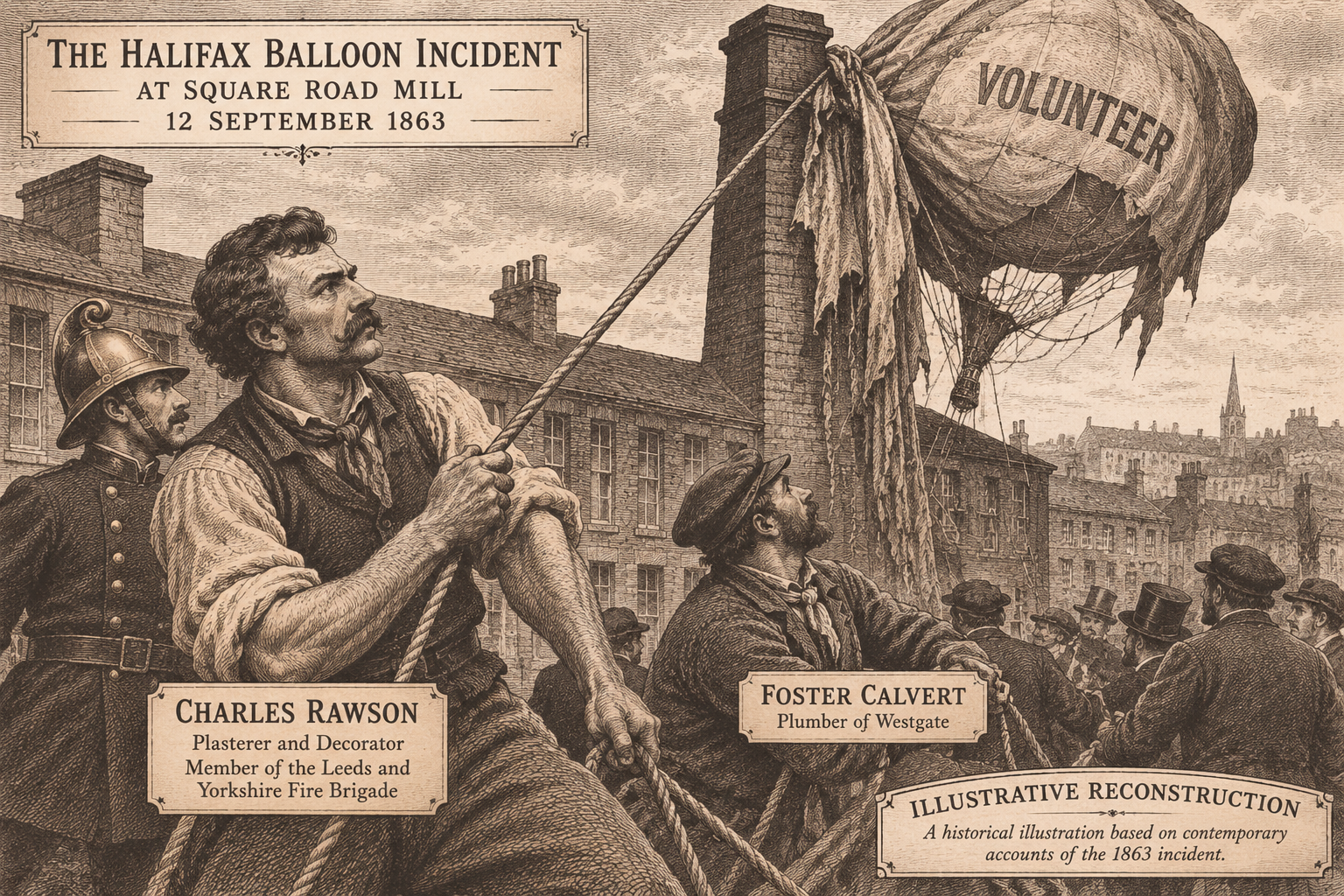
AI-generated illustration inspired by the Halifax balloon incident of September 1863. Not a contemporary image.
The other men involved
Rawson was not the only Halifax tradesman associated with the incident.
Foster Calvert, a plumber working in Westgate, is recorded as having taken part in the effort to rescue Mr Youings.
Calvert was born in 1830 and had married Harriet Thompson in 1851.
According to the later local-history account, he was also among the men who recovered the balloon the following morning.
That detail suggests the rescue and the removal of the damaged balloon were separate operations. It also raises questions that deserve answers: how was the pilot brought down, what happened to the balloon overnight, and how did the rescuers gain access to it?
The names of any other rescuers, and the identities of additional injured people mentioned in later summaries, remain to be established.
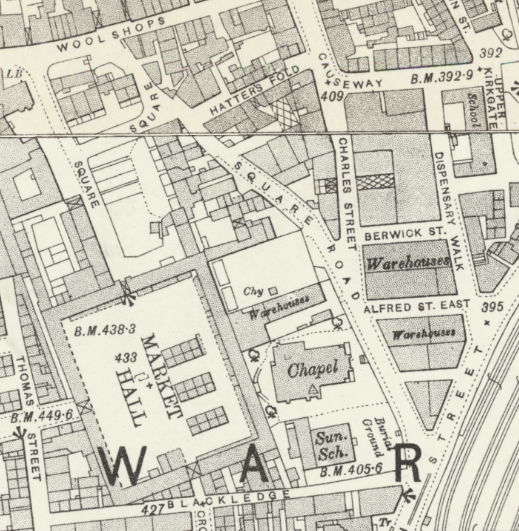
Piece Hall (Market Hall) and local mills
The chimney at Square Road Mill
The location is one of the most intriguing parts of the story.
Square Road Mill stood close enough to the balloon's path for its chimney to become the final obstacle. The telegraph wires were another sign of a rapidly changing town: industrial buildings and new communications infrastructure were now part of the skyline.
The Piece Hall had been constructed in the eighteenth century for the handloom cloth trade. By 1863, the surrounding streets were dominated by a very different industrial landscape.
The accident brought those two versions of Halifax together in a single extraordinary incident: a balloon rising from the old cloth hall and coming to grief against the machinery-era skyline.

Mills around Square Road. The Piece Hall was just out of picture to the left
What happened afterwards?
The damaged balloon was reportedly recovered the following morning.
Beyond that, the publicly accessible accounts leave several important gaps.
Was there a coroner's inquest into Charles Rawson's death? Did the organisers face criticism for holding the ascent so close to telegraph wires and industrial chimneys? Was there a collection for Rawson's family? Did the newspapers praise the rescuers or question the pilot's judgement?
Those are not minor details. They would tell us how the people of Halifax understood the disaster at the time.
The local newspaper index records a balloon-and-chimney accident on 11 September 1863, while the more detailed secondary accounts consistently give Saturday 12 September as the date of the ascent. Since 12 September 1863 was indeed a Saturday, that appears the stronger date, but the discrepancy needs checking against the original newspaper.

A much more recent balloon flight from the Piece Hall
Remembering the man, not just the balloon
It is easy to be fascinated by the strange sight of a balloon stranded on a mill chimney.
Yet the lasting significance of the incident lies with Charles Rawson.
His name is absent from the familiar accounts of Halifax's grand buildings, famous industrialists and civic ceremonies. He was a tradesman whose ordinary life became connected with an extraordinary public event.
The Volunteer was supposed to provide a few minutes of excitement above the town.
Instead, the story became one of danger, rescue and the death of a Halifax man who had gone to help.
More than 160 years later, Charles Rawson deserves to be remembered as more than a footnote to a failed balloon ascent.
If you have enjoyed your visit to this website, please spread the word by clicking the 'like' and 'share' buttons below. Thank you