

Halifax Borough Market
Halifax Borough Market is more than a place to buy groceries. It is one of the town centre’s great Victorian landmarks — a building designed to bring trade, architecture and everyday life together beneath one enormous glass roof.
The story begins before the building we know today. In 1790, a red-brick marketplace called the New Market was built on the site. Trading was concentrated there after an Act of Parliament in 1810 restricted street trading elsewhere in Halifax. In 1853, Halifax Corporation bought the market from its private owners for £7,700.
By 1890, the old market had become too crowded. The council decided to replace it, and local architects Joseph and John Leeming were commissioned to design the new building. Work began in 1891–92, with costs eventually rising far beyond the original estimate. The finished project cost around £130,000 — a huge investment for the time.
The new Borough Market officially opened on 25 July 1896, by the Duke and Duchess of York, who later became King George V and Queen Mary. They also opened the Royal Halifax Infirmary during the same visit, making the day a major civic occasion.


enhanced
The market’s most unusual feature may be hidden above the shopfronts. The upper floors along Southgate and Market Street were built as living accommodation for traders and market staff. Residents could live above their businesses, with direct access between the houses and shops below.
The elevated walkways outside these homes are now known as the “Streets in the Sky”. They form a rare piece of Halifax’s social history: ordinary domestic streets suspended above a busy market hall. Research by Visit Calderdale and Halifax Central Library has begun uncovering the stories of the people who lived there. One example is Michael Damsky, a draper who lived at 29 Southgate Balcony with his wife and three adult children in 1921.


Inside, the market’s glass-and-iron roof spans a vast trading space, with an 18-metre-high octagonal lantern supported by decorative cast-iron columns. Its elaborate metalwork includes dragon-shaped brackets, while the central clock became a familiar meeting point. The structure was designed not simply as a roof over stalls, but as a grand civic building — sometimes described as a “cathedral of commerce”.
There was also a dedicated fish market, originally inside the building in the south-west corner, known as the Albany Arcade. The fish shops later turned to face Albion Street. The market’s outward-facing shops were originally largely butchers, while public houses were incorporated into the surrounding ranges.


enhanced
A Victorian landmark adapted for modern Halifax
In 1973, the market’s stonework was cleaned, and Southgate became a pedestrian area with the road raised to pavement level. In 1987, the Civic Trust recognised the restored Victorian shopfronts with an award. The market is now Grade II* listed, reflecting its architectural and historic importance. Restoration and improvement work continues as the town works to preserve the building for future generations.
Halifax Borough Market’s real distinction is that it brings together several layers of history in one place: an eighteenth-century market site, a grand Victorian trading hall, shops and pubs, and homes built above the bustle. Look up from the stalls and you can still see evidence of a time when the market was not just where people shopped — it was also where some of them lived.


enhanced

enhanced

enhanced


enhanced


enhanced
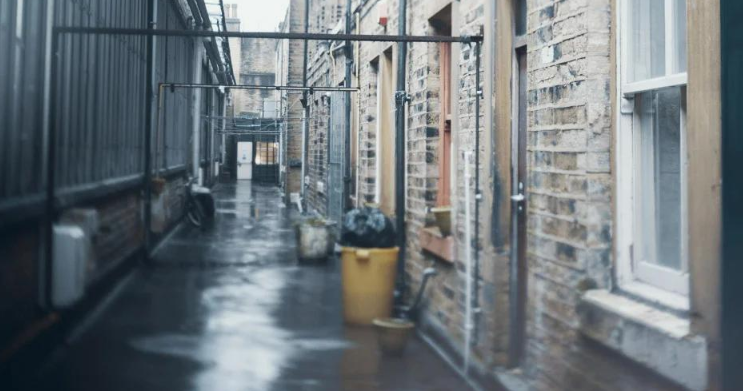
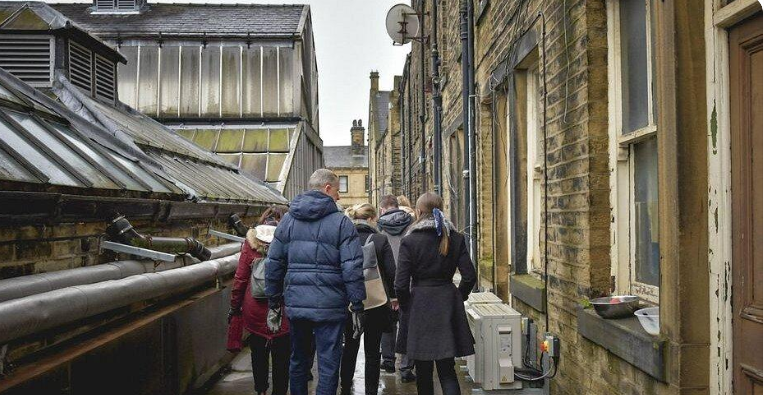
The original Borough Market buildings included houses above the shops on Southgate. These were not simply decorative upper floors: people actually lived there, with direct access between their homes and the shops below.
Calderdale's research has identified some of the residents using the 1921 census.
For example:
- 15 Southgate Balcony: Henry Holmes, a manufacturing chemist, lived there with his wife Edith and their two sons.
- 29 Southgate Balcony: Michael Damsky, a draper, lived there with his wife Lily and their three adult children. Lily subsequently became the proprietor of their drapery business.
People still live in these houses today.


enhanced
 |
 enhanced |
 |
 enhanced |
 |
 |
 |
 |
If you have enjoyed your visit to this website, please spread the word by clicking the 'like' and 'share' buttons below. Thank you