The Great Halifax Exhibition of 1882
The Great Halifax Exhibition of 1882
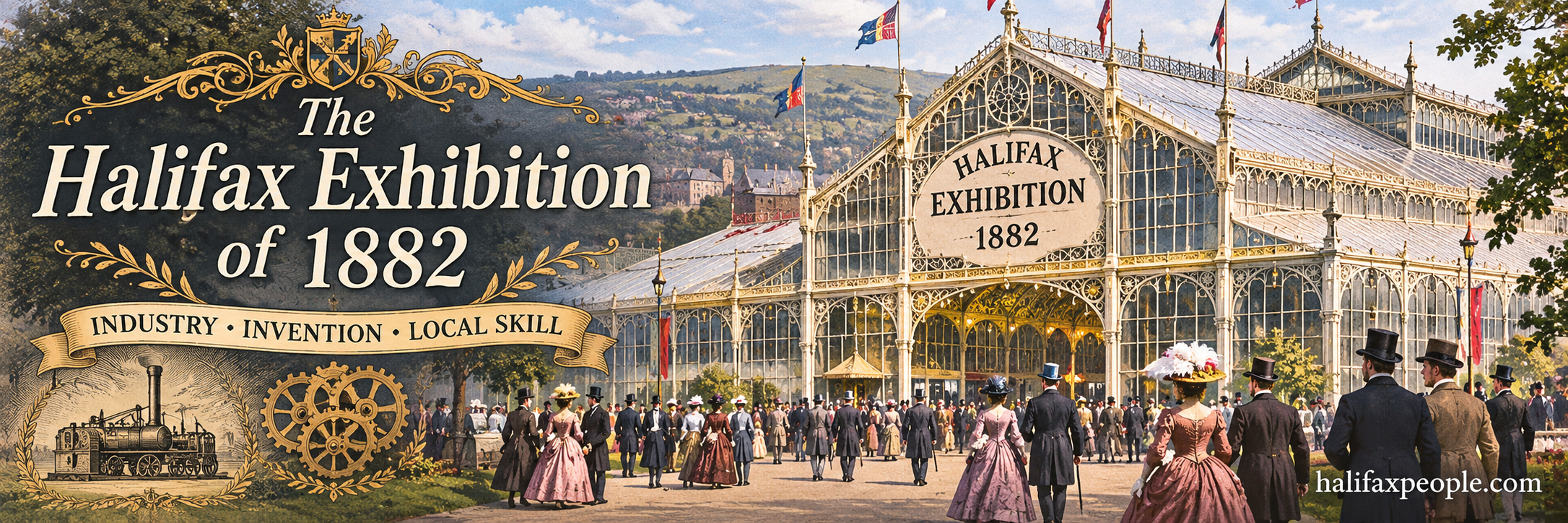
The exhibition was held at Halifax Drill Hall. The grand glass exhibition building, visitors and other details shown are imaginative reconstructions and should not be taken as an accurate representation of the actual event.
The forgotten showcase where Halifax put its inventions on display
In October 1882, Halifax held an exhibition designed to show the world what its manufacturers, engineers and inventors could achieve.
It was a time when the town's reputation rested heavily on its mills and factories. But the people behind those industries wanted to demonstrate that Halifax was about much more than spinning and weaving. They had machinery to show, new inventions to promote, engineering skills to display and products they believed could compete in markets far beyond Yorkshire.
The event was called the Halifax Fine Art and Industrial Exhibition.
Today, it has largely disappeared from popular memory. Yet a contemporary account published shortly afterwards gives us a fascinating glimpse inside an exhibition where machines were put to work, manufacturers displayed their latest inventions and local businesses competed for attention.
It also reveals some remarkable names from Halifax's industrial past.

An exhibition to promote Halifax
The plans were already being discussed during the summer of 1882.
In July, the Journal of Fabrics, a specialist textile publication edited and printed in Halifax, announced that a committee had been appointed to organise a Fine Art and Industrial Exhibition.
The organisers invited manufacturers, engineers, machinists and people involved in scientific and artistic work to apply for exhibition space. The intention was to hold the event early in October.
The honorary secretary was A. W. Briggs, who was later praised for the way the arrangements had been carried out.
The exhibition opened on 11 October 1882.
A month later, the Journal of Fabrics and Textile Industries published a detailed report. Its writer described the event as a success and said the exhibits were mostly from local firms.
That contemporary report is particularly valuable. Rather than relying on a later recollection, it allows us to identify actual businesses, their addresses and the products they brought to the exhibition.

Inside the Drill Hall
The battle against Halifax's factory smoke
One of the most interesting exhibits came from Charles Gall of Milner Street Works, Hanson Lane.
Gall displayed an improved patent self-acting mercurial air valve for steam boilers and furnaces. It was intended to help factories deal with smoke emissions.
Smoke was a serious problem in industrial towns. The report noted that local authorities were enforcing requirements to consume smoke, but many existing appliances had proved ineffective.
Gall claimed his invention was simpler than competing devices. It could reportedly be fitted to a boiler within a few hours and operated by an ordinary labourer rather than a specialist.
The report also mentioned that Gall had received 27 silver medals at exhibitions since introducing his invention.
This was a practical problem for Halifax manufacturers. They needed steam power, but the smoke pouring from factory chimneys was increasingly attracting attention from authorities and the public.
Gall was offering a solution made in Halifax.

Smoke over Halifax
A machine that was actually working
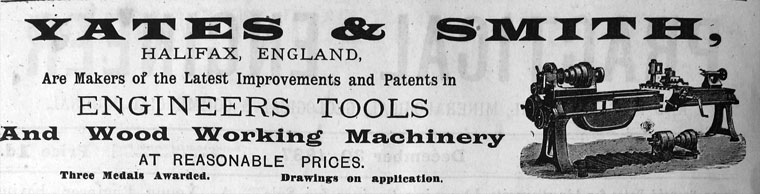
Another attraction was the exhibit of Alfred Yates of Blackwall Works.
Yates brought two steam-powered velocimotors, one of three horsepower and another of one horsepower. The larger machine was used to drive machinery at the exhibition itself.
In other words, visitors could see the invention doing its job rather than simply looking at a model or a drawing.
Yates also displayed a bench drilling machine designed to work either by hand or by power. The contemporary report described it as a useful machine for mill repairs.
The exhibition was not simply a display of finished goods. It was an opportunity for manufacturers to demonstrate the equipment that helped keep industrial Halifax running.
The makers of tools and machinery
Several other Halifax businesses used the exhibition to show their products.
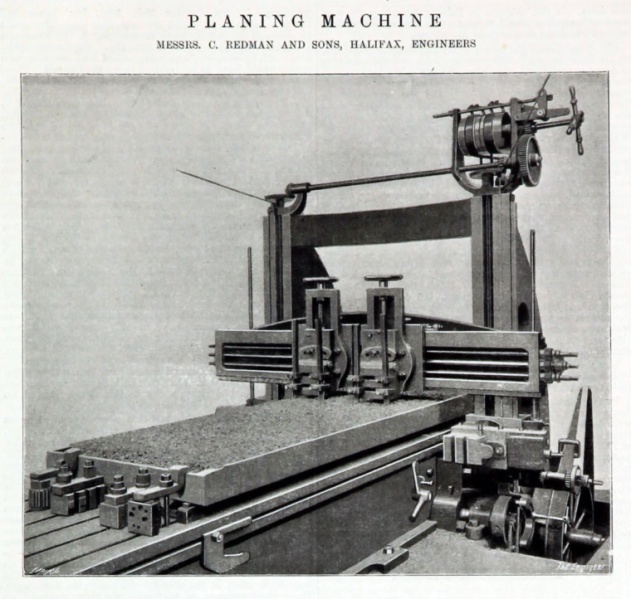
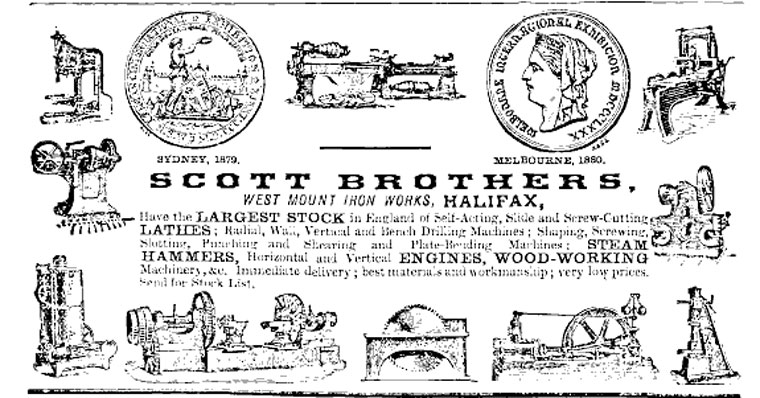
Mr Redman of Archer Street displayed a four-geared drilling machine and a bench drill. The larger machine could drill nine inches deep and was a substantial piece of equipment, weighing 15 hundredweight.
The report gave its technical specifications in considerable detail, including the dimensions of its spindle, gears, table and pillar.
It also recorded that Redman had produced 250 bench drills during the preceding two years.
This gives us a glimpse of a specialist engineering business that was already producing machinery in quantity.
George Binns of Archer Street Mills exhibited machine wool-combs. These were precision components used in the wool-combing process, with examples designed for different machines and different grades of wool.
The report singled out the quality of the workmanship, mentioning drawn brass components and examples of combs for Noble's and Lister's machines.
Meanwhile, Mr Pratt of Wade Street showed a card-setting machine designed for setting tinned-wire cards, particularly for use on damp wool.
These were not household gadgets. They were specialist tools for the textile industry, and their presence demonstrates the depth of engineering expertise available in Halifax.
Brass, rubber and mill equipment
E. Foster & Son, brassfounders of Square Road, brought a large collection of brasswork.
Their display included mill fittings and fire-brigade equipment. The report described the firm's reputation as well established throughout the United Kingdom and regarded its stand as one of the leading features of the exhibition.
R. P. Stafford of King Cross Street also displayed a wide range of metal fittings.
His stand included water hydrants, standpipes, valves, water gauges, whistles and delivery pipes. There were also fire cocks for use inside mills and on staircases.
The exhibition therefore showed the equipment required not only to run factories but also to protect them.
F. Horton, a mill furnisher and india-rubber merchant of George Street, exhibited belting, valves, joints, engine packings and other goods used in industrial machinery.
One of his displays included a working split drum fitted to the machinery department's shafting.
The exhibition was becoming a working demonstration of the industrial supply network that supported the town's mills.
The loom that attracted attention
The textile industry was represented by some particularly interesting machinery.
Scarborough Brothers of Halifax exhibited a circular box loom which was actually working on dress goods.
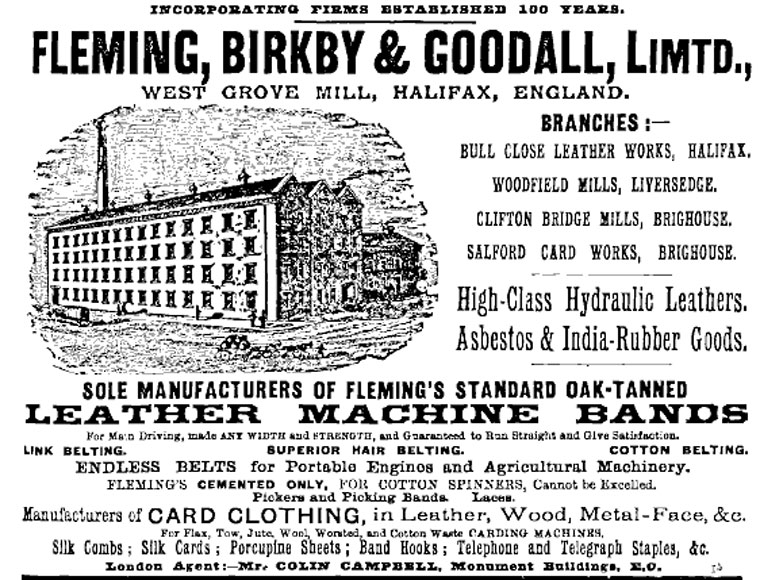
Fleming, Son & Co. of West Grove Mills displayed leather belting in various sizes.
The report also described the work of Charles Gall, George Binns and other local manufacturers whose products were closely connected with the textile trade.
The exhibition showed how many different trades supported the production of cloth. Behind every finished piece of fabric there were machine-makers, engineers, brassfounders, toolmakers, mill furnishers and specialist component manufacturers.
Halifax's industrial success depended on all of them.
The people behind the exhibition
The surviving report is especially useful because it names the businesses and gives their addresses.
It allows us to place the exhibitors back into the streets of Victorian Halifax:
- Charles Gall – Milner Street Works, Hanson Lane
- F. Horton – George Street
- Redman – Archer Street
- R. P. Stafford – King Cross Street
- E. Foster & Son – Square Road
- Alfred Yates – Blackwall Works
- George Binns – Archer Street Mills
- Pratt – Wade Street
- Fleming, Son & Co. – West Grove Mills
- Scarborough Brothers – Halifax
These were not distant national manufacturers. They were local businesses, many operating within a relatively small area of the town.
Their participation was an opportunity to attract customers, demonstrate technical ability and advertise their products to people who might otherwise never have visited their workshops.
The exhibition also recognised artistic and decorative manufacture. The wider Fine Art and Industrial Exhibition included the work of local makers beyond engineering and machinery.
One surviving record is an 1882 piano made by Stephen Hartley, bearing an award inscription for excellence in the manufacture of pianofortes at the Halifax exhibition. It is now recorded in the collection of the National Music Museum in the United States.
That surviving instrument provides a tangible link to the event more than 140 years later.
What happened to the exhibition?
The contemporary trade journal described the 1882 event as a success, but the report does not provide a full attendance figure or financial statement. We should therefore be cautious about claiming how many people visited or how much money it made.
It was not the only exhibition of its kind in Halifax. The town held further Fine Art and Industrial Exhibitions in 1888, 1893 and 1895.
These events belonged to a period when industrial towns increasingly used exhibitions to advertise their achievements and encourage technical improvement.
Halifax was competing for attention in a world where engineering, design and manufacturing were changing rapidly.
The 1882 exhibition gives us a particularly vivid picture of that ambition. Its displays were not simply about showing what had already been made. They were about inventions that promised to improve factories, save fuel, reduce smoke, make machinery more efficient and give local manufacturers an advantage.
A forgotten piece of Halifax's industrial story
The exhibition has left us with something more valuable than a list of prize-winners.
It has preserved a snapshot of the people and businesses that made Victorian Halifax work.
We can follow the names from the exhibition report back to individual streets and workshops. We can see the kinds of inventions they produced and understand the practical problems they were trying to solve.
A smoke-consuming valve from Hanson Lane, a drilling machine from Archer Street, brass fittings from Square Road and a working loom from a Halifax manufacturer all appeared under one roof.
For a few weeks in October 1882, Halifax put its industrial talents on show.
It is a pity that the event is now so little remembered, because it tells us something important about the town: its industrial history was not just about the great mills and the famous manufacturing families. It was also built by dozens of smaller specialist firms, inventors and craftsmen whose names might otherwise have been lost.
And thanks to a trade journal printed in Halifax at the time, some of those names can still be recovered.
If you have enjoyed your visit to this website, please spread the word by clicking the 'like' and 'share' buttons below. Thank you