The Town's First Great Water Scheme
The Town's First Great Water Scheme
When John Smeaton Planned to Bring Water to Halifax – The Town's First Great Water Scheme
Today, turning on a tap and getting clean water is something most people take for granted. In eighteenth-century Halifax, obtaining a reliable supply was a much more complicated business.
The town depended on wells and springs, and as its population and industries grew, providing enough water became an increasingly serious problem.
In 1761, Halifax turned to one of the most celebrated engineers of the age: John Smeaton. His work survives in an extraordinary document – a plan showing how he proposed to pipe water through the streets of Halifax.
It was an early step towards the organised water supply that would eventually transform the town.
Where Halifax got its water
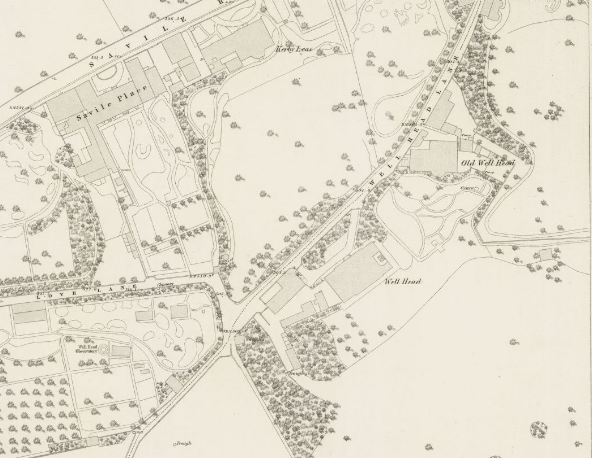
For much of the eighteenth century, one of Halifax's important sources of fresh water was Well Head, just off Skircoat Road, a short distance from the town centre.
The name itself preserves the memory of its purpose. Water from the springs and wells was collected and conveyed towards the town, with wooden pipes and underground channels forming part of the supply system.
Highroad Well was another source associated with the town's water provision.
These supplies were important to households, businesses and public houses. A later local account recalled that customers in some Halifax inns would ask for “Whisky and Well Head”, a reminder of the reputation attached to the water.
But a growing town needed more than a collection of wells and springs. It needed a system capable of delivering water to different parts of the built-up area.

Calling in John Smeaton
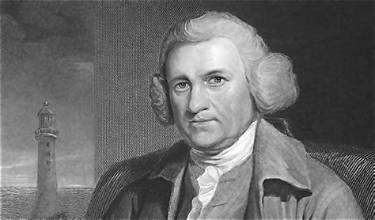
John Smeaton (1724–1792) was already an established engineer. He is particularly remembered for designing the third Eddystone Lighthouse, but his work extended to bridges, canals, harbours and water engineering.
In 1761, he was asked to consider a scheme for supplying Halifax with water.
His report was dated 14 February 1761 and addressed to Mr Simpson, who was later secretary to the committee responsible for building the Piece Hall.
Smeaton's surviving letter is particularly revealing. He explained that he had prepared a sketch showing how he proposed to lay the pipes, together with an estimate of the cost.
He also suggested that his proposals should be examined by another engineer, Joseph Knight, whose knowledge might identify mistakes or improvements.
It is an interesting glimpse of professional engineering practice in the eighteenth century: even a famous engineer wanted another experienced pair of eyes to check his calculations.
A problem caused by Halifax's hills
The most interesting part of Smeaton's report concerns the town's geography.
Halifax was built on steeply sloping ground. Water travelling down from higher ground would exert increasing pressure on the pipes as it descended.
Smeaton recognised that this created an engineering problem. Pipes in the lower parts of town would be subjected to much greater pressure than those higher up.
Rather than simply specifying thicker and more expensive pipes throughout, he proposed varying their internal diameter.
He also explained that the water would be supplied from above the head of the town. The main pipe would initially carry the water required for the whole supply, but as branches carried water away to different districts, the main pipe could become progressively smaller.
This was a carefully considered design for a town whose streets and buildings occupied very different levels.

The map that survives
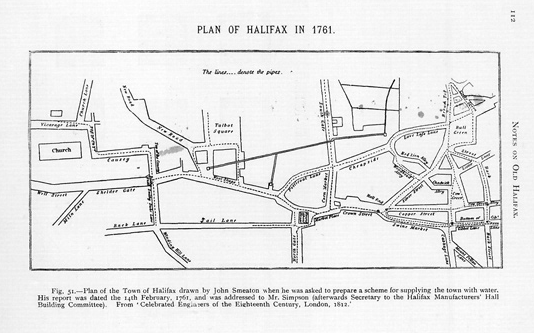
The Calderdale archive preserves a plan of Halifax drawn by Smeaton in 1761.
It shows the proposed arrangement of water pipes through the town, making it a valuable record of Halifax before the major expansion of the nineteenth century.
The document is particularly interesting because it connects an engineering proposal with the actual street pattern of eighteenth-century Halifax.
It is not simply a general drawing of a waterworks. It is a plan for distributing water around the town itself.
The map can be viewed in Calderdale's From Weaver to Web archive.
The Act of 1762
The following year, Parliament passed legislation establishing trustees with responsibility for supplying Halifax with water.
The Act of 1762 gave the trustees powers to manage the supply and levy charges on those who used it. Further legislation followed in 1768, extending and revising their responsibilities.
This was an important development in the town's administration. Water supply was no longer simply a matter of individual wells and private arrangements; it was becoming a public undertaking organised through statutory powers.
However, it is important not to assume that every detail of Smeaton's 1761 proposal was necessarily constructed exactly as he had drawn it. His surviving plan records the scheme he recommended, while the subsequent Acts record the legal powers created to organise water provision.
The two documents together show how Halifax was beginning to tackle the problem.
Albert Reservoir
A town still searching for enough water
The water question did not disappear after the 1762 Act. As Halifax expanded, its requirements grew, and the existing sources and distribution arrangements came under increasing pressure.
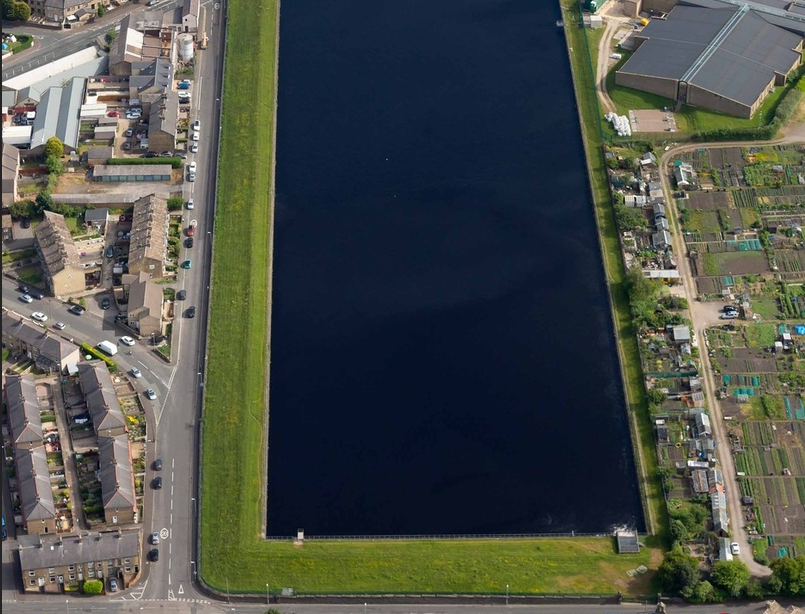
In the nineteenth century, the town needed a much larger and more dependable supply. Engineer John Frederick Bateman was consulted in 1851, and his proposals involved bringing water from reservoirs on the moors above Halifax.
That was a much larger undertaking, reflecting the growth of the industrial town.
But the story of organised water provision in Halifax had an important earlier chapter. In 1761, John Smeaton had already been asked to solve the problem of getting water through the town's steep streets.
His map remains a fascinating reminder of a time when a reliable supply of water was one of the great practical challenges facing Halifax.
If you have enjoyed your visit to this website, please spread the word by clicking the 'like' and 'share' buttons below. Thank you