Halifax's First Modern Police Force
When Halifax Got Its First Modern Police Force
The End of the Old Town Watch in 1848
In November 1848, Halifax underwent a significant change in the way its streets were policed. The old town watch, whose men had patrolled the streets for generations, was disbanded and replaced by a new borough police force.
It was not a smooth handover. The council dismissed the existing watchmen, refused to compensate them and recruited an entirely new body of constables. Some of the old men were left struggling to find work, while the new force faced suspicion from people who feared that professional policing might become an instrument of political control.
The change also marked the beginning of a police organisation that would eventually grow into the modern Halifax force.
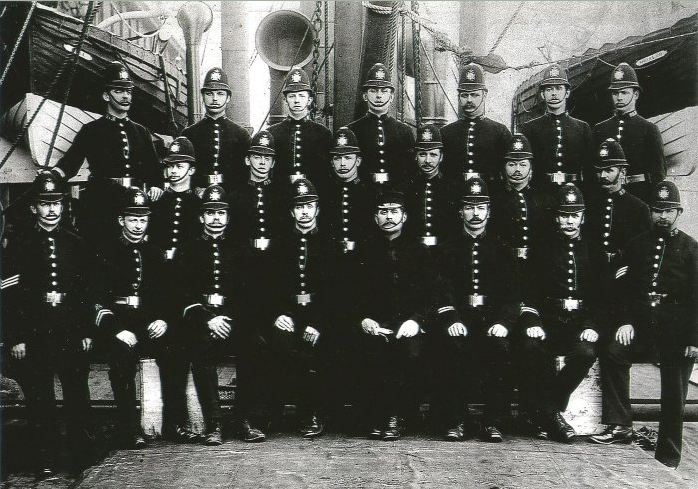
Halifax police 1893
Before the bobbies: the old Halifax Watch
Before 1848, Halifax relied on a mixture of local watchmen and constables to maintain order. The system was administered through local authorities and had developed over many years.
The old watch was not necessarily as useless as later critics suggested. It had experienced officers, and some councillors believed that the town was already well served by two senior men, Thomas Spiers and James Rawson.
But there were complaints about the condition and abilities of some of the ordinary watchmen. At a council discussion in October 1848, Alderman Craven reportedly described some as deaf, while others were old and lame.
The argument was not simply about whether the town needed more police. It was about the sort of police Halifax wanted, who should control them and how much the ratepayers should have to pay.
A town suspicious of a new police force
Halifax had strong radical and Chartist traditions. The memory of the Plug Plot disturbances of 1842 was still relatively recent, and the authorities were wary of anything that might inflame political tensions.
In April 1848, a Chartist meeting on Skircoat Moor was reported by the Halifax Guardian to have attracted more than 20,000 people. Fearing trouble, the authorities arranged for a troop of Dragoon Guards to support special constables and local troops.
The military, rather than a professional police force, was still regarded as the appropriate response to a major public-order emergency.
There were fears that a new police force might be expensive, militaristic and controlled by people whose interests were not those of ordinary Halifax residents. The council therefore wanted a relatively small force, rather than what one contemporary discussion described as a “regiment of police”.

The old town hall building was also the police station in 1851
The new force is organised
Halifax's new Watch Committee settled on a force of twenty-five men:
- One Superintendent
- One Inspector
- One Detective
- Four Sergeants
- Eighteen Constables
The committee chose Thomas Spiers as Superintendent. He had previously worked in the Leeds police and had already served Halifax as Deputy Constable.
James Rawson was retained as Detective Police Officer. A Halifax man, Rawson had worked as a detective locally for about ten years and was credited with securing the convictions of more than 250 felons.
John Pearson, who had previously served in the Manchester police and as a constable in Skircoat, became Inspector.
These appointments provided experience at the top of the new organisation, but the ordinary watchmen were not retained.
178 applicants for the new jobs
The council advertised for new sergeants and constables. The response was substantial: 178 applications were received.
The selection process was more thorough than might be expected. The Watch Committee recorded details of candidates' ages, heights, previous occupations, addresses, family circumstances and literacy. Applicants were interviewed and required to provide testimonials. Successful candidates also underwent medical examinations.
One candidate, despite having previous experience in the Manchester police, failed the medical.
Another recruit, John Copley, was dismissed in March 1849 after it was discovered that he had lied about his age. The evidence against him included his baptism certificate.
The new force was intended to be younger and fitter than the old watch, with a greater emphasis on discipline and training.
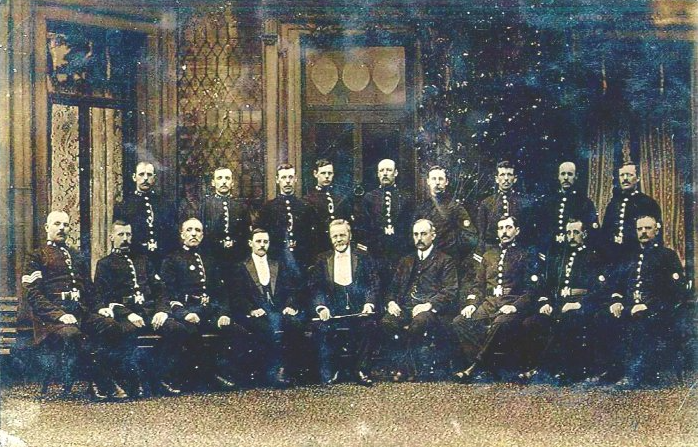
Halifax Police in 1893
The old watchmen lose their jobs
The final night of duty for the old watchmen was 12 November 1848.
After that, they were out of work. The Borough Council refused to grant them pensions, arguing that it had neither employed nor dismissed them. The trustees of the old system also denied responsibility, saying they no longer had the necessary powers.
There was considerable public sympathy for the men. A collection was organised and money distributed among the former watchmen, but they were not offered alternative employment. Some had to rely on Poor Relief.
It was an uncomfortable beginning for a new police force that was supposed to represent improvement and better organisation.
The first years of the Halifax Police
The new force began work in November 1848, with a basic wage of seventeen shillings a week for a constable and twenty shillings for a sergeant.
Discipline was taken seriously. Drunkenness was one of the first problems to come before the Watch Committee, and the first dismissal for the offence came in January 1849, barely two months after the new force took to the streets.
The officers also had to deal with the everyday problems of a busy industrial town: drunkenness, disorder, theft, street obstructions and the growing demands of a changing borough.
The police were not universally popular. In February 1850, some councillors complained that too many officers were parading the streets and that the cost was excessive. Others defended the new force, arguing that its men had long beats and could barely complete their rounds in the time allowed.
Thomas Spiers remained Superintendent until July 1851, when he resigned to take up a post with the West Riding police. John Pearson, his Inspector, was promoted to succeed him.

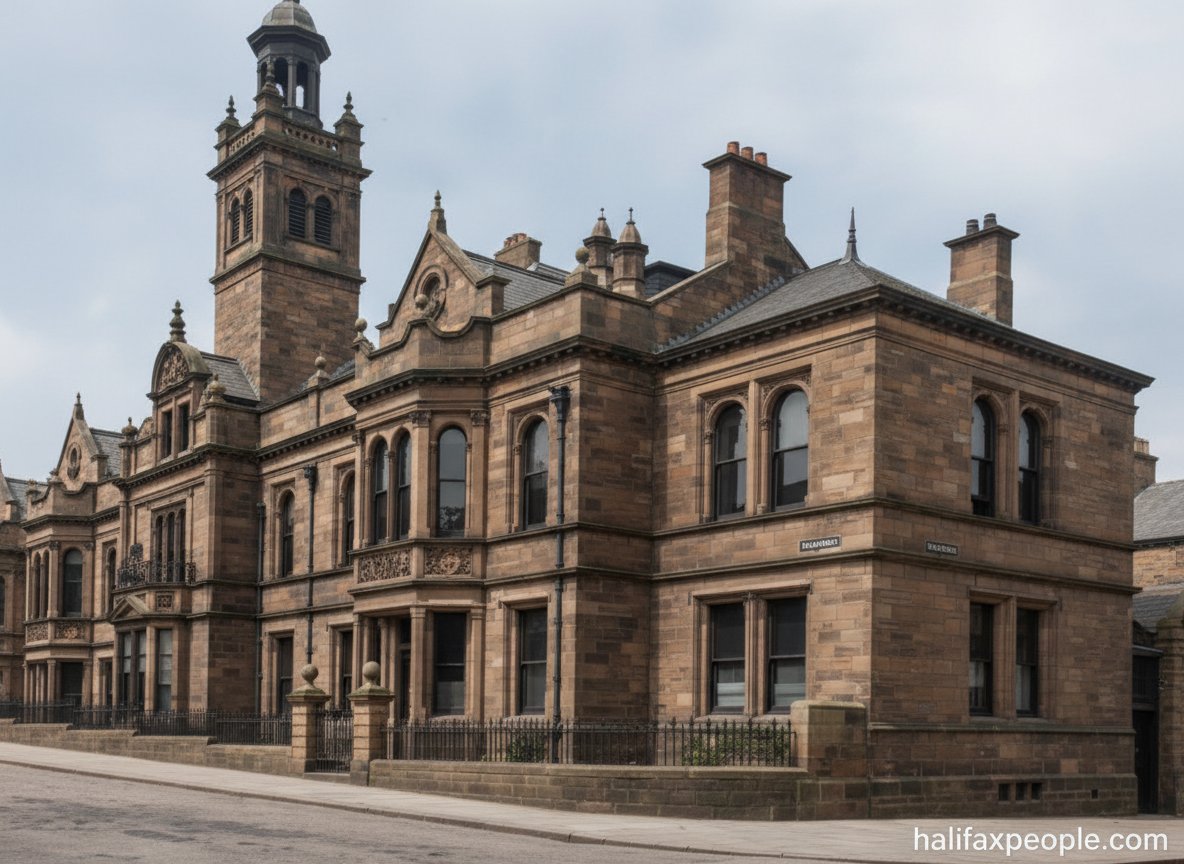
Harrison Road Police Station
From the old watch to the police station
The first modern Halifax police force did not begin life in the grand police station that later became a familiar landmark.
In 1863, the new Town Hall provided police accommodation, but it proved far from satisfactory. The police offices were below ground, poorly ventilated and increasingly cramped as the force expanded.
By 1894, the Chief Constable had repeatedly complained about the conditions. A government inspector also criticised the accommodation, recommending that new offices should be built above ground.
The council eventually purchased land and commissioned a new police station and court buildings. The project cost £27,764, exceeding the original budget, but the result was intended to be among the most modern police stations in the country.
The new Borough Police Station and Court opened in October 1900.
It included new cells, a covered parade ground, a recreation room and a police court. The buildings were heated by steam and had electric lighting. The plans even included semaphore signals to help control traffic at the nearby crossroads.
The opening marked another stage in the development of policing in Halifax, just over half a century after the old watchmen had made their final patrol.
The men who walked the streets in 1848 could scarcely have imagined the facilities that would be provided for their successors by 1900. But the change began with a decision that had a very human cost: the dismissal of the old watchmen, many of whom were left without work or a pension.
enhanced
If you have enjoyed your visit to this website, please spread the word by clicking the 'like' and 'share' buttons below. Thank you