Historic Cragg Vale

Historic Cragg Vale
The Old Wesleyan Chapel
Methodist worship in Cragg Vale began before the construction of the surviving chapel. Early Methodists met at Higher Cragg and later in a cottage at Smithy Stead, which was made available by John Wilcock.
A purpose-built chapel was opened in September 1835 on Cragg Road. It was originally known as Providence Wesleyan Church, and the date 1835 is still displayed on the building, now called Wesley House. The opening services had a particularly local significance: the sermons included prayers that the Cragg Vale Coiners and other thieves might see the error of their ways.
The chapel was supported by a group of local trustees, including members of the Atkinson, Barker, Wilcock and other local families. By 1845 it could accommodate approximately 260 worshippers, making it an important place of worship for the scattered community.
Music became part of chapel life. An American organ was replaced in 1897 by an instrument brought from Springside Wesleyan Church. In 1908 a new organ was installed by Conacher of Huddersfield.
The chapel did not have its own burial ground. Members of the congregation were buried at the Methodist graveyard on Scout Road. When Mount Zion Primitive Methodist Church in Mytholmroyd closed in 1960, its congregation joined with the Scout Road Methodist society. The Cragg Vale chapel itself closed during the 1970s and was subsequently converted into a private residence.
The former chapel survives as an important reminder of the strong Methodist tradition in the valley.
The Mills of Cragg Vale
The steep-sided valley of Cragg Vale provided an abundant supply of water from the surrounding moors, making it a suitable location for water-powered industry. Before the arrival of large factories, local people combined farming with domestic textile production, weaving cloth in their own homes and farm buildings. Mills gradually developed along the streams, using waterwheels to power machinery.
In 1758 there were three recorded mills in Cragg: a paper mill near the present Robin Hood Inn, a corn mill at Hoo Hole, and a fulling mill where woven cloth from local farms was finished. Fulling involved cleaning and thickening woollen cloth by working it in water.
As the textile industry expanded, more mills appeared. Among the sites identified along the valley were Turvin Mill, Pepper Bank Mill, Marshaw Bridge Mill, New Mill, Rudd Clough Mill, Castle Mill, Cragg Mill and Lower Cragg Mill. Other local histories also identify Victoria Mill, Vale Mill and Hoo Hole Mill. These works produced cotton, woollen and worsted goods, and their machinery was powered by water, steam, or a combination of the two.
The paper mill, also known as Cragg Mill, stood across Cragg Brook, also called Elphin Brook, a short distance uphill from the Robin Hood. It was associated with John Greenwood and his father-in-law Richard Hinchliffe. An 1877 sale advertisement described a five-storey paper mill with a reservoir and waterfall, a waterwheel measuring 23 feet 6 inches in diameter, and a 30-horsepower steam engine. The ruins of the mill survive on the old bridging platform, while the mill pond can still be seen and the waterwheel has been restored. Nearby former workers' cottages are now known as Paper Mill Cottage.
The growth of the mills brought employment and wealth to some local families, including the Greenwoods, Hinchliffes and Sutcliffe

Iron Smelting and Early Industry
The industrial history of Cragg Vale began long before the large textile mills of the eighteenth and nineteenth centuries. Local historical accounts describe iron smelting as one of the activities carried out in the district during the medieval period.
The valley and its surrounding slopes provided several of the resources needed by early industries. Woodland supplied timber, which could be converted into charcoal for heating furnaces, while streams provided water and the surrounding countryside supported farming and other forms of work.
Iron smelting was part of a mixed rural economy. Alongside agriculture, local people produced cloth, made clothing, farm implements and household utensils, and provided transport services using packhorses and carts.
The exact locations and scale of the early ironworking sites are not yet firmly established by the evidence consulted for this account. It would therefore be premature to identify particular surviving ruins or buildings as medieval ironworks without archaeological confirmation.
The reference to iron smelting is nevertheless important because it shows that Cragg Vale had an industrial history before the better-known cotton and woollen mills. The valley's later manufacturing economy developed from a much older tradition of using local resources and skills.
Cragg Hall, the Simpson-Hinchliffe Family and its Gardens
Cragg Hall was one of the most remarkable houses in the history of Cragg Vale. It was closely associated with the Hinchliffe family, whose wealth came from textile manufacturing in the valley. Richard Hinchliffe established an early cotton mill, and succeeding generations developed a substantial industrial and property estate.
Hinchliffe Hinchliffe acquired the Cragg Hall estate. His daughter Helen eventually inherited the family fortune and, after her marriage to William Algernon Simpson, the couple transformed the Hall into a much grander country house.
Between approximately 1904 and 1906, the building was extensively enlarged and modernised. The resulting mansion combined several architectural styles, with elaborate gables, steep roofs, turrets, tall chimneys and decorative stonework. The gatehouse, dated 1906, is attributed to the Arts and Crafts architect Edgar Wood. It is possible that Wood also contributed to the design of the Hall, although this has not been established.
The couple became known locally as the Simpson-Hinchliffes. They entertained lavishly, and their guests included the celebrated singer Dame Clara Butt, actor Henry Ainley and billiards champion Melbourne Inman. They also supported local workers, tenants, schools and societies, and organised celebrations and entertainments for the community.

The Old Sunday School and Vicarage
One of the historic buildings in Cragg Vale has served more than one purpose during its lifetime. The building now known as the old Sunday School was formerly the residence of the vicar of St John the Baptist in the Wilderness.
Before the 1860s, the vicar lived in this building on Swine Market Lane. It was later replaced as the vicarage by Woodville, which served as the vicar's home from the 1860s until a new vicarage was built in 1901.
The 1901 vicarage was erected by Helen Strickland, daughter of Hinchliffe Hinchliffe of Cragg Hall, in memory of her father. A commemorative tablet records the gift and the date. The design of the building was in the Vernacular Revival style and was considered similar in character to Cragg Hall.
The building later became known as the Old Vicarage. It is an important reminder of the close connections between the church, the Hinchliffe family and the development of the village.
The former vicarage on Swine Market Lane continued in its religious and educational role as a Sunday School building. These changes in use illustrate how buildings in a small rural community were adapted to meet changing needs.

The Pleasure Gardens
The grounds of Cragg Hall were as impressive as the mansion itself. During the improvements made between 1904 and 1907, the gardens were developed into extensive landscaped grounds with terraced lawns and a variety of recreational features.
These included tennis courts, a croquet lawn, a gazebo, a fountain and a revolving summer house. The estate also had a bathing pool and a boating lake, creating an elaborate setting for outdoor recreation and entertaining.
The gardens were used for social occasions as well as private enjoyment. In 1907, when the improvements were complete, the Simpson-Hinchliffes held a large garden party, inviting their staff and other guests. Photographs of the occasion provide a valuable record of the estate at the height of its brief period of splendour.
The grounds were not a public pleasure resort in the same sense as a commercial amusement park. They were the private gardens of a wealthy country house. Nevertheless, they were an extraordinary feature of Cragg Vale and demonstrate how dramatically the landscape around the Hall had been transformed.

 |
 |
The Fire of 1921
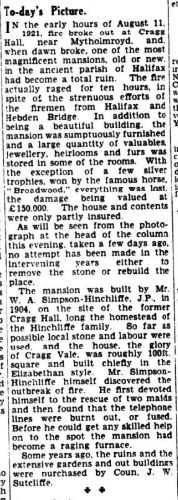
Helen Simpson-Hinchliffe died in 1917. Her husband continued living at Cragg Hall until a devastating fire destroyed the mansion in August 1921.
In the early hours of 11 August, a fire broke out and spread rapidly through the building. William Algernon Simpson-Hinchliffe was at home and reportedly helped rescue two young maids from the upper part of the burning house. He sent his chauffeur to Hebden Bridge to summon the fire brigade, and difficulties obtaining an adequate water supply hampered the efforts to tackle the blaze.
The fire was so large that its glow was reportedly visible from Hebden Bridge, Heptonstall and Halifax. The mansion's contents were devastated, including family possessions, pictures, silver, clothing and trophies associated with Simpson-Hinchliffe's racehorse Broadwood. The house was left as a burnt-out ruin.
Rumours circulated afterwards about the circumstances of the fire and the financial position of the owner. These remain speculation and should not be treated as evidence that the fire was deliberately started.
The ruins stood for several decades before much of the site was cleared in the 1950s. Parts of the former grounds survived, including terraces, steps and other garden features. The former rose garden is now associated with a tennis court.
The destruction of Cragg Hall marked the end of one of the most extraordinary periods in Cragg Vale's history. The surviving landscape features and photographs preserve the memory of a mansion, its wealthy owners and the remarkable pleasure gardens that once occupied this part of the valley.


Cragg Vale School
Education in Cragg Vale was initially associated with the church and its National School. As the population increased during the nineteenth century, the need for better school accommodation became more pressing.
A new school was built in 1887 by the Todmorden and Hebden Bridge School Board. It replaced a temporary school which had been operating at St John's National School. The building provided a purpose-built educational facility for children living in the valley and surrounding settlements.
The school later became known as Cragg Vale Junior and Infant School. It served generations of local families and remained an important part of village life for well over a century.
In March 2017, the governing bodies of Cragg Vale Junior and Infant School and Calder High School agreed to amalgamate. The Cragg Vale school closed in July 2017, and pupils transferred to new premises on the Calder High School site.
The school's history reflects the changes in rural education, from the early church-based arrangements to the provision of a purpose-built school and, eventually, the consolidation of local education into a larger school.
Cragg Vale Co-operative Society
The co-operative movement became an important part of everyday life in Cragg Vale during the nineteenth century. The Cragg Vale Co-operative and Industrial Society was registered in 1861, and a store opened on Cragg Road in 1862.
The shop provided local residents with access to groceries and other everyday goods. Co-operative societies were established to allow members to purchase goods collectively and share in the benefits of the business. They offered an alternative to relying entirely on private shopkeepers and were often closely connected with local working communities.
The Cragg Vale store also had a meeting room, giving it a wider role as a community facility. It was not simply a place to buy provisions but also a location where local people could gather.
Barker Greenwood was recorded as manager in 1893. The society merged with Luddendenfoot Co-operative Society in 1902 and became part of Mytholmroyd Industrial Co-operative Society in 1934.
The Cragg Vale store continued operating into the twentieth century but closed during the 1960s. Its history reflects the growth of organised co-operation in the valley and the importance of local shops before the arrival of modern supermarkets and larger retail centres.

Cragg Vale Post Office
Cragg Vale had its own Post Office from 1 February 1856. It was situated at Bank Bottom and became an important part of village life, serving the scattered farms and houses along the valley.
The Post Office remained at Bank Bottom for 130 years. In 1986, the postmistress, Mrs Reynolds, retired after approximately eighteen years in the position. The service was transferred to Cragg Holme, but this replacement Post Office closed three years later.
The village also had its own part-time postman. A local account of postal work in the 1950s describes how the Cragg Vale delivery was divided between two postmen. Cecil Greenwood, based at Mytholmroyd, covered one side of Cragg Brook, while the part-time postman based at Cragg Vale Post Office delivered to the other side.
The work involved much more than delivering letters along the main road. The postmen served cottages and farmhouses high on the valley sides and across the moors. Cecil Greenwood began work at 5.45 in the morning, sorted the mail and caught the 7 o'clock bus up to Cragg Vale. His route took him along Blackstone Edge Road and out to isolated farms before he returned to Mytholmroyd.
The local postmen also collected outgoing mail from the Post Office and village post boxes. In 1957, the postmen were transferred to Hebden Bridge.
The history of the Post Office and its delivery service provides a glimpse of a time when the village had its own postal arrangements and when daily communication depended on a network of local postmen covering long rural routes.
Cragg Fair and the Rushbearing
Cragg Vale had an annual celebration known as Cragg Fair, also called the Cragg Vale rush-bearing. It took place on the second Tuesday in August and was one of the traditional events in the village calendar.
Rushbearing was an old custom in which rushes were gathered and taken to a church to provide fresh floor covering. In earlier times, church floors were often covered with rushes, and the annual gathering gradually developed into a larger community celebration.
In many northern communities, rushbearing became associated with processions, music, fairs and other festivities. Cragg Vale's event was known locally as Cragg Fair and was held in August.
The tradition was discontinued during the 1870s. Although the details of the Cragg Vale procession and its activities are not fully recorded in the surviving local reference, its name preserves the memory of a customary village celebration that had disappeared by the end of the nineteenth century.
The rushbearing is a reminder that the social calendar of Cragg Vale once included traditional fairs and religious customs as well as the better-known events associated with the mills and public houses.
The Working Men's Club and Local Brass Bands
The social life of Cragg Vale was supported by clubs, musical groups and community organisations as well as its churches and public houses.
A Cragg Vale Working Men's Club and Institute was recorded in 1893, when John Sutcliffe was its secretary. Working men's clubs provided places where local residents could meet, read newspapers, take part in social activities and enjoy recreation outside working hours. They became an important feature of many industrial communities during the nineteenth century.
Music also played a part in local life. A Cragg Vale and Mytholmroyd Prize Brass Band was recorded in 1940, when it appeared at a Sunday Sing. A later Cragg Vale and Mytholmroyd Band was formed in 1949 and subsequently became associated with the Moderna Blanket Works Band.
These organisations demonstrate the importance of shared recreation and music in the valley. They brought people together across the communities of Cragg Vale and Mytholmroyd and provided a social life beyond the workplace and home.
St John the Baptist in the Wilderness
The church of St John the Baptist in the Wilderness is one of the most prominent historic buildings in Cragg Vale. It stands close to the old industrial village and reflects the growth of the local population during the period when textile mills were developing along the valley.
There was an earlier church on the site before the present building. The foundation stone of the first church was laid on 15 March 1813, and it was consecrated in 1817. It provided accommodation for about 250 worshippers. By 1838, however, the building was reported to be in poor condition. Its roof had already collapsed once and was being supported by props.
The present church was built in 1839 at a cost of £2,130. The money was partly provided through the Million Pound Act, a national scheme which helped finance the building and repair of churches. The sandstone used in its construction was quarried at Clattering Stones, in the surrounding area. The new building was considerably larger than its predecessor and could accommodate around 800 people.
The church became an important centre of community life as Cragg Vale expanded. Its congregation included local farming and mill families, and the Hinchliffe family were among its supporters. Mrs Hinchliffe presented a lectern, while Mr Hinchliffe provided an organ costing £400 in memory of his two sons. The organ had originally been made by Wards of York in 1821 and was brought to Cragg Vale from Square Independent Chapel in Halifax.
The church also has a connection with the Brontë family, who are recorded as having visited. It was originally within the Parish of Halifax, before becoming an independent parish in 1844.
The churchyard contains prominent graves of members of the Hinchliffe family and provides another record of the people who helped shape the history of the valley.
St John's is therefore more than a religious building: its successive churches reflect the changing needs of the community, from the early nineteenth-century settlement to the larger industrial village that developed around it.
 |
 |
Cragg Vale War Memorial
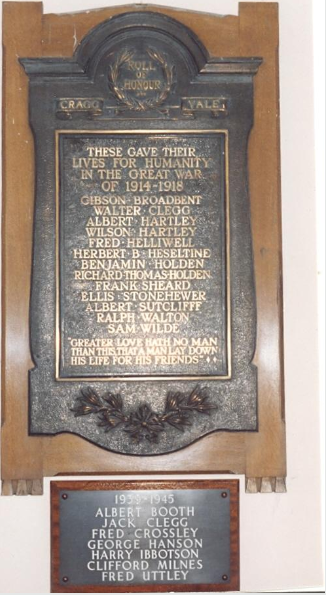
The men of Cragg Vale who lost their lives in the two world wars are commemorated by memorial plaques inside St John the Baptist in the Wilderness Church.
The First World War memorial is a decorative bronze plaque mounted on a wooden backing. Its inscription is headed “Roll of Honour, Cragg Vale” and commemorates those who gave their lives during the conflict of 1914–1918. A second plaque below it records the fallen of the Second World War.
The memorial records thirteen deaths from the First World War and seven from the Second World War. It was made by F. Osborne and Company Ltd and was unveiled on 20 June 1920 by the Bishop of Wakefield.
The inscription includes the words “Greater love hath no man than this, that a man lay down his life for his friends”. The memorial is located in the south aisle of the church and remains a permanent reminder of the losses suffered by the local community.
The names are an important starting point for researching the individual men and their families. Their occupations and addresses help connect the memorial with the wider history of Cragg Vale, including its farms, mills and working households.
The Methodist Graveyard at Scout Road
The Methodist community in Cragg Vale had its own burial ground at Scout Road, alongside the former Methodist chapel. The graveyard provided a place of burial for members of the local Methodist congregation and their families.
The chapel on Cragg Road, known as Providence Wesleyan Church, opened in September 1835. It did not have its own burial ground, and interments were instead made at the Methodist graveyard at Scout Road.
The surviving gravestones and monumental inscriptions provide an important source for the history of the valley. They record the names of local families and can help trace the lives of people associated with the mills, farms, chapels and businesses of Cragg Vale.
Among the families represented in the wider history of the Methodist community were the Atkinsons, Barkers, Wilcocks and other local families who supported the chapel and its activities.
The graveyard is therefore more than a burial place. Its inscriptions form a valuable historical record of the religious and family life of Cragg Vale during the nineteenth and twentieth centuries.
The Hinchliffe Arms
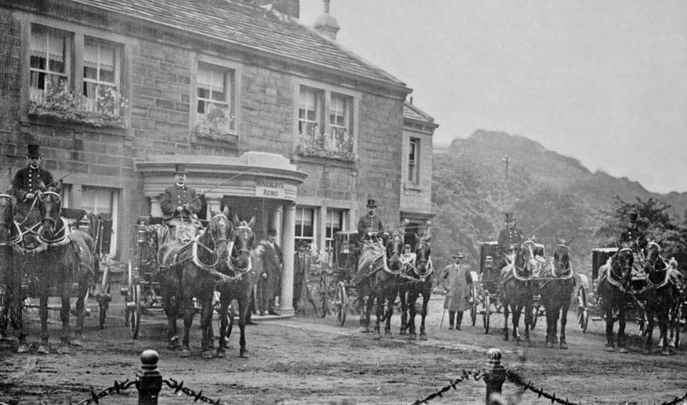
The Hinchliffe Arms is one of the best-known public houses in Cragg Vale. It was formerly known as the Cragg Vale Inn and was renamed the Hinchliffe Arms in 1912, taking its name from the prominent local family whose textile mills and estate played such an important part in the history of the valley.
The Hinchliffes were closely connected with the industrial development of Cragg Vale. Their mills provided employment for local people, while their property and charitable activities influenced the wider community. The change of the pub's name reflected the family's importance in local life.
Public houses were important meeting places in a rural industrial community. They provided refreshments for workers, travellers and visitors, as well as places where neighbours could meet and exchange news.
The Hinchliffe Arms remains a recognisable landmark in the village and a reminder of the family whose name is woven into so much of Cragg Vale's industrial history.


Farms, Weavers and the Old Cottages
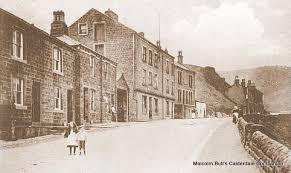
Cragg Vale did not begin as a compact village. Its early settlement was made up largely of scattered farms and small groups of buildings on the valley sides. The name Cragg appears in historical records by 1449, although it is not clear whether a recognisable village existed at that time. For centuries, farming was the main occupation, with families keeping livestock and working the surrounding fields.
The valley's steep slopes and streams shaped the pattern of settlement. Farms were established on the more suitable ground, while woodland and rough grazing occupied much of the steeper land. Sheep farming became particularly important, and wool provided a valuable source of income for local families.
Textile production developed alongside agriculture. Before the growth of large factories, many families worked as domestic weavers, producing cloth in their own homes or in small workshops attached to their cottages. Some larger farmhouses belonged to yeoman families who combined farming with textile manufacture and the organisation of local trade.
The remains of this period can still be seen in the old stone buildings along Cragg Road and on the valley sides. Calderdale's historic landscape survey identifies several rows of late eighteenth- and early nineteenth-century weavers' cottages, as well as an early nineteenth-century cottage within the village itself. Some older houses and farms date from the seventeenth century, including Old Cragg Hall, which stands above the village.
As textile production expanded, domestic workshops were built in greater numbers. Improved routes, including Cragg Road and the turnpike established in 1815, helped connect the valley with neighbouring settlements and markets. The development of water-powered and later steam-powered mills brought further changes, and workers' housing grew along the road and around the emerging industrial village.
Farming nevertheless remained an important part of life. The valley continued to be characterised by small farms, fields, stone cottages and scattered homesteads, even as the mills brought new employment and industry.
The old cottages and farmhouses are therefore more than picturesque reminders of the past. They preserve the evidence of a way of life in which agriculture, home-based textile work and later factory employment were closely connected. They also help explain why Cragg Vale developed as a long, dispersed settlement rather than a traditional village centred on a market place.
Erringden Medieval Deer Park
Long before the industrial mills and scattered farms became the familiar features of Cragg Vale, much of the surrounding countryside formed part of a large medieval hunting landscape. Erringden was the site of a deer park associated with the de Warenne family, powerful Norman landowners who held extensive estates in Yorkshire.
The park was enclosed to keep deer within a managed area for hunting. In medieval England, the right to maintain a deer park was an important privilege and a visible sign of wealth and status. The word 'park' did not mean a public recreation ground as it does today: it referred to enclosed land where deer could be protected and hunted.
Research by local historian Nigel Smith suggests that Erringden Park was probably established in the late 1320s. At its greatest extent it covered approximately 3,000 acres, although its boundaries changed during its existence. The park included parts of the steep-sided landscape around Cragg Vale and the surrounding moors.
The boundaries were marked by earthworks, ditches and wooden fencing known as palings. Some landscape features and old place names may preserve traces of these boundaries. Dick's Lane, for example, has been suggested as a possible reference to an earlier boundary ditch. Names such as Lodge and Pallis House have also been considered as possible clues to buildings associated with the management of the park, although their precise medieval functions are not certain.
The deer were valuable both as a source of venison and as part of the status and ceremonial life of the landowning family. The steep and remote terrain of Erringden may also have made the park useful as a place to maintain and replenish deer stocks for other estates.
The park was eventually disparked in 1451. Its land could then be used more freely for farming and other purposes. Over time, the landscape developed into the mixture of farms, fields, woodland and moorland that surrounds Cragg Vale today.
The history of Erringden's deer park is an important reminder that the valley's story reaches much further back than the Coiners, the textile mills and the industrial village.
Bell House, Cragg Vale Coiners


The Turnpike Road over Cragg Vale
The road through Cragg Vale was an important route connecting the Calder Valley with the upland roads towards Blackstone Edge, Rochdale and Lancashire. Before the construction of the modern road, older tracks and packhorse routes crossed the hills, linking farms and settlements on both sides of the Pennines.
The improvement of the route became part of the early nineteenth-century turnpike movement. The Mytholmroyd Bridge Trust Turnpike dates from 1815, although parts of the road may have followed much older routes. The road was constructed in stages, with the section through the upper valley completed in 1824.
Turnpike roads were maintained by trusts authorised to collect tolls from travellers. The money was used to repair and improve the highway, making it more suitable for carts, commercial traffic and passenger travel. Better roads helped connect Cragg Vale's farms and mills with markets in the surrounding towns.
The road climbs steadily from Mytholmroyd through the valley towards the open moorland at the top. It is now known as Cragg Road through the lower village and Blackstone Edge Road higher up. The turnpike trust was dissolved in 1886, but the route continued to be an important road.
Today the climb is particularly well known to cyclists. In 2014 it formed part of the Tour de France route through Calderdale, bringing international attention to a road whose importance to the valley dates back centuries.


Cragg Spa and Spaw Sunday
Cragg Vale has its own historic spa spring, traditionally known as Cragg Spa or Cragg Spaw. The spring is reputed to be at least 300 years old and was once an important gathering place for people living in the valley and the surrounding Upper Calder area.
The water is sulphurous and has a distinctive smell. In earlier times, people believed that drinking spring water could help restore health after the long winter. Whether the water had any genuine medicinal properties is uncertain, but the custom of visiting the spring became an established local tradition.
The annual gathering became known as Spaw Sunday and usually took place on the first Sunday in May. People would meet at the spa to drink the water and celebrate the arrival of spring. A traditional way of making it more palatable was to shake the water in a bottle with a stick of liquorice before drinking it. Some local people also used the sulphurous water to make tea, although its strong smell was not to everyone's taste.
Spaw Sunday developed into a popular local event. A report from 1906 recorded a gathering at the spa followed by a procession to the White House on Blackstone Edge, where the Hebden Bridge Band was playing. The report suggested that the numbers attending had declined, but around 500 people continued on to the White House.
The Second World War brought the traditional celebrations to an end. The event was briefly revived in 1987, but the spring later fell into disrepair and became less familiar to local residents. In 2009 restoration work improved the site, including landscaping and the installation of steps to make access easier.
On 1 May 2010, Cragg Vale Community Association revived Spaw Sunday as a community celebration. The modern event has included music, dancing, a blessing of the water and a picnic, bringing the old spring back into the life of the village.
The names of nearby places, including Spa Laithe Farm, Spa Terrace, Spa Wood and Spa Bridge, preserve the memory of the spring's importance to Cragg Vale. The old custom of taking the waters remains one of the valley's most distinctive traditions.
Prehistoric Cragg Vale
The history of human activity around Cragg Vale reaches back thousands of years before the development of the village. Evidence of prehistoric activity has been found on the surrounding moors, including flint tools and weapons.
Flint is not naturally found in the local bedrock, so the presence of flint artefacts suggests that prehistoric people obtained the material through movement and exchange over considerable distances. Flint spearheads and arrowheads have been found on Marsden and Rishworth moors, and the high ground around Blackstone Edge and Midgley Moor has also produced evidence of early activity.
The open moorland would have provided hunting grounds and routes across the uplands. The steep-sided valleys were more heavily wooded, but people travelling between the high moors would have needed to descend to cross streams and rivers.
The landscape itself was very different from the one seen today. Changes in climate during prehistoric times helped create the deep peat deposits on the higher moors. Around 5,000 BC, a prolonged period of wetter conditions contributed to waterlogged ground and the development of peatland.
These finds do not prove that there was a permanent prehistoric village in Cragg Vale. They do, however, show that people were active in the wider landscape long before the medieval farms, deer park and industrial mills appeared.
If you have enjoyed your visit to this website, please spread the word by clicking the 'like' and 'share' buttons below. Thank you