Historic Sowerby


Stansfield Court No.s 3,4,5,6 on left, No.s 7 and 8 on left down steps, no.s 9, 10 on right landing

Stansfield Court

Woods Court on left, Stansfield Court in background

Woods Court

 |
 |


  enhanced |
 |

 |
 |


Cobden Street


  |
 |

Sowerby Congleton Church
 |
 |

Wood Lane Hall


For Boulderclough see Historic Luddenden

This is Boulderclough Methodist Church. For some 112 years there has been active religious work here. The first place of worship was opened in 1822, its establishment being chiefly due to the evangelising influence of the Rev. T.Halliday, a primitive Methodist missionary from Sheffield. An interesting point is that the people not only helped financially, but also gave their free labour in its erection.
In the early days the cause prospered despite persecution and even imprisonment, but after about ten years, enthusiasm waned for a while. In 1834, the church came under control of the Methodist New Connexion, which, in 1852 purchased the whole estate for £120. The last services were held in the old chapel on Jan 31st 1897, and the new chapel, built in the style of renaissance chateux of France and Belgium, at a cost of approx £3050, was opened on Oct 1st 1898.


 |
 |


enhanced

 |
 |
 |
 |


Rooley Lane 1875
 |
 |


Star Inn - Rushcart
 |
 |
John "Almighty" Whiteley – The Star Inn, Sowerby
At the bottom of Well Head Lane in Sowerby stands the Rushcart Inn, formerly known as The Star Inn. Built in 1798 by the Jennings family, it became home to one of Halifax's most eccentric characters: John Whiteley, known locally as "John Almighty."
The Man Behind the Legend
Whiteley took over the pub around 1810 and quickly became a fixture in local life. A Sowerby Parish Constable and man of curious habits, he styled himself "The Lynx Eyed Thief Catcher" and "The General." A Whig supporter, he even stood as a candidate for Halifax in 1832.
By day, Whiteley held various local government offices. By night, he preached from an old Post Boy's box converted into a pulpit in an upper room at the pub. Behind the building, he rebuilt a cottage in 1837 to serve as a prayer meeting house.
The Lost Portrait
A large portrait was commissioned and hung proudly on the pub wall, bearing the inscription:
"John Whiteley Aged 44 Years""The Lynx Eyed Thief Catcher and General Candidate for Halifax A.D. 1832""The Reward of Integrity in the Discharge of Arduous Public Service"
But Whiteley's fortunes declined. By 1849, mounting debts forced the sale of the pub. He moved to Mill Bank and eventually died in Halifax Workhouse on 6th April 1858, likely buried in an unmarked grave at St Peter's Church, Sowerby.
The portrait vanished into history.
The Mystery Solved
Decades later, the painting resurfaced on the Antiques Road Show (broadcast from Arundel Castle, September 2007), valued at £2,500. Its new owners had purchased it at auction and were intrigued by newspaper cuttings about ghostly connections to The Star Inn—and by strange events occurring since they'd hung it in their home.
The mystery was solved: during the late 1950s, Whittakers Brewery had removed the portrait from the pub and displayed it in their Halifax offices. When the brewery closed, the painting was auctioned off.
A Ghost Remains
Many locals hope to see John "Almighty" Whiteley's portrait return to its rightful home at the Rushcart. As for the man himself? Legend has it his ghost still haunts the pub—a fitting tribute to one of Sowerby's most unforgettable characters.
 |
 |
Ball Green, Sowerby: A Hidden Piece of Halifax History
An old Yorkshire house with a story stretching back more than 400 years
Tucked away on Well Head Lane, in Sowerby near Sowerby Bridge, stands Ball Green, one of the area's historic houses whose weathered stonework offers a glimpse into a very different Yorkshire.
Today, it may be easy to pass by without realising the history held within its walls. Yet Ball Green has connections reaching back to the early seventeenth century, when Sowerby was a rural community of farms, small settlements and substantial stone-built homes.A House from the Early 1600s
Ball Green is an important survivor from the period when wealthy local families built enduring houses from the millstone grit quarried in the surrounding countryside.
Historic England records the house as dating from around 1600, with a rear section dated 1634. The building was subsequently altered and partly rebuilt during the nineteenth century. Constructed from squared millstone grit beneath a stone-slate roof, it retains features characteristic of an old Yorkshire house, including substantial stone mullioned windows and carefully shaped stonework.
The property is now divided between a house and a cottage, with an attached outbuilding. It was officially listed as a Grade II historic building on 15 November 1966, recognising its architectural and historical interest.The People Who Called Ball Green Home
Ball Green's story is also a story of the families who lived there.
Records gathered by local historian Malcolm Bull in Calderdale Companion associate the property with several occupants over the centuries. These include William Wade around 1590, Henry Crowther in 1635, Israel Wilde around 1700, Joseph Rhodes and, in the nineteenth century, John Rawson.
The Wilde family is particularly associated with the house. Architectural details include a distinctive letter “W” incorporated into a window head. One interpretation, noted in the building's historical record, is that the letter refers to a member of the Wilde family, who occupied the property between 1703 and 1763.
Such details remind us that old houses can preserve family history in unexpected places. A carved initial or an old date-stone may be one of the few surviving clues to the people who once lived behind the windows.Henry Crowther and a Message from 1635
One of Ball Green's most intriguing historical connections is Henry Crowther, who was recorded as living there in 1635.
Crowther's story survives through an inscription on his monument in the churchyard of Halifax Parish Church. The verses offer advice on how to live a long life:
Eighty four years I liv'd; Wouldst thou do so,
Be thou, as I, quiet, chaste, and temp'rate too.
Norland me gave, and Sowerby, took my breath,
Man knows the place of birth, but not of death.
The inscription says Crowther lived to the age of eighty-four. It also connects Norland, where he was born, with Sowerby, where he died.
It is a striking survival from another age: a personal message about moderation, character and the uncertainty of life, preserved for generations in stone.The Old Gateway

enhanced
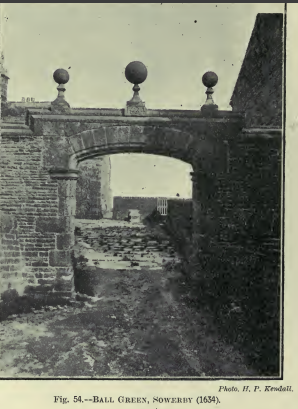
Ball Green's historic interest is not confined to the house itself. The nearby wall and arched gateway are also listed Grade II.
The gateway is thought to date from the seventeenth century and has a shaped stone arch with moulded details. Its stonework and ball finials give it a distinctive appearance, suggesting that the entrance was designed as an important architectural feature rather than simply a gap in a wall.
In an age when a house's entrance could make a statement about its owner, such craftsmanship would have helped distinguish the property from more modest dwellings.A Glimpse of Old Sowerby
When Ball Green was first built, the landscape and pace of life around Sowerby were very different from today. The area was shaped by farming, local trades and close-knit communities. Over succeeding centuries, industrial growth transformed the wider Calder Valley, bringing mills, workshops, transport links and expanding settlements.
Ball Green survived these changes, although the alterations made to the building over time show that it was adapted to changing needs. Its survival gives us a tangible link with the period before industrial Halifax became the place familiar to later generations.
The house also reminds us that local history is not only found in grand public buildings or famous industrial landmarks. It can be found in an old doorway, a date carved into stone, a family name in a historical record, or a verse commemorating a man who died nearly four centuries ago.Remembering Ball Green
Ball Green remains one of Sowerby's notable historic properties, recognised for its architectural features and its place in the area's long story.
Its early origins, its association with the Wilde family, the seventeenth-century gateway and the memorial to Henry Crowther all contribute to a history that reaches well beyond the building itself.
Next time you are exploring the old places around Sowerby and Sowerby Bridge, remember Ball Green. Behind its stone walls lies a small but fascinating chapter in the history of the Calder Valley.

enhanced
 |
 |


Sowerby New Road 1922


If you have enjoyed your visit to this website, please spread the word by clicking the 'like' and 'share' buttons below. Thank you