


https://en.wikipedia.org/wiki/North_Bridge,_Halifax
North Bridge, Halifax: the bridge that collapsed during a civic ceremony
Few Halifax landmarks have a history quite like North Bridge. It has been rebuilt several times, survived a dramatic collapse during a traditional ceremony, carried trams and horse-drawn traffic, and eventually found itself overshadowed by a modern flyover.
The bridge crosses the valley of the Hebble, linking the town centre around Northgate with routes towards Haley Hill, Northowram, Bradford and Leeds. Its story is about more than engineering: it reflects the growth of Halifax from a market town into an industrial centre that needed faster, more reliable routes through its steep landscape.
A crossing recorded as early as 1277
The earliest known reference to a bridge here dates to 1277, when a wooden bridge over Hebble Brook was mentioned in records of a medieval court held at Halifax.
A stone bridge was recorded by surveyor John Warburton in 1719. That crossing did not last. Around 1770, it collapsed during a Rogation Day “beating the bounds” ceremony — a traditional procession in which a community walked its boundaries. Historical accounts report that people were injured.
The replacement was a much more ambitious structure: a six-arched stone bridge, built by Matthew Oates of Northowram using stone from nearby Crib Lane. It opened in 1774 and was about 400 feet long, carrying the turnpike road high across the valley rather than forcing travellers down to the brook and back up the opposite bank.
That made it a major improvement for people travelling between Halifax and the surrounding districts.
The Victorian iron bridge
By the mid-19th century, the six-arched stone bridge was no longer adequate. The arrival of the railway and the need to carry traffic across the valley at a greater height helped drive plans for a replacement.
The new bridge was designed by engineer John Fraser and built with ironwork supplied by J. Cliff and Son of Bradford. Construction began in the late 1860s, and the bridge opened on 25 October 1871.
The opening day was anything but orderly. A large crowd, enjoying a half-holiday, surged onto the bridge before the official ceremony was ready. Malcolm Bull’s account, quoting local historian Mayhall, describes the event as more confusion than ceremony. Despite the crush, the crowd was reportedly in good humour, and the mayor eventually declared the bridge open.
The bridge cost around £21,000 according to Calderdale Libraries’ historical account. Its two main spans each measure approximately 160 feet, and the roadway sits around 11 feet higher than the old bridge.
A bridge with a memorial and a hidden time capsule
North Bridge is more than a way across the valley. Its stonework and decorative iron arches give it a distinctive Victorian appearance, and a drinking fountain at the southern end commemorates James Oates, a worker involved in the bridge’s construction.
There is also a time capsule within the central pier, reported to contain coins, photographs, newspapers and documents. It offers a little snapshot of the world Halifax’s builders wanted future generations to remember.
In 1876, a bronze statue of industrialist Edward Akroyd was unveiled near the north-west corner of the bridge. It was later moved to All Souls’ Church in 1901.
From trams to Burdock Way
North Bridge became part of Halifax’s developing transport network. Trams crossed it, and photographs from the early 20th century show the overhead equipment used by the tram system. Railway lines and industrial sites filled the valley beneath and around it.
Then came another dramatic change. Burdock Way opened in 1973, carrying major traffic routes above the older bridge. The new road system took much of the through-traffic away, leaving North Bridge to serve local journeys while its Victorian structure remained in use.

The original stone bridge


These were the scenes during the Plug Riots of 1842 Picture from Graces Guide
Note the wooden structure buildings that stood where the Grande Theatre was to later stand
Completed as a cast iron arch bridge in 1869. Designed by John Fraser. The contractor was Archibald Neill of Bradford, and the ironwork was supplied by J. Cliff and Son of Bradford.
Now only the original outer pairs of arch ribs are cast iron, the inner five being steel replacements for four original arches. The original inner arch ribs were each assembled from four castings, while the middle 52ft long lection was fabricated from wrought iron plate.
  Picture from Graces Guide |
 |


North Bridge, Halifax 1903. Image used for one of the photographic illustrations in "Life and Tradition in West Yorkshire" (1976), plate 81
Photograph © Marie Hartley Estate Image © University of Leeds


Colonel Akroyd's Statue far left of picture before being moved to All Souls Church


 |
 |


Grand Theatre


Drinking fountain, North Bridge
At the south end of the bridge, it forms a memorial to James Oates who was a worker during the bridge construction. Listed Grade II as part of the bridge Listing.
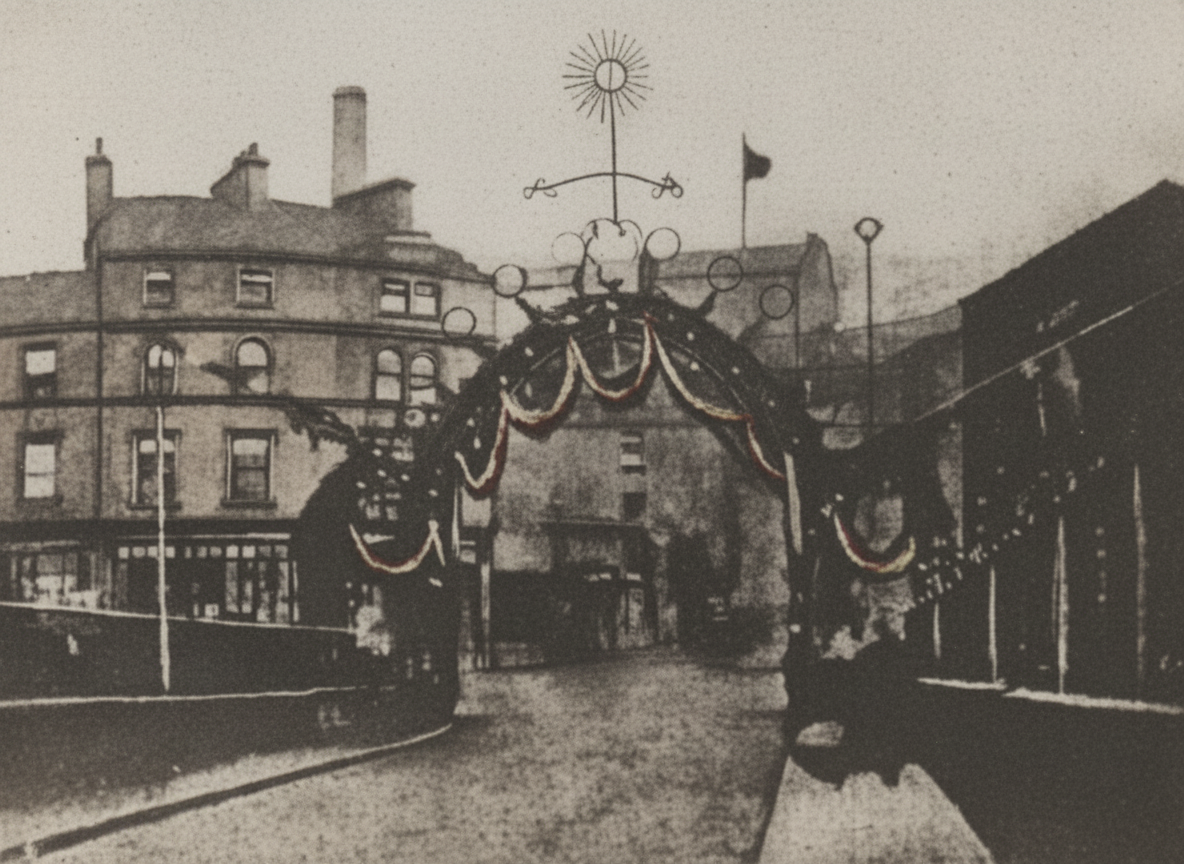 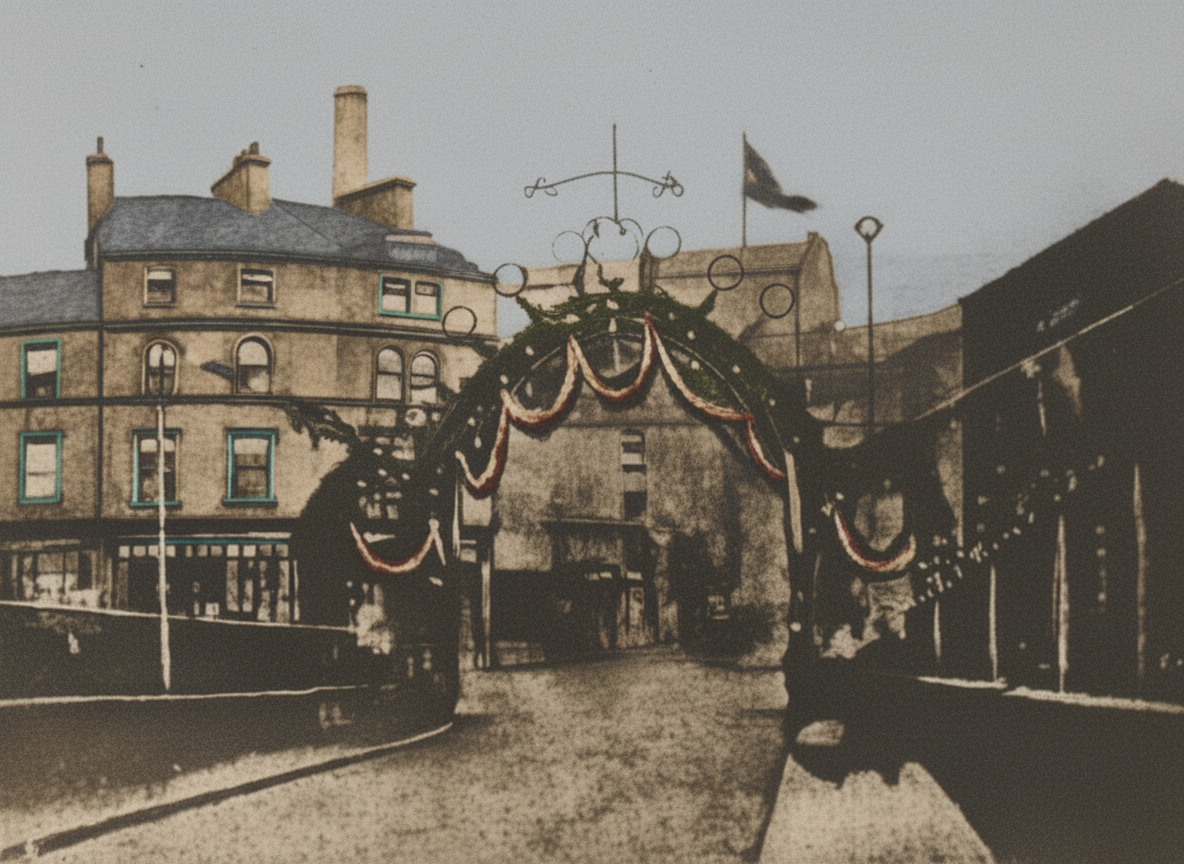 |
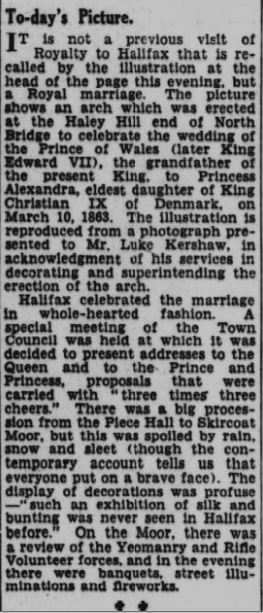 |

Tram accident
 |
 |


 |
 |


 |
 |


Looking towards Claremount
http://www.disused-stations.org.uk/h/halifax_north_bridge/index2.shtml
http://www.filmwasters.com/forum/index.php?topic=7725.0


The final curtain for the Grand Theatre (centre), the railway goods yard (right centre), Haley Hill (far end of bridge), Claremount (top)

Car boot sale underneath North Bridge

If you have enjoyed your visit to this website, please spread the word by clicking the 'like' and 'share' buttons below. Thank you