Ovenden Hall
Ovenden Hall
A house, a family, and the making of Halifax
There are houses that belong to a landscape, and there are houses that seem to gather a piece of the landscape's history within their walls. Ovenden Hall was one of them.
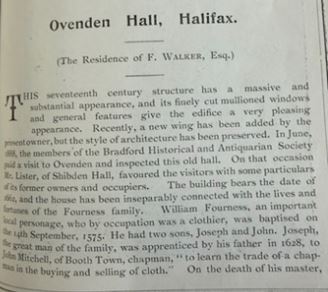
Standing in the Ovenden district of Halifax, the old house was already an impressive survival of the seventeenth century when its history was recorded in detail. Its substantial construction, finely cut mullioned windows and strong architectural character gave it a presence that marked it out from the ordinary buildings around it. It was not merely a substantial country residence. It was the home of a family whose fortunes became closely woven into the commercial, civic and political life of Halifax.
By the nineteenth century, the Hall had acquired the atmosphere of an old family seat: part house, part historical monument, and part reminder of the men who had helped shape the district.
The Fourness connection
The story of Ovenden Hall is inseparable from the Fourness family.
Among the family remembered in connection with the property was William Fourness, a figure who belonged to the generation in which Halifax was developing rapidly through trade and the cloth industry. The old account describes him as occupying a cottage associated with the family and records his baptism in 1579.
His father, John Fourness, is remembered as a successful chapman — the term then used for a travelling or wholesale trader — and as a man who understood the buying and selling of cloth. This was the world from which many of Halifax's prosperous families emerged. Wealth was not necessarily inherited in the modern sense; it could be built through trade, reputation, connections and an ability to recognise opportunity.
The Fourness family became part of that rising mercantile class.
And with prosperity came influence.From cloth to civic power
The life of Joseph Fourness illustrates how quickly a successful trading family could become involved in the wider affairs of the town.

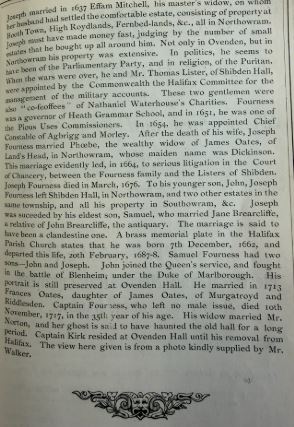
Joseph married in 1637 Effam Mitchell, the widow of his former master. The marriage brought him further connections, and he went on to acquire property, including an estate at Northowram. His position was no longer simply that of a tradesman. He had become a man of property and standing.
The seventeenth century was a turbulent period in England, and Halifax did not stand apart from the political and religious upheavals of the age. Joseph Fourness became involved in public affairs and was associated with the Parliamentary side during the Commonwealth period.
The surviving account records him among those entrusted with important local responsibilities, including the administration of military accounts.
Such appointments tell us something about his standing. Men chosen for these duties had to be trusted with money, property and authority at a time when the country itself was being reshaped.
Fourness was also connected with the administration of charitable institutions. He and other prominent Halifax men were appointed as co-feoffees of Nathaniel Waterhouse's charities, linking the family not only with political administration but with the charitable life of the town.
His interests extended into education too. He became governor of Heath Grammar School, another indication of the position the family had attained.A house at the centre of a changing landscape
It is easy today to look at an old house and see only its architecture.
But buildings such as Ovenden Hall were never simply buildings.
The people who lived in them bought land, married into other families, employed local craftsmen, traded in the town, served on committees, supported charities and took part in the arguments and political struggles of their time. Their influence spread well beyond the front door.
That is what makes the history of Ovenden Hall particularly interesting.
The Hall belonged to a period when Halifax was changing from a medieval market community into an increasingly prosperous centre of the Yorkshire textile trade. Wealth generated by wool and cloth was beginning to transform the landscape. Houses became larger. Families acquired land. Civic institutions became more important. Private fortunes began to leave a permanent mark on the town.
Ovenden Hall stood within that transformation.The memory of the old Hall
By the nineteenth century, the building had become an object of historical curiosity.
In June 1888, members of the Bradford Historical and Antiquarian Society visited Ovenden and inspected the old Hall. Their interest is significant. By then, buildings of its age were increasingly being recognised as physical evidence of a past that was disappearing rapidly.
The visitors were not simply looking at an old house. They were looking at the remains of another Halifax — a Halifax of family estates, cloth merchants, chapmen, substantial stone houses and long-established local connections.
The Hall's architecture reinforced that impression. Its mullioned windows and substantial proportions gave it the appearance of a house built to last, rather than a temporary expression of wealth.More than bricks and windows
The story of Ovenden Hall is ultimately the story of people.
It is the story of a family that rose through trade; of a man who moved from the world of cloth into property and public responsibility; of a community in which wealth, religion, politics, education and charity were closely connected.
It is also a reminder that Halifax's history was not made only in its mills and markets.
It was made in houses like Ovenden Hall.
Behind its windows lived people whose decisions could affect estates, businesses, charities and public affairs. Their fortunes were tied to the extraordinary growth of the district, and their names became part of the network of families that gave Halifax its character.
The old Hall therefore deserves to be remembered for more than its age.
It represents a moment when commercial success was becoming civic influence, when a cloth merchant could become a landowner and public figure, and when the fortunes of one family could become part of the wider story of a town.
Ovenden Hall was a house of stone.
But its real significance lies in the lives that passed through it — and in the Halifax they helped to build.
If you have enjoyed your visit to this website, please spread the word by clicking the 'like' and 'share' buttons below. Thank you