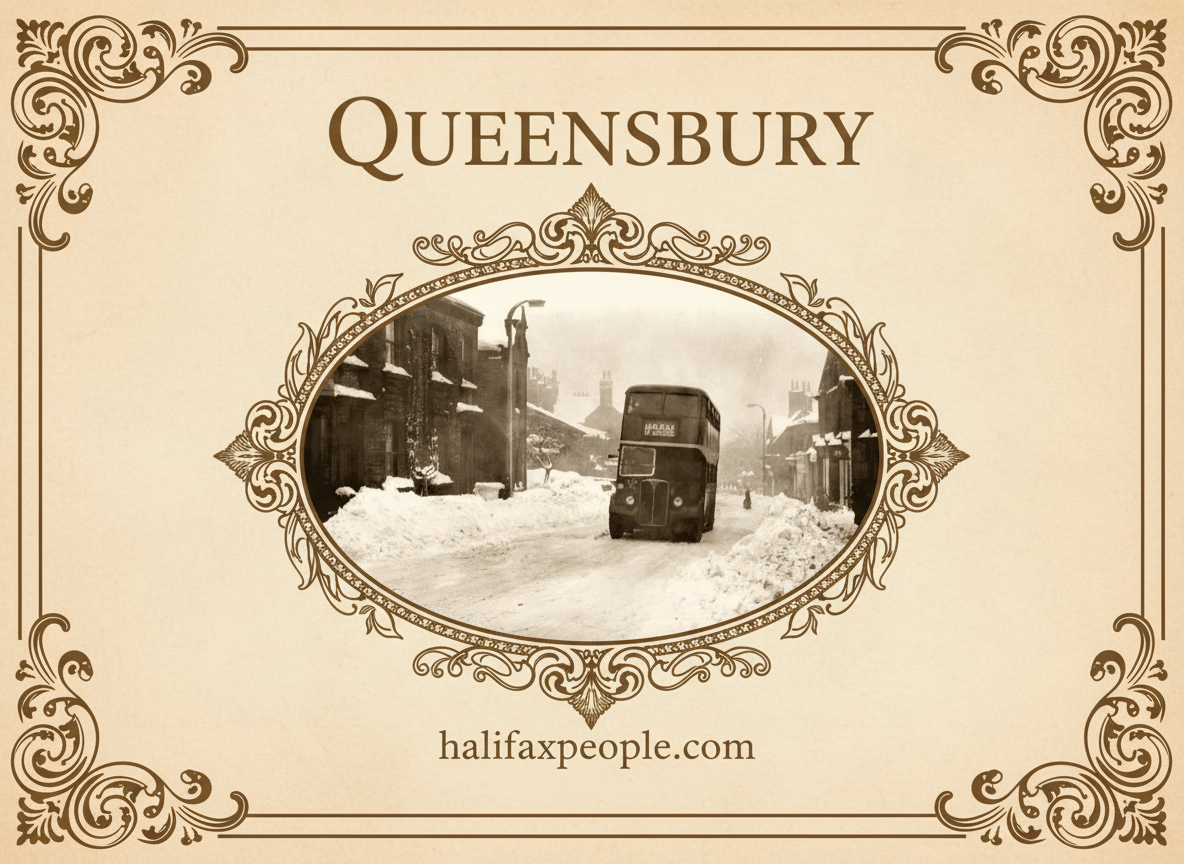
Queensbury Blog

WundaNumba 777-545 - What's behind your WundaNumba.com
Queensbury, Halifax and Bradford — Black Dyke Mills, the Lost Railway Junction and Victorian Village Life
Queensbury stands high on the hills between Halifax and Bradford, where exposed moorland once made permanent settlement difficult. The village began to take shape after the Bradford–Halifax turnpike opened in 1740, with the Queen’s Head coaching inn giving Queenshead its name. In the nineteenth century, textile entrepreneur John Foster and his family transformed the area through the expansion of Black Dyke Mills, workers’ housing and community buildings such as Victoria Hall, opened in 1891.
Queensbury also became home to one of Britain’s most unusual railway stations. Opened in 1879, its triangular layout connected lines towards Halifax, Bradford and Keighley. Trains approached through deep cuttings and long tunnels, including Queensbury Tunnel, which stretches for 2,501 yards beneath the village. Passenger services ended in 1955, leaving a remarkable industrial railway legacy in the surrounding landscape.
The village’s heritage is still visible in its Victorian streets, Holy Trinity Church, the former mill complex and the Black Dyke Band, founded in 1855 and closely associated with the Foster family and the mills.
 |
 Random Queensbury |
If you have enjoyed your visit to this website, please spread the word by clicking the 'like' and 'share' buttons below. Thank you