Sion School - Wade Street
Sion School - Wade Street
The Lost School Behind Halifax Bus Station
The Victorian Sunday School That Refused to Disappear
Thousands of people pass Halifax Bus Station every week, but how many notice the impressive Victorian stonework incorporated into its eastern entrance?
It is not part of the original bus station design. It is the surviving frontage of the former Sion Sunday School, a building that once stood alongside one of Halifax's most important Nonconformist chapels.
Its survival is a fascinating story of religious education, Victorian architecture, industrial reuse and the redevelopment of central Halifax.
A chapel for a growing congregation
The story begins with Sion Congregational Chapel in Wade Street.
The chapel was opened in 1819, having cost more than £6,000 to build. It was an impressive building with seating for more than 1,000 people and a schoolroom in its basement.
The congregation belonged to the Independent or Congregational tradition, an important part of Halifax's religious life during the nineteenth century.
As the congregation grew, so did the need for proper educational accommodation.
A separate school building was opened in January 1846. It became known as Sion or Syon School.
The school provided religious instruction for children connected with the congregation, at a time when Sunday schools played an important role in the education of working-class families.

The Jubilee Memorial of 1866
Twenty years after the school opened, a further building was added.
In 1866, the Jubilee Memorial Hall was constructed, commemorating the Sunday School's anniversary.
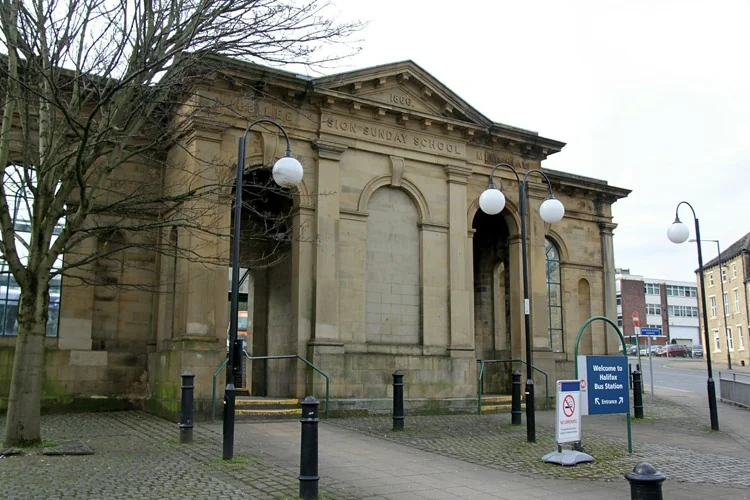
This is the structure whose impressive frontage survives today on the eastern side of Halifax Bus Station.
The design was very different from an ordinary school entrance. Constructed in fine ashlar stone, it featured classical Doric pilasters, a projecting central section and a triangular pediment.
The inscription beneath the pediment reads:
JUBILEE
SION SUNDAY SCHOOL
MEMORIAL
The date 1866 appears above it.
There are three round-arched openings, with the central one now blocked. On either side are round-arched windows and decorative niches.
It is an elegant piece of Victorian architecture, and one that deserves rather more attention than it receives.

David Livingstone's visit
One of the most interesting events associated with Syon Chapel was a visit by the famous Scottish missionary and explorer David Livingstone.
In 1857, Livingstone preached a sermon and delivered a lecture at the chapel.
Livingstone had returned to Britain after his celebrated African explorations, and his appearances attracted considerable public interest.
His visit provides a fascinating connection between this Halifax congregation and one of the most famous explorers of the Victorian age.

From Sunday school to industrial premises
The chapel and school continued for many years, but changing patterns of religious attendance eventually took their toll.
Both closed in 1959.
The former school buildings subsequently found industrial uses. By 1962–63, the site was recorded as being occupied by a works, and the buildings were later used as a warehouse.
The chapel itself also became associated with industrial occupation, including the firm Scipio Brook Limited.
The old religious complex was no longer serving the purpose for which it had been built.

The demolition – and the survival of the façade
During the 1980s, the area was redeveloped to make way for Halifax's new bus station.
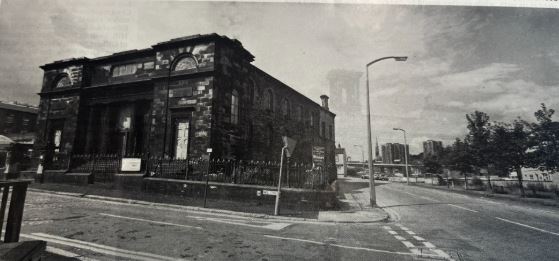
The former chapel and school buildings were dismantled and much of the site cleared. The school frontage, however, was retained and incorporated into the new development.
The bus station opened in 1989.
The surviving school façade had already been recognised for its architectural and historical importance. It was Grade II listed on 23 November 1973.
The decision to retain it meant that a visible reminder of the old religious complex survived the redevelopment.

enhanced
Two old façades in one modern building
There is another interesting detail.
The bus station also incorporates the frontage of the former Syon Congregational Chapel itself, which is on the Wade Street side.
This is a separate historic façade from the 1866 Sunday School frontage.
The chapel frontage dates from the early nineteenth century, while the school memorial frontage carries the date 1866.
Both were retained as part of the new bus station development, allowing two important pieces of Halifax's religious history to survive within a modern transport building.
A piece of Victorian Halifax hiding in plain sight
Today, the old Sunday School frontage is easily overlooked.
People arrive to catch buses, walk past the stonework and continue on their way, often unaware that the façade once welcomed children attending a Sunday school more than 150 years ago.
Its inscription remains, quietly recording the purpose for which it was built.
The next time you pass Halifax Bus Station, take a closer look at the eastern entrance.
Behind the modern transport facilities is a fragment of Victorian Halifax – a reminder of the thousands of children who attended Sunday school, the congregation that built it, and a religious community whose buildings once occupied this busy corner of town.
If you have enjoyed your visit to this website, please spread the word by clicking the 'like' and 'share' buttons below. Thank you