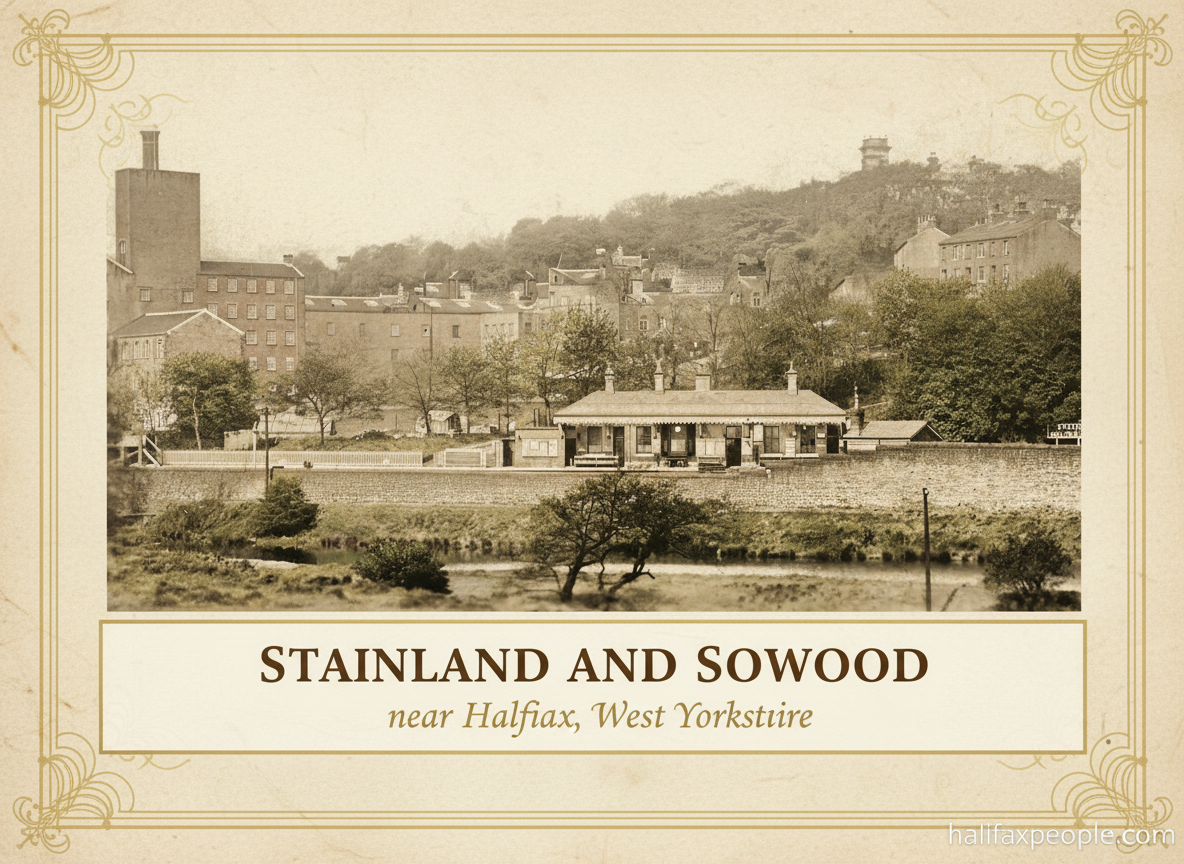
Stainland

Stainland, a village and a township which is bordered on the west by the township of Barkisland and adjoins Huddersfield on the southeast. The village of Holywell Green is in Stainland township where the Shaw family had a large textile mill complete with a branch railway line (now disused). Providence Congregational chapel now converted into flats had a large congregation and much of the graveyard still remains.

WundaNumba 777-545 - What's behind your WundaNumba.com
Stainland, Calderdale — Medieval Cross, Woollen Mills and the Old Hilltop Village
Stainland is a historic hilltop village south-west of Halifax, whose origins reach back to the Domesday Book of 1086, where it was recorded as Stanland. The name is derived from Old Norse and means “stony land”, reflecting the rugged landscape of the surrounding Pennine hills. The village developed along an old high-level route, where travellers could avoid the wetter valley bottoms. Its medieval past is still visible in Stainland Cross, a carved stone monument believed to date from the Middle Ages, now standing near St Andrew’s Church. The historic village green and surrounding lanes preserve the shape of an early settlement that grew around farming, local trade and the woollen-cloth industry.
For centuries, families in Stainland combined farming with textile production, particularly the spinning and weaving of woollen cloth. From the eighteenth century onwards, workshops, cottages and mills grew around the village and nearby streams, reflecting the wider industrial transformation of Calderdale. The historic Manor House, dated 1703, and the seventeenth-century buildings around the village offer glimpses of the area’s earlier prosperity. By the nineteenth century, Stainland had become a busy industrial community, with woollen, worsted, cotton, paper and pasteboard manufacturing recorded in the wider township. Chapels and schools served the growing population, while the nearby settlement of Holywell Green gradually expanded along Stainland Road until the two communities became joined by later development.
St Andrew’s Church is another key part of the village’s story. The building began as a chapel shared by different Christian congregations before becoming an Anglican church in the nineteenth century. Religious disagreements led some worshippers to establish separate chapels, reflecting the strong Nonconformist traditions found across the Calder Valley. Stainland also developed community institutions such as the Mechanics’ Institute, built by the Shaw family in the nineteenth century, and the former library, which continues to be associated with local community life. Today, Stainland combines its medieval origins and stone-built village centre with later industrial and residential development, while Stainland Cross, historic houses and former textile sites preserve reminders of its long past.
 |
 Random Stainland |
 Random Sowood |
 Stainland Mechanics Hall |
If you have enjoyed your visit to this website, please spread the word by clicking the 'like' and 'share' buttons below. Thank you