The Coiners of Cragg Vale
The dramatic true story of Halifax's most notorious criminal gang — counterfeiting, murder, and the hangings that followed

The Yellow Trade
In the steep-sided valley of Cragg Vale, five miles west of Halifax, a gang of counterfeiters ran one of the most audacious criminal operations in 18th century England.
They called it the "yellow trade." By the 1760s, several gangs across upper Calderdale were clipping and filing the edges from gold coins, melting the shavings, and hammering out counterfeit Portuguese moidores — foreign coins that were legal tender in England thanks to the Methuen Treaty of 1703.
The process was devastatingly simple. Using a metal cutter, the complete rim of a gold coin could be clipped off in two minutes. Two more minutes to file the edge smooth. Four minutes to hammer on a new rim and file new grooves. Ten minutes' work — and the original coin went back into circulation looking barely different, while the clippings were melted in a three-cornered pot over a fire and poured into moulds to make new coins.
The tools — hammers, metal cutters, files, a smelting pot and bellows — could pass as normal workshop equipment. The dies, engraved with coin designs, were the only items that couldn't be explained away. They had to be hidden fast — up the chimney, behind a loose stone in the wall, or under a flagstone.
It wasn't just a handful of criminals. A list drawn up at the time named about 80 suspected coiners: 30 from Cragg Vale, 20 from Sowerby, 15 from Halifax, seven from Wadsworth, and six from Warley and Midgley. A report noted that "almost every woolcomber in the north keeps a file for that purpose." Even Joseph Hanson, the Deputy Constable of Halifax and innkeeper of the Upper George Inn, was arrested on charges of coining in 1769.
King David
Their leader was David Hartley of Bell House, Erringden — the last house between valley and moor, impossible to approach without being seen. They called him "King David." He was the man with the hammer, striking the counterfeit coins. An informer once told of being invited to try his hand at striking a new coin, but failing to make a satisfactory one.
The dies were made by three engravers: Thomas Sunderland of Halifax, Joseph Shaw of Bradford, and a man named Lighthoulers. The surviving dies show no great skill — but the Coining Irons commanded huge prices. Joseph Shaw sold three pairs for nine pounds. At a time when the average weekly wage was below ten shillings, people expected to make very good profits indeed.
They chose Portuguese moidores for good reason. No moidores had been minted after 1722, so by the 1760s any genuine coin would be at least 40 years old. A little loss of shape or weight could be put down to age. Better still, the moidore had no 'head' — just geometric designs on both sides — making it easier for the engravers to copy. Even so, the crude workmanship of the coiners' copies was quite obvious. But they were accepted across the West Riding at their weight value of 27 shillings.
Murder on Bull Close Lane
The Government's attention was first drawn to Calderdale in 1767 when Daniel Greenwood, a Halifax man, was arrested in Hamburg for clipping Danish coins. HM Customs and Excise followed his trail back to the Calder Valley.
In September 1769, William Dighton, a government supervisor of taxes — an Excise Man — was sent to Halifax to investigate. Within weeks, several men from "coiners' country" had been arrested and taken to York Castle. His most important capture was David Hartley himself.
The coiners decided Dighton had to go.
It was about half past eleven on the night of Friday 10 November 1769. Two men crouched behind a wall in Bull Close Lane, about half a mile from the centre of Halifax. Each carried a pistol loaded with powder and a homemade lead bullet. It was the third night they had waited there.
They heard footsteps. A man came into view walking up from Halifax.
They waited until he came opposite them, then pulled the triggers. One gun misfired, but the lead bullet from the other hit the man in the left forehead and killed him. The gunmen climbed over the wall, went through his pockets, took anything of value, and departed — leaving the marks of their boots in the field, round the body, and even on his clothing.
The two men were Robert Thomas and Matthew Normanton. The dead man was William Dighton.
They walked across the fields to Gibbet Street, along the packhorse route to Highroad Well, Newlands, down to Luddenden, up to Midgley, and down again to Mytholmroyd, where they spent the night at the Dusty Miller Inn.
The real organiser of the murder was Isaac Hartley, brother of King David. It was Isaac who had promised £100 to anyone who would kill Dighton. It was Isaac who sent messengers to coining gangs across the West Riding and Lancashire, asking for contributions to the murder fund.

Bull Close Lane today
The Reckoning
The murder of a government officer forced London to act. The Marquis of Rockingham, Lord Lieutenant of the Riding, took charge. A meeting of the Nobility and Gentry of Halifax, Bradford, Leeds and Wakefield was held on 27 November 1769 — just 16 days after the killing. A reward of £100 was offered for information.
The informer James Broadbent, aged 33, a former soldier and charcoal burner's son, came forward. But the coiners got to him. They persuaded him his evidence was faulty, that Hartley and Jagger were innocent, and talked him into going to York to beg their forgiveness. He rode there on a little Galloway horse with his father and Isaac Hartley. David Hartley and Jagger, in York Castle, said they would forgive him — "if they were to be hanged the next Minute."
Broadbent tried to retract his evidence. But Justice Leedes insisted Mr Dighton should also be present — and before this could be arranged, Dighton had been murdered.
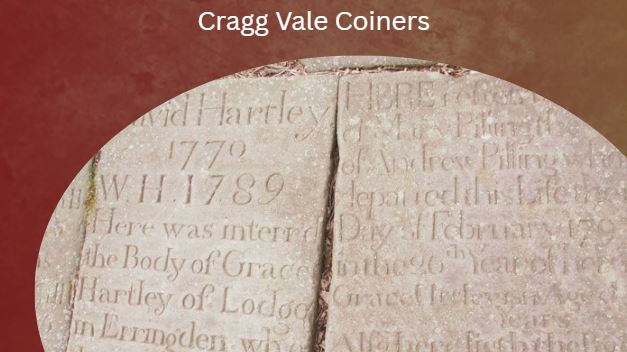
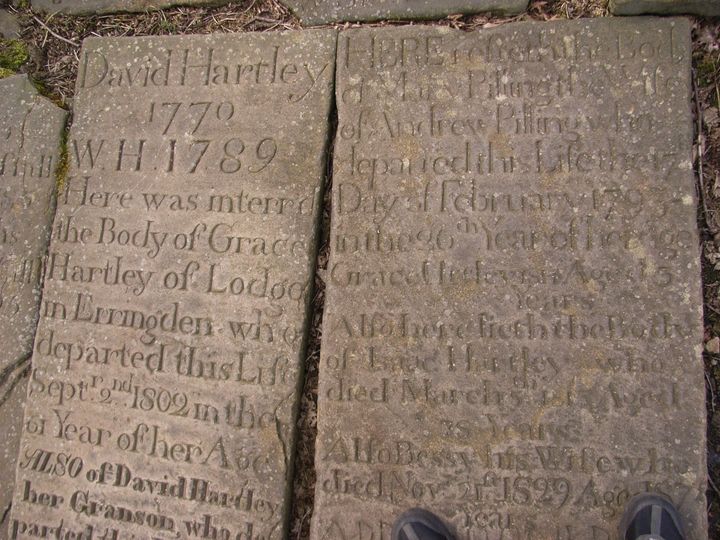
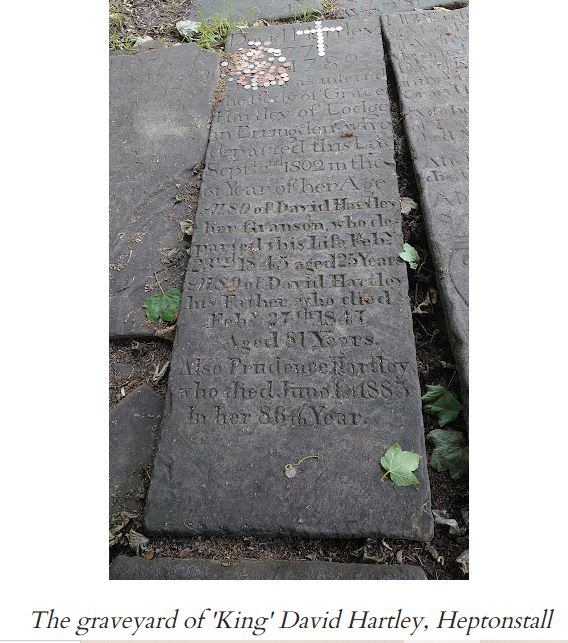
By Christmas 1769, about 30 coiners had been arrested. David Hartley was tried at the Spring Assizes, found guilty of counterfeiting, and hanged at Tyburn near York on 28 April 1770. His body was brought back to Heptonstall churchyard. The burial register records the cause of death as "hanged by the neck near York for illicitly cutting and stamping coins of the realm." His gravestone — 12 stones from the doorway of the old church and two stones down — bears the simple inscription: "David Hartley 1770."

The three men accused of Dighton's murder were found Not Guilty — the witnesses had changed their stories too many times. But justice caught up with them.
Robert Thomas was convicted of highway robbery and hanged on 6 August 1774 at York. His body was brought to Halifax and displayed on Beacon Hill in chains as a warning. The people of Halifax gathered on the hill to prevent it. To avoid a clash, the body was held at Birstall until nightfall, then hung up when the crowds had dispersed.
Matthew Normanton fled, hid in a barn at Spa Laithe, was caught, and hanged at York on 15 April 1775. Before the rope, he made a full confession. His body too was brought to Halifax to hang on Beacon Hill beside his accomplice.
Thomas Spencer, who had waited behind the wall on the first two nights but not the third, was hanged at Beacon Hill in August 1783 — not for the murder, but for leading the Corn Riots in Halifax.
Isaac Hartley, the man who planned it all, was never brought to justice. He died at White Lee, Mytholmroyd in 1815, aged 78.
In 1771, Abraham Ingham was overheard at the Union Cross in Heptonstall saying he knew who had murdered Dighton. The coiners threw him on the fire and poured burning coals down his breeches, killing him.
Of the rest of the gang, nothing is known. They faded into obscurity — hopefully to live honestly and die peacefully.
A Legacy in Stone and Iron
The original coiners' dies are in the Museum at Heptonstall, seven miles west of Halifax. A display case in the Hinchliffe Arms at Cragg Vale shows coins struck from the surviving dies by Eric J. Stenhouse of Cragg Vale. The original documents — the papers of Robert Parker, the Halifax attorney who handled the cases — are preserved in the Calderdale Archives Department.
It is estimated that nearly £3½ million worth of unlawfully diminished gold coin was eventually paid into the Bank at the Mint, reduced in value by around 9%.
Bell House still stands in Cragg Vale. Little has changed inside or out since David Hartley lived there more than 200 years ago.
A note to intending treasure seekers: all the buildings and surrounding land associated with the coiners have been thoroughly searched with metal detectors. Nothing has been found.


The tv dramatisation of the Cragg Vale Coiners
Explore More of Halifax
If you have enjoyed your visit to this website, please spread the word by clicking the 'like' and 'share' buttons below. Thank you