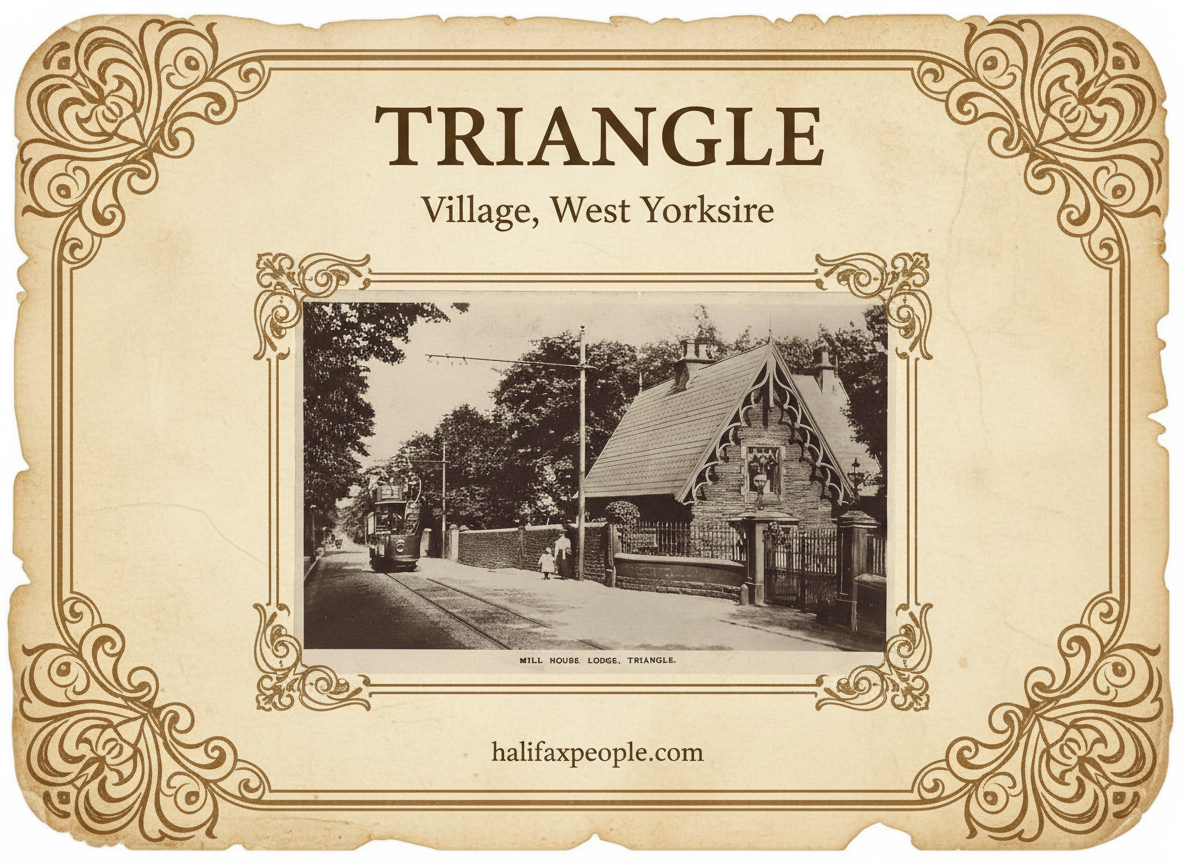
Triangle


WundaNumba 777-545 - What's behind your WundaNumba.com
Triangle, Calderdale — Mill Sisters, Stansfield Grange and the Old Turnpike Road
Triangle lies in the Ryburn Valley between Sowerby Bridge and Ripponden, along the route now followed by the A58. Although the village’s present-day character largely reflects 19th-century industrial growth, the surrounding valley had a much older tradition of farming and textile work. Before factories transformed the landscape, local families produced woollen cloth at home. Water-powered mills later developed beside the streams, helping turn Triangle into an important part of Calderdale’s textile industry.
One of the village’s best-known historic buildings is Stansfield Mill, which was operating by the early 19th century. The mill was associated with William Morris and Sons, whose textile business became part of the Illingworth Morris Group in 1921. The mill finally closed in 1977, marking the end of a long chapter in the village’s manufacturing history.
Nearby, Stansfield Grange provides a particularly interesting link to the people who worked in the mills. Known as the Lodge, Triangle, until 1900, the building was originally a millowner’s home. In 1921, it was converted into a hostel for around 100 women employed in the local textile factories. These workers, many recruited from outside the valley, shared accommodation and a social life away from their families. Their experiences were later documented in the Triangle Mill Sisters exhibition and accompanying book. The former Grange is now divided into private apartments.
Transport also shaped Triangle’s development. The turnpike road linked the village with neighbouring communities, while electric trams served the Sowerby Bridge–Triangle route from 1902 until 1938. Historic photographs show trams passing buildings such as Porter Lodge, offering a glimpse of everyday travel before buses and private cars became dominant.
Today, Triangle’s stone buildings and former mill sites preserve traces of its industrial past, while the story of the Mill Sisters adds a personal dimension to the village’s history.
Kebroyd, Calderdale — Silk Mills, a Millowner’s Hall and the Lost Industrial Village
Kebroyd is a small historic district in the Ryburn Valley, between Triangle and Ripponden, close to Sowerby Bridge. Its story is closely connected with the streams that powered its early mills and the textile families who built their businesses along the valley. The name includes the element royd, a local place-name element associated with a clearing. Calderdale’s wider settlement history records how woodland was cleared for farming, while many families combined agriculture with textile work.
By the 17th century, mills at Kebroyd were processing woollen cloth. The early complex included fulling mills, where woven cloth was cleaned and thickened, alongside a corn mill. In the 18th century, Samuel Hill acquired the estate and expanded its textile operations. The mills later turned to cotton spinning and, under subsequent owners, silk spinning. Their products included silk yarns for lace, velvet, plush and sewing silk, linking this small Calderdale settlement to wider textile markets.
Kebroyd was also home to Kebroyd Hall, a substantial house associated with Samuel Hill and his son Richard. Samuel acquired the estate in 1739 and built a grand residence for his son. The Hall later passed through several owners, including the Hadwen family, prominent local millowners. In 1918 it was sold to Sowerby Bridge Industrial Society; the historic building was subsequently divided into flats. Its surviving stonework offers a reminder of the wealth generated by the valley’s mills.
The industrial landscape suffered major losses in the 20th century. Kebroyd Mills were damaged by fire and later demolished, with the main mill complex lost in the 2000s. Some earlier buildings and traces of the water-management system remain in the wider area, while woodland footpaths follow the stream through the former industrial landscape.
Today, Kebroyd’s history is easiest to appreciate through its surviving houses, old mill sites and the wooded valley that once supplied power to its textile industry.
 |
 Random Triangle |
If you have enjoyed your visit to this website, please spread the word by clicking the 'like' and 'share' buttons below. Thank you