Warley Wells, Halifax:
The Wells That Gave a District Its Name

Warley has always had a slightly different feel to it — more open country than town, even when Halifax was spreading fast in every other direction. And tucked into that landscape is a place name that tells its own story: Warley Wells.
This article brings together a wonderful old photograph of Warley Wells and a set of newspaper cuttings that explain why the wells mattered, how they were used, and how they helped shape the identity of this part of Halifax.
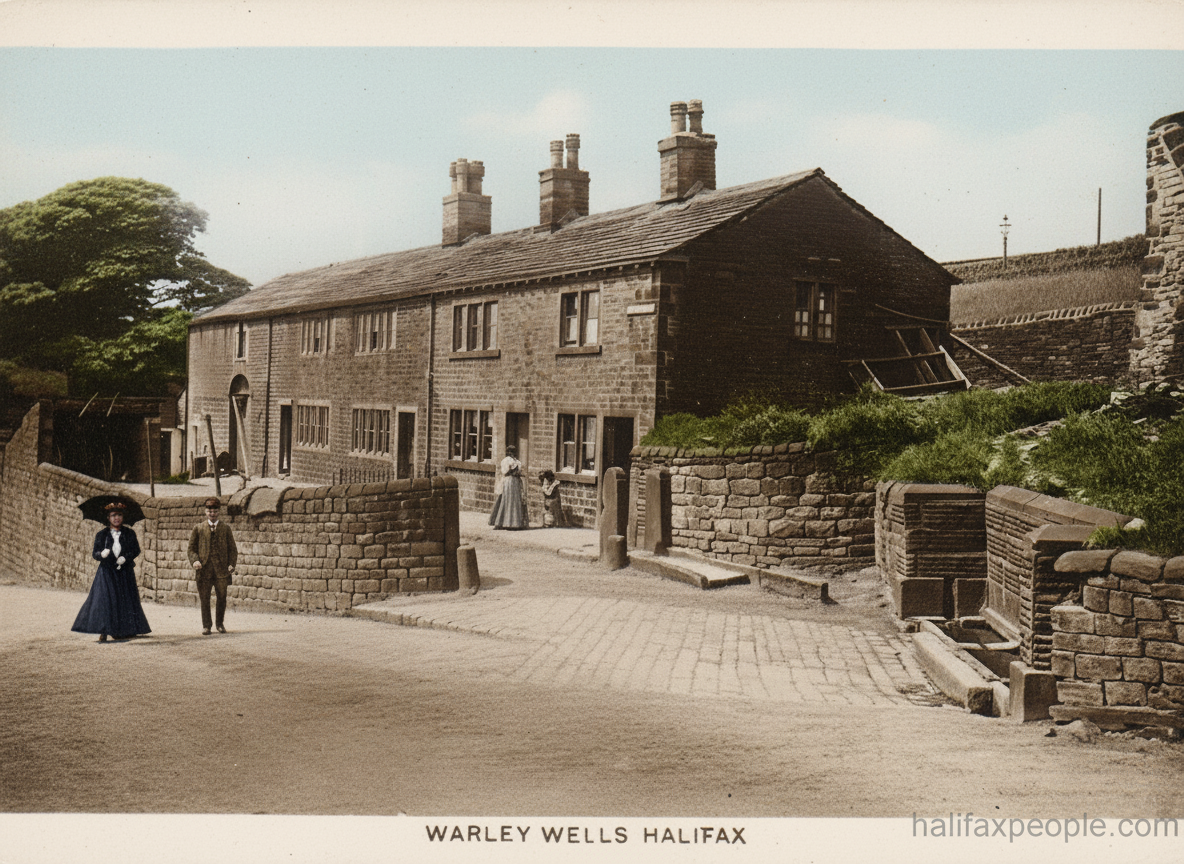
 The postcard view labelled “WARLEY WELLS, HALIFAX” shows a solid row of stone cottages, a walled lane, and the well structures in the foreground. It’s a calm, everyday scene — but it captures something important: this wasn’t a single “well”, but a small system that served the community. One of the cuttings introduces the photograph as a scene that would be familiar to many readers — a view “at the head of this column”, taken along the road to Warley, with a mention of Head-road and Stocks-lane, Warley. |
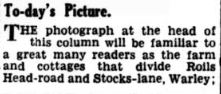  |
enhanced
That’s a big clue: these wells weren’t hidden away. They sat right on a route people used daily.
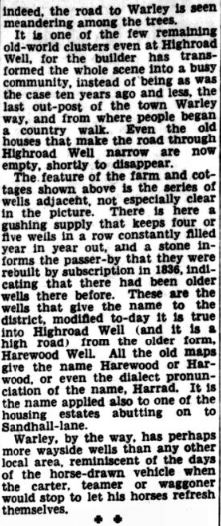
The longer cutting gives the key detail: there were several wells adjacent to the farm and cottages, and the supply was substantial.
It describes four or five wells that were “constantly filled year in year out”, and notes that a stone wall forms the passage between the wells and the fence wall.
That’s exactly the sort of detail you can match to the photo — the walls, the channelled space, and the practical layout built for everyday use.
A rebuild in 1836 — and a name that stuck
The cutting also says the wells were rebuilt by subscription in 1836, with the work carried out under the direction of the Rev. H. Thesea (as printed). And here’s the line that matters for local history: the wells gave their name to the district.
It also notes that the wells were known as “Highroad Well” and that the name appears on old maps as “Harewood Well”.
So you’ve got a place where the water source wasn’t just useful — it was important enough to become a map label, and then a district name.
Another great phrase in the cutting describes Warley as “the last out-post of the town”, with open country beyond. That’s a brilliant way to frame Warley historically — a boundary zone between Halifax’s urban growth and the older rural landscape.
It even suggests that in the days of horse-drawn travel, teamers or waggoners may have stopped here to let their horses refresh.
- Warley Wells consisted of multiple wells, not a single spring.
- The wells were reliable year-round.
- They were rebuilt in 1836 by public subscription.
- They were associated with the names Highroad Well and Harewood Well on older maps.
- The wells helped give the district name “Warley Wells”.
If you have enjoyed your visit to this website, please spread the word by clicking the 'like' and 'share' buttons below. Thank you