
WundaNumba 777-545 - What's behind your WundaNumba.com
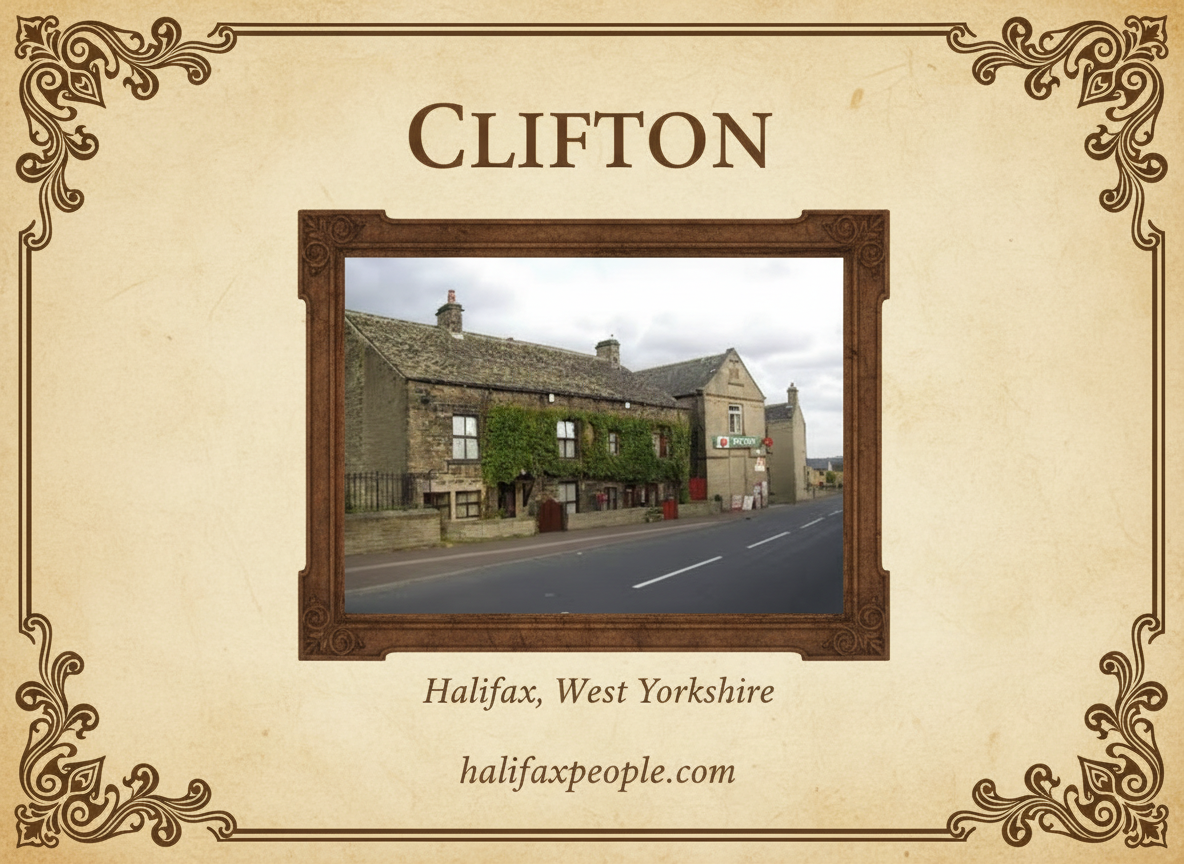
Clifton, near Brighouse — the story behind the photographs
Clifton is an ancient village east of Brighouse, standing on high ground above the River Calder. Its history reaches back at least to the Domesday Book of 1086, when the settlement was recorded in the survey of William the Conqueror. The name is generally understood to mean a farmstead on or near a steep bank, an apt description of the village’s position above the valley. For centuries, Clifton was part of the parish of Hartshead-cum-Clifton before becoming a separate ecclesiastical parish in 1887, with St John the Evangelist Church serving as its parish church.
The Armytage family and village landmarks
Clifton’s development was closely linked to the Armytage family, whose influence extended across the village and neighbouring estates for several centuries. After John Armytage acquired land associated with the former Kirklees Priory in 1565, the family gradually gained extensive holdings in Clifton and Hartshead. Members of the family supported local education and welfare, including a school with free places for village boys, almshouse provision and the building of St John’s Church and its school. Kirklees Hall, to the east of the village, remains an important part of the wider area’s historic landscape.
Old village photographs can help trace the history of landmarks such as Towngate, the former co-operative store and the village inns. A branch of the Brighouse District Industrial Society opened at Horsley Fold in 1874; the building’s gable carries the date 1882 and the co-operative beehive emblem. After the society moved out, the premises became a village shop and post office. The Black Bull at Towngate, meanwhile, closed as a pub in 1933 and became a farm. Such changes reveal how familiar village buildings were adapted as local needs evolved.
Coal mining, industry and the railway
Although Clifton retained its agricultural character, industry also shaped the surrounding countryside. Coal was collected from surface deposits from the medieval period, and mining expanded substantially from the 1840s. Several collieries operated in the district, and a remarkable feature of this industrial history was the Clifton colliery railway, constructed in 1834–35 by brothers Benjamin and Edmund Walker. The narrow-gauge line carried coal downhill towards the Brighouse canal basin, using rope haulage on parts of the route. It later connected with the Low Moor Iron Company’s tramway network and continued operating until 1928.
The steep road between Brighouse and Clifton Common also became part of the area’s transport story. The old toll bar near the top of the hill on the Leeds–Elland turnpike was discontinued in October 1878. The road’s gradient could be hazardous: on 16 October 1915, a motor bus travelling downhill lost control, killing three people and injuring others. The incident remains one of the most serious recorded events in the history of the route.
Village life and a changing landscape
Clifton’s history includes farming, local chapels, schools, village organisations and public houses, as well as its better-known industrial remains. A maypole stood in the village until the mid-nineteenth century, while cricket, brass-band and other community activities became part of local life. Clifton’s parish council was abolished in 1937, and the village became part of the Borough of Brighouse; since local government reorganisation in 1974, it has formed part of Calderdale.
Clifton’s story is therefore one of continuity as well as change. Its old farms and village buildings recall its agricultural origins, while the surviving evidence of mining, transport and the Armytage family’s influence reveals how a rural settlement became connected to the wider industrial life of West Yorkshire. Historic photographs help bring these layers together, preserving details of streets, buildings and community life that might otherwise be overlooked.
 |
 Random Clifton |
 Clifton Airport |
 |
If you have enjoyed your visit to this website, please spread the word by clicking the 'like' and 'share' buttons below. Thank you