Elland - Huddersfield Road
Elland - Huddersfield Road
Briggate


This will be the start of Briggate, before it turns into Huddersfield Road and then Ainleys as we continue along this main road.


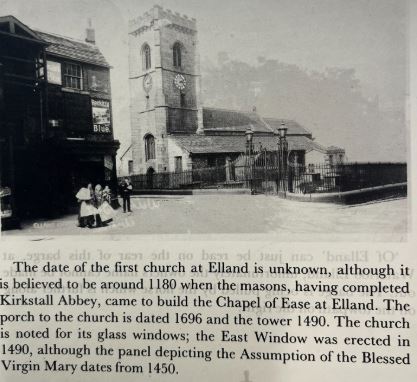
Huddersfield Road

Looking towards Briggate from Huddersfield Road
Briggate and the Changing Roads into Elland
The present Huddersfield Road changed the way people approached Elland. The older town had developed around The Cross, where four principal roads met: Northgate, Westgate, Southgate and the route towards South Lane. Southgate continued towards South Lane and Upper Edge, forming part of the older route in the direction of Huddersfield.
When the newer road through Briggate and Castlegate was constructed, through traffic could pass the old centre more easily. This altered the importance of the medieval street pattern and helped create the different character of the town's newer road frontage.
The development of turnpikes during the eighteenth century and improvements to road transport encouraged this change. Elland's street layout therefore preserves two stages of its history: the older settlement clustered around The Cross, and the later roads which brought traffic and commercial development along the valley.


Elland Wesleyan Chapel (seen in the distance)
Elland's Wesleyan Methodists built a substantial chapel on Huddersfield Road in the early nineteenth century. The building was erected in 1807 and opened on 4 October 1808, with accommodation for around 600 people. It became popularly known as Dog Lane Chapel and was an important centre of Methodist worship in the town.
The chapel was altered in 1860, when a schoolroom was added. As the congregation continued to grow, the original building was eventually replaced by a much larger chapel. Its memorial stones were laid in August 1891, and the new building opened on 4 October 1892. Designed by Waddington's of Manchester and Burnley, it could accommodate about 750 worshippers and included galleries on three sides.
The later chapel closed in 1974, and the congregation subsequently became part of the Methodist community at Southgate. The earlier chapel and its successor illustrate the growth of Methodism in Elland during the nineteenth century.
Providence Congregational Chapel (centre on right)
The original Providence Congregational Chapel on Huddersfield Road dates from 1822. The foundation stone was laid in August of that year, and the chapel opened on 9 July 1823, with room for approximately 350 worshippers. It served a growing Congregational community which had first been meeting in a hired room in New Street.
As the congregation expanded, a larger church was built on the adjoining Brook Street site in the 1880s. The original Huddersfield Road chapel then became the Sunday School. The older building is particularly interesting because it retains features of its early nineteenth-century interior, including its gallery and box pews. Its forecourt is paved with old gravestones, reminders of the families associated with the congregation.
The building has had several later uses, but in 2025 it returned to worship as Elland Christian Centre. It is Grade II listed.


Commercial Mills: These stood between Southgate and Huddersfield Road. The six-storey mill was occupied by Daniel Tetlaw & Son in 1878 and Thomas Casson & Brother in 1905. It was demolished during the town-centre redevelopment of the 1960s, and flats were built on the site.

Elland Octave Club in between Casson Place and Timber Street
The Elland Octave Club
The Elland Octave Club stood between Casson Place and Timber Street, close to Huddersfield Road. It was an established local social organisation by the beginning of the twentieth century: the club is recorded in 1905, and in 1917 James Hawkyard was its secretary. Shaw Mackrell had been caretaker around 1916.
The club's name and its position among the streets and workplaces of Elland are a reminder of the social life that developed alongside the town's mills and commercial businesses. Clubs such as this provided organised meeting places for local people, although further details of the Octave Club's activities and membership would need contemporary records before they could be described more fully.

The Temperance Methodist congregation arose from a disagreement within Elland's Methodist community in 1871 over the question of total abstinence. Those who favoured a stricter temperance position separated from the congregation at Elland Wesley and established their own place of worship.
For a time, services were held in Cocker's Warehouse on Briggate. A purpose-built chapel followed in Temperance Street. Its date stone records 1875, and it opened in 1876, with seating for approximately 272 people. Among those associated with its establishment were Edwin Iredale, Joseph Peel and Samuel Warrington.
The chapel had its own pipe organ, donated by Edwin Thornton, which had previously been at Oliver Hall in Elland. The congregation eventually joined St Paul's Church in 1962. The former chapel survives as the Cartwheel Centre, and although Temperance Street has disappeared, its name can still be found on a surviving street sign.


Elland's Victoria Swimming Baths
Elland's Victoria Swimming Baths were built in 1901 and opened on 22 November 1902 by Councillor W.H. Eastwood. The £6,300 building provided much more than a swimming pool. Its facilities included a bath measuring 75 feet by 25 feet, 33 dressing boxes, slipper baths for men and women, and Turkish, Russian and vapour baths.
A drinking fountain on the outside wall commemorates Sergeant Joshua Hemingway, who volunteered for service in the Boer War and was killed there. The baths became an important public amenity for the town, although they have since closed.

 |
 |
Elland Town Hall
The imposing building at the junction of Huddersfield Road and Southgate was opened on 19 September 1888 by Sir John Savile. Designed by Halifax architect C.F.L. Horsfall, it was built in a Palladian style at a cost of £7,000. Its foundation stones had been laid on 21 June 1887.
Despite its familiar name, the building was originally intended as a public hall rather than a municipal town hall. The main assembly hall and balcony could accommodate around 1,000 people, making it an important venue for concerts, public meetings and other large gatherings.
A clock was added to the tower in 1909. It was presented by Lewis Mackrell in memory of his father, James, and began keeping time on 8 June that year. The building later became the Town Hall Cinema, renamed the Palladium in 1920. After the cinema closed in 1959, it was used as a bingo hall and subsequently a snooker club. A serious fire in 1994 caused considerable damage.
The Grade II listed building remains one of the most distinctive landmarks at the entrance to Elland town centre.


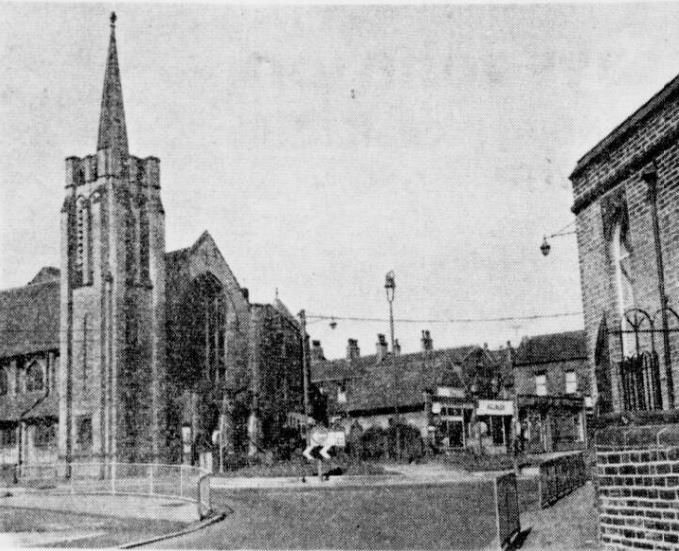
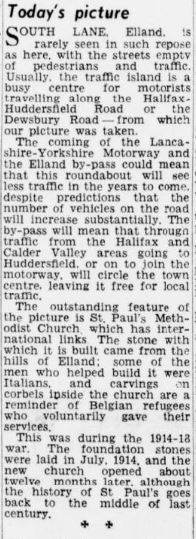
Southgate Methodist Church: The present church was opened as St Paul's in June 1915. Its origins go back to a group of Wesleyan Reformers who broke away in 1850 and initially met in a room at Joshua Dodgson's dyeworks. Their first chapel, at Central Hall on Coronation Street, opened in 1855.

 |
 |

The Town Room and Elland's Local Government
Before the present Town Hall was built, Elland had a much smaller public building known as the Town Room. It stood at South End, near the junction of Dewsbury Road and Huddersfield Road, and was completed in 1821. It served several purposes, including use as a lock-up and as an office for parish officials.
When Elland's Local Board of Health was established in 1852, the Town Room became its regular meeting place. The first meeting of the Board was held there on 6 October 1853. The Board was responsible for local improvements and public health matters during a period when Elland was expanding rapidly through industrial growth.
The building later served as a tram and bus shelter and became the town's first public library. It was demolished in 1963. The stocks which had stood outside were transferred to the gardens of South House, the former council offices.
The Town Room was a modest building, but it played an important part in Elland's development from an old market town into a growing industrial community with its own local administration.
 |
 |


 |
 |


Zion Church, Catherine Street
Zion Primitive Methodist Church: Records a foundation-stone ceremony on Catherine Street on 2 April 1864, conducted by the Rev John Simpson. The church was recorded in 1905 and 1915, but its later closure and demolition dates are uncertain.


Pendleton Mill
Pendleton Mill stood on James Street and was a cotton mill. Its history is recorded through a succession of owners and tenants, including Jonathan Bottomley and partners in the 1870s, Farrar & Company in the 1880s, Sutcliffe Brothers in 1891, and M. Akroyd & Sons in 1896 and 1905.
Later occupants included Jonathan Illingworth and Henry Illingworth & Sons, whose connection with the mill continued into the twentieth century.
The mill was still part of Elland's industrial landscape when it was advertised for sale in October 1910, alongside South Lane Mills. The sale particulars describe its buildings, boiler and engine houses, chimney and a substantial steam engine. This gives a glimpse of the machinery and infrastructure required to keep a large cotton mill operating.
Elland Working Men's Club
Before moving to its present site in Rosebery Street, Elland Working Men's Club occupied less commodious premises on Huddersfield Road. In July 1927 a new club building was opened by Councillor Fred Holroyd. Designed by Exley Fisher, architect to Elland District Council, it cost about £3,000, excluding the boundary wall and furnishings.
The new building was designed to provide a range of facilities. The basement contained beer and spirit stores and heating equipment, while the ground floor included a billiards room, committee room, conversation room, ladies' room, kitchen and bar. Plans were also made for bowling greens and tennis courts.
At the opening, Councillor Lumb praised the decision to include women in the club's membership, noting the growing role of women in public and local government. The move marked a new chapter in the club's history, replacing its earlier Huddersfield Road accommodation with a purpose-designed social centre.


South Lane – the Old Road to Huddersfield
Before the present Huddersfield Road was constructed, South Lane formed the main route from Elland towards Huddersfield. It was part of the older road system which connected the town with the settlements on the higher ground to the south.
The construction of the newer road changed the pattern of traffic through Elland. The old route remained in use, but its role as the principal through-road diminished. South Lane is still notable for its surviving nineteenth-century industrial buildings and stone cottages, which preserve something of the appearance of this earlier approach to the town.

The Cottages at 72–74 South Lane
The old stone cottages at 72–74 South Lane are part of the surviving domestic architecture associated with this former industrial street. They stand within an area where workers' homes and larger mill buildings developed close together.
The wider South Lane and James Street area is recognised in Calderdale's conservation appraisal for its tightly grouped historic industrial buildings. Many were built directly against the pavement, in local stone, and some retain original windows and loading doors.
The cottages and workshops together help illustrate how closely everyday housing and textile production were woven into the same streetscape in nineteenth-century Elland.

South Lane Mills
South Lane developed as an industrial street, with mills and workshops among its buildings. Trade directories record a succession of textile manufacturers and mill occupiers here during the late nineteenth and early twentieth centuries.
Among those recorded were J. & J. Farrar in 1885, Joseph Iredale, Uriah Kaye, Benjamin Kaye and William Dyson in 1905, together with businesses associated with the Peel family. Hanson Lee & Sons were recorded in 1910.
An advertisement in the Yorkshire Post on 29 October 1910 offered South Lane Mills for sale. The property included one- and two-storey buildings and a weaving shed. The sale gives an indication of the scale and variety of the industrial premises which once lined this part of Elland.
 72-74 South Lane |
 |

Smithfield Road
Smithfield Mill
Smithfield Mill was a cotton mill on South Lane. It appears on the Ordnance Survey mapping of the late nineteenth century, although it is not shown on the earlier mapping examined in a modern heritage assessment.
Thomas Whiteley & Sons were recorded as cotton spinners and doublers at Smithfield Mill in 1905. The Whiteley family had other connections with Elland's textile industry, and members of the family lived at Smithfield House.
The mill is a reminder that cotton spinning and doubling formed an important part of Elland's industrial economy alongside its better-known woollen and worsted trades.
Elland Pipe Works
Elland Pipe Works stood on South Lane and is recorded in local industrial directories in 1905, when Victor A. Day was listed as an occupier. The works formed part of the varied industrial activity which took place in this part of the town, alongside the cotton mills, weaving premises and engineering businesses.
The surviving record is brief, so it is safer not to attribute particular products, manufacturing methods or a precise opening date to the works without further evidence. Its listing nevertheless adds another name to the range of small and medium-sized industries which once operated along South Lane.


If you have enjoyed your visit to this website, please spread the word by clicking the 'like' and 'share' buttons below. Thank you