Only dates listed in the published-editions
register are offered as Chronicle links.
More dates can be added to the register
as your archive grows.
🎩 Harry's Parting Words
"And there we have it, my friends!
A little news, a little history,
a dash of Yorkshire weather and
another good reason to return
to Halifax tomorrow.
Until our next edition,
keep your curiosity polished
and your walking boots ready!"
1st January
GRAND OPENING OF HALIFAX PIECE HALL
Friday, 1 January 1779 — A magnificent New Year's Day celebration marks a new chapter in the town's cloth trade.
Halifax welcomed the New Year of 1779 with the grand opening of its impressive new Piece Hall, built to serve the district's flourishing woollen industry.
Crowds gathered from Halifax and the surrounding townships to witness the occasion, which marked the completion of one of the town's most ambitious commercial buildings.
The celebrations began with the ceremonial opening of the North Gate using a silver key. A procession of local tradesmen, accompanied by bands of music, then made its way through the streets.
The Piece Hall, Halifax
The festivities continued into the evening with a spectacular firework display arranged by Signor Pietro.
The Piece Hall had been built to provide a central marketplace for the sale of pieces of handwoven woollen cloth produced in homes and workshops throughout the district.
John Caygill, a prominent Halifax businessman, had agreed to lease the land to local merchants and manufacturers for five shillings a year, under an extraordinary 5,000-year arrangement.
Although the official opening took place on New Year's Day, the first regular cloth market was held the following morning, Saturday, 2 January.
The Piece Hall courtyard
The building would go on to become one of Halifax's most recognisable landmarks, surviving long after the original cloth trade had disappeared.
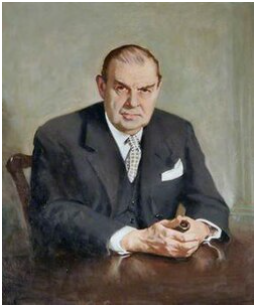
SIR HAROLD MACKINTOSH NAMED IN NEW YEAR'S HONOURS
1 January 1948 — Halifax confectionery manufacturer selected for a peerage.
In the New Year's Honours, Halifax has cause to mark a distinction of no small significance. Sir Harold Mackintosh has been created a peer, and has taken the title of Lord Mackintosh of Halifax. The announcement places a familiar local name within the upper chamber of the realm, and will be received in the town with keen interest and no little pride.
The Mackintosh name is long associated with Halifax enterprise and the wider commercial life of the district. In an age when industry and public service are increasingly entwined, such honours are commonly read not merely as personal advancement, but as recognition of the standing of a firm, a family, and the community from which they spring.
It is fitting, too, that the title should carry the town's name. Halifax, built of enduring stone and sustained by enduring labour, has for generations sent its cloth, its goods, and its people far beyond the borough boundaries. To see "of Halifax" appended to a peerage is to see the town itself acknowledged in the language of the nation's formal honours.
Sir Harold, who took charge of the confectionery business upon his father John's death in 1920, has since overseen its expansion into one of Britain's foremost chocolate and toffee manufacturers. The company, floated as John Mackintosh & Sons Ltd in March 1921, has grown to employ hundreds and to command respect in markets across the Commonwealth and beyond.
SEVENTY-EIGHT WOUNDED SERVICEMEN ARRIVE IN HALIFAX
Saturday, 1 January 1916 — A wartime convoy reaches the town on New Year's Day.
The people of Halifax entered 1916 with another reminder of the terrible human cost of the First World War.
On Saturday, 1 January, a convoy carrying 78 wounded servicemen arrived in the town.
The arrival was recorded in the historical calendar of the Halifax Evening Courier.
Halifax wartime hospital
By this stage of the war, Halifax and the surrounding district were involved in caring for wounded soldiers, with local hospitals and auxiliary facilities providing treatment and accommodation.
Medical staff and volunteers played an important part in supporting the men who arrived for care.
The surviving calendar entry does not identify the soldiers, their injuries or the hospital to which this particular convoy was taken.
The arrival of 78 wounded men on the first day of the year was a sombre reminder that the war continued, despite the turning of the calendar.
Copyright - On this subject which can be a bit of a mine-field I would like to state that I have not knowingly breeched any copyright and if found that I have I will be happy to discuss the issue with the owner hopefully to come to a happy solution and if this is not possible I will immediately remove any offending material.