Historic Claremount Page 2
Historic Claremount Page 2

Claremont — Once Known as Beaumont Town
Just over a century ago, the district we now call Claremount was known as Beaumont Town, named after George Beaumont, the man who built much of the property there. The name officially changed to Claremont on October 13, 1864, marking a new chapter in the area’s history.
George Beaumont was a native of Morpeth, Northumberland, and at one time served as minister of Salem Methodist Church, Halifax. Later, he entered the worsted trade, becoming a respected figure in local industry and civic life. He sat on Halifax Town Council for three years and was among the borough’s first magistrates — a man whose influence helped shape the community that still bears traces of his legacy.


St Thomas Street looking south past the Claremount Tavern and on the right is St Thomas Church schoolroom

Dover Street 1967 (no's 12-2)

Dover Street 1967 (no's 11-1)

Earl Street W.C's and middens 1967

Brown Street

St Luke's Street with St Thomas's at the bottom

Gable end of St Luke's Street. W.C's middens etc. Horley Green Road in the distance
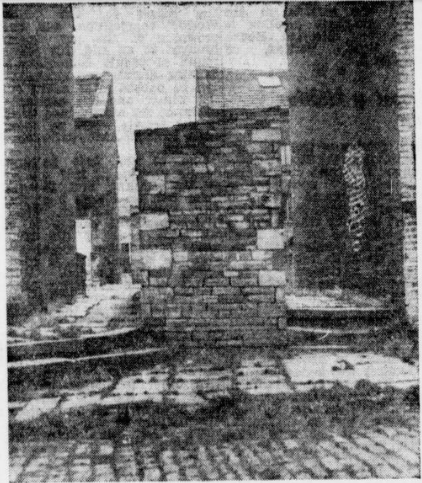
St.Luke's Street

St Luke's Street 1967 (no's 18-2)

Sanderson Street 1967 (no's 4 & 2)

Sanderson Street 1967 (no's 13-1)

Walshaw Street, south side. Sheds, WC's, garages etc 1967

Walshaw Street 1967 (no's 1-3)

St Thomas Street looking North as far as George Swift premises 1967 (no's 20-24)

Sanderson Street 1967 (no's 29-15)

Sanderson Street pens, sheds and garages, south side, 1967

Dover Street 1967 (no's 28-14)

Cross Street looking north past Claremount Fisheries 1967

View south along Cross Street and showing gable ends of Parker Street, Neville Street, St Marks Street and Sanderson Street 1967
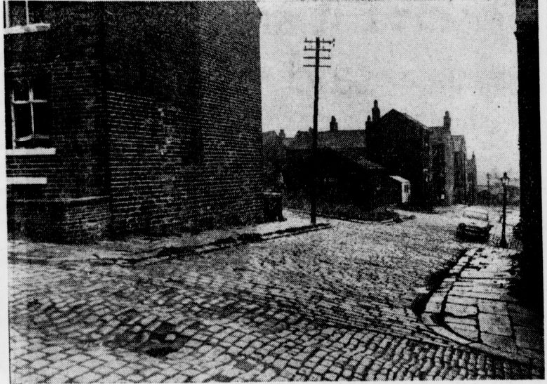
Cross Street

Parker Street towards Cross Street 1967


Neville Street middens and WC's 1967

North side of Hollin Street, Upper Horley Green looking east 1967

South side of Hollin Street looking West 1967

South side of Hollin Street looking West 1967

South side of Hollin Street looking West 1967

South side of Hollin Street looking West 1967

Back to the "Beacon" which was closed in 1968 and no's 4-14 St Thomas Street 1967.
-
Now we shall head right towards Horley Green

Beacon Terrace during demolition (no's 1-9)

Salubrity Street right side from Primrose Street 1967

Sarah Street from Primrose Street

Salubrity Street left side from Primrose Street

Salubrity Street right side from Primrose Street


Union Court left side from Cowper Street

Freedom Court from Cowper Street

Horley Green Road looking north-east 1967

Camden Street from Horley Green Road 1967

Corner of Horley Green Road and Belmont Street


Green Street from Horley Street

Sour Milk Hall, 14/16 Horley Green Road/Miles Street, closed in 1960 and was demolished in 1976


Belmont Street facing north from Horley Green Road

Miles Street from Horley Green Road. Claremount Post Office 1967


Horley Green Mills, Standeven & Co Ltd 1967

Primrose Street from Lily Street. Claremount Liberal Club 1967

Alma Road from Primrose Street

Dale Street from Primrose Street

Belgrave Street left side from Horley Green Road

Belgrave Street right side from Horley Green Road

Horley Green Road from corner of Gadd Street

Gadd Street from Horley Green Road

Claremount House 1967
Horley Green Villa


Horley Green Villa — From Mill Owner’s Home to Wartime Refuge
Looking across Godley Cutting from the Southowram side, the large house that dominates the view is Horley Green Villa. Like Eastfield, a similar residence just fifty yards away, it stands on land once part of the farmlands of South Wood Hall. This southern section wasn’t developed until around 1858, marking the beginning of Horley Green’s transformation.
An early resident was Mr. John Gardiner, who partnered with Mr. Samuel Illingworth in a carpet‑manufacturing business at a nearby mill. In the early 20th century, the villa was occupied by Roman Catholics and served as a nunnery. During the Second World War, it housed evacuees, and afterward was converted into two self‑contained flats.
Godley Cutting, which breaks the natural line of Beacon Hill with Horley Green, was created in 1830. The excavated earth was used to fill the valley below, completing the road to Stump Cross — a feat of early engineering that reshaped the landscape around these historic homes.

Henry Court west side from Havelock Street (no's 1-3)

Henry Court east side from Havelock street (no's 2-6)

Oates Court west side from Havelock Street 1967
Oates and Green

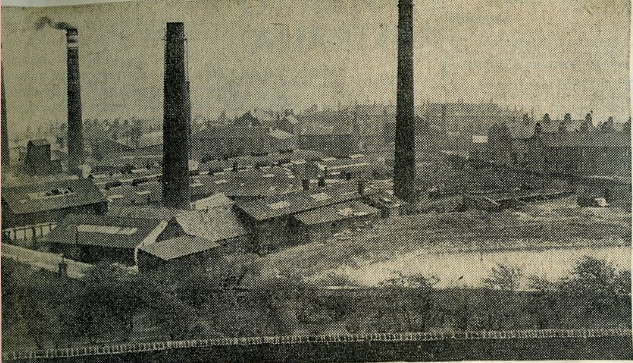
Claremount — The Industrial Shoulder of Halifax
Though Claremount may not boast great beauty, this exposed hillside of Halifax has long been a hub of industry. Dominating the skyline are the chimneys of Oates and Green Ltd., manufacturers of sanitary and fireclay pipes at Horley Green Works, whose products were once shipped across the world.
The original photograph was taken from Hollin Grove, one of the highest vantage points in the district, not far from High Sunderland. In the foreground lies a small section of Claremount Park, where trees planted years ago include a palm that still blooms regularly — a curious touch of the exotic amid Yorkshire stone.
Below, the dam supplies water to Horley Green Works, while Horley Green Road runs to the left of the scene. In the distance, the roof of the Methodist Chapel can be seen — a reminder that even in Halifax’s most industrious corners, faith and community stood side by side with the smoke and sound of progress.


Gable ends of West Field Court, Ashfield Court, Henry Court and Oates Court. These were built on the north side of Havelock Street 1967

Horley Green Road looking south towards Camm Cottage

Camm Cottage, Horley Green Road

Horley Green Road looking south from Camm Cottage 1967

Horley Green Dam

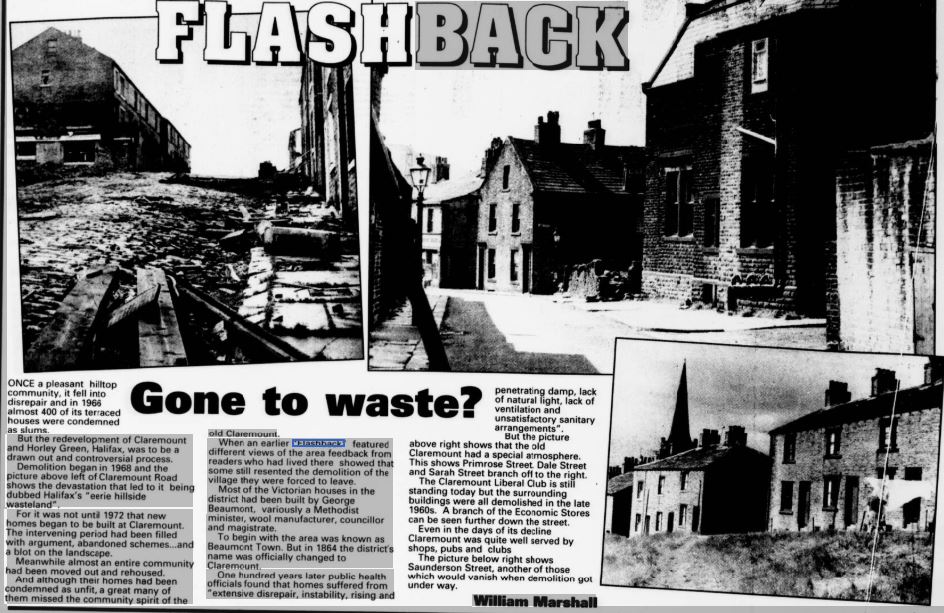

View of Range Bank, Ellen Royd and Haley Hill from Claremount Road. 1930's
(Yorkshire Post)

See High Sunderland
Return to Historic Claremount
If you have enjoyed your visit to this website, please spread the word by clicking the 'like' and 'share' buttons below. Thank you