Historic Claremount
Historic Claremount Tour starts at North Bridge, and climbs New Bank towards Godley. Then we go from Godley Bridge to Claremount Road. After Claremount Road we come back to Godley and go round the back road to Horley Green.
How Claremount got its name
The district has not always been known as Claremount. Earlier names included Blackcar and Beaumont Town. In October 1864, a meeting chaired by Thomas Parker decided that Beaumont Town should be renamed Claremont. It was also agreed that a large sign bearing the new name should be erected at the top of New Bank. Over time, the spelling evolved into the Claremount used today.
The change of name came as the district was developing into a distinct residential neighbourhood, close to the expanding industries of the Hebble Valley.

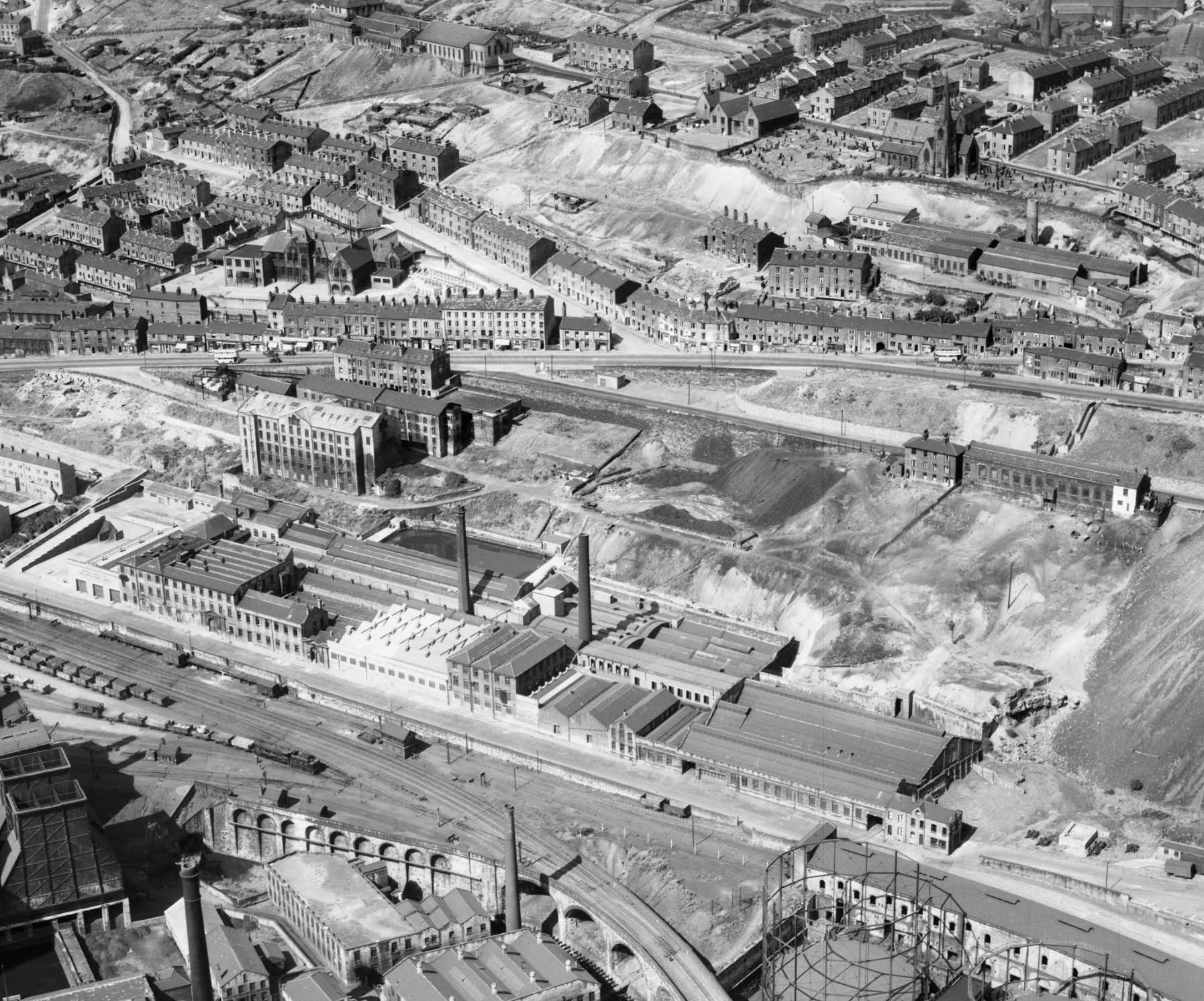
Looking up towards Claremount from Dean Clough


In the distance was Claremount (taken before Burdock Way was built)

Looking at Godley from Beacon Hill Road

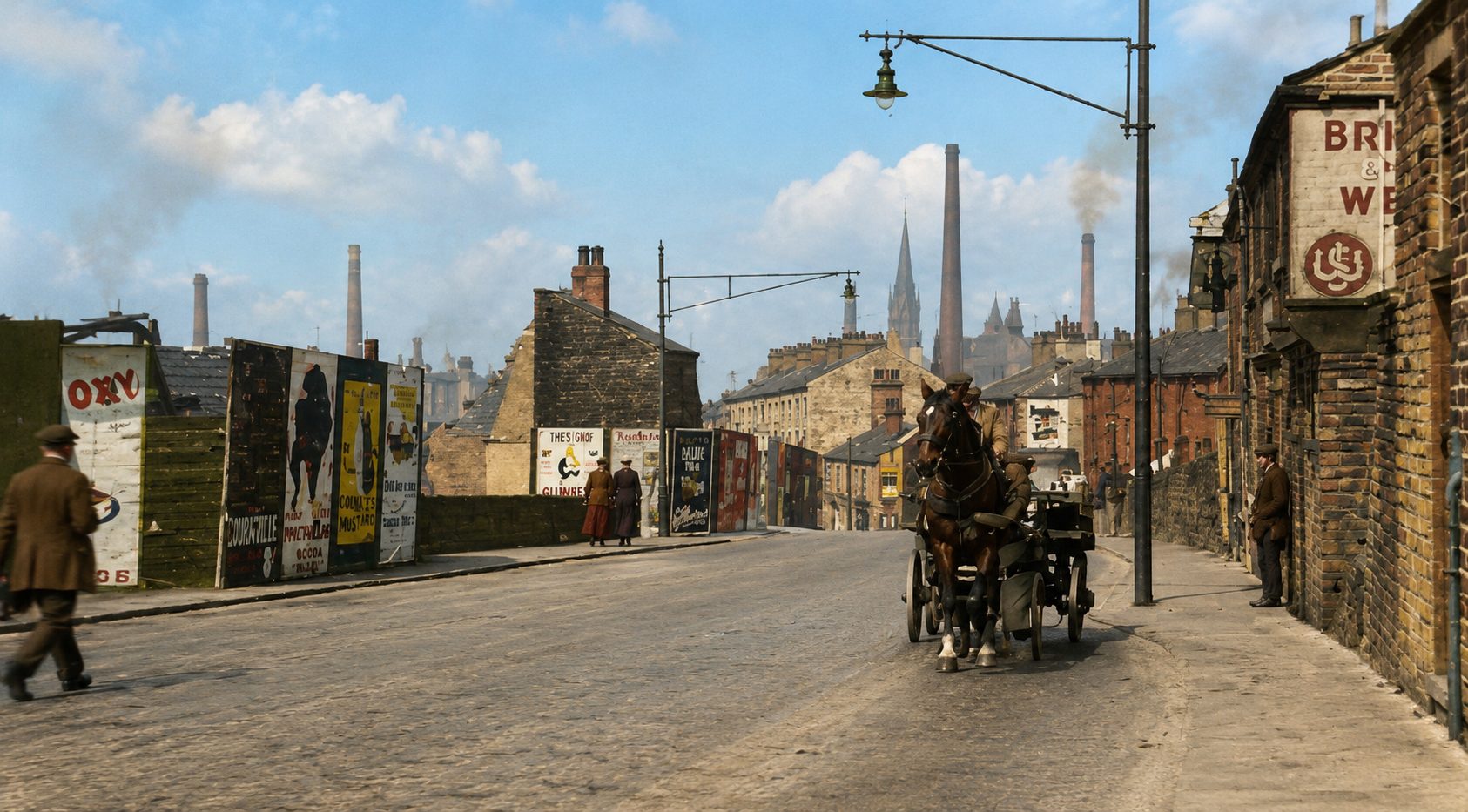
As we come along North Bridge the sights facing us were grim.

Horse drawn traffic on North Bridge c1910. The ornate, overhead ironwork was holding up the tram lines. The first tram route across the bridge was Route no.8 Halifax to Boothtown in 1899. The route from Halifax to Stump Cross no.3 commenced in 1900. This route was impassable until the completion of the iron bridge across the godley cutting in 1900.


After crossing North Bridge we arrive with this view.
The road immediately to the left went up Haley Hill and continued on to Boothtown Road and eventually to Queensbury (See Historic Boothtown)
The road immediately right was Charlestown Road (see Historic Charlestown)
The road left (after the second horse and cart) went up Range Bank towards Claremount Road.

Great Northern Hotel taken from the end of North Bridge looking up Range Bank.
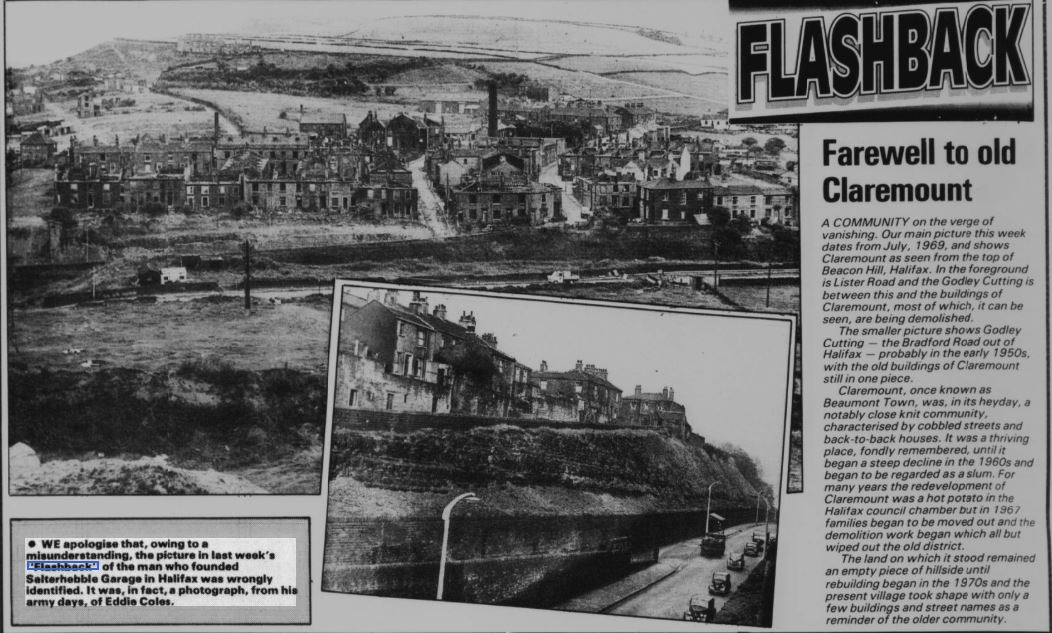
A highly distinctive pub which dated back to the late 18th century. It was at the junction of New Bank and Charlestown Road. It's name may stem from the fact that at one time there was an extensive pleasure garden in this area.
Taken from Flashback-Evening Courier


New Bank
 |
 |

Wellington


New Bank 1947-48


New Bank rising towards Godley


Top of Prospect Street


Prospect Inn on Prospect Street enhanced

Prospect Street from New Bank. This picture was taken during it's demolition. St. Joseph's School is visible with a notice for "Fee's" the builders on Portland Road. The building immediately behind the bus was the "Crown Tavern" and Mr Costello, a Barber Shop.

Crown Tavern - 93 New Bank / Prospect Street.


View of Range Bank, Ellen Royd and Haley Hill from Claremount Road in the 1930s

Probably taken from St. Thomas Street, Claremount looking towards Dean Clough


As you come up New Bank the fork left remained New Bank while the main road became Godley Road which continued round towards Stump Cross

New Bank (left) and Godley Road


Junction of New Bank and Godley Road with Brickmakers Arms on right of picture

The Brickmakers Arms in "Coffin Row" New Bank was owned by Stock's, the Queensbury brewers, and it was taken over by Samuel Webster and Sons Ltd in 1933. Presumably the name is explained by its proximity to the old Horley Green brickyard. The pub was definitely original in its shape.

Brickmakers Arms known as 'the coffin' because of it's shape

enhanced



Godley Road continues under Godley Bridge



There was a road that went up past to Beacon Hill called "Miss Lister's Road"


"Albion" and the "Beacon Tavern" . The Albion was often regarded as the posh one. Just beyond the Beacon Tavern, there used to be a Chapel.

On top of Godley Bridge
Left would take you back down New Bank
Right to Horley Green
Straight ahead on St.Thomas's Street which continues into Claremount Road.


We return here to the end of Godley Bridge where the pub on the left was the Albion Hotel. Entrance to New Bank left, Claremount Road straight ahead, Beacon pub and Horley Green Road to the right 1967.

St Thomas Street during demolition (no's 14-4)

Looking from Claremount towards Godley (St. Thomas's Church on the right) and Horley Green on the left.

Continue along St.Thomas's Street to St. Thomas's Church

Cricket at St Thomas's
St Thomas's Church was also at the centre of local sporting life. The church's Sunday School cricket club was formed around 1870. A senior team followed in 1873. The club is an interesting example of how a Victorian church could bring people together beyond Sunday services. Sunday School cricket gave young people an organised sporting activity and helped connect the church with the wider neighbourhood.

Claremount Works of George Swift Ltd Machine Tool Makers 1960's (West side).

Crawford Swift's engineering on Claremount Road

Claremount Works of George Swift Ltd Machine Tool Makers 1960s (East side).

A Conservative organisation was also established locally. The Claremount Ward Conservative Club was recorded at 170 New Bank in 1917, while the Belgrave Social Club is associated with the former Claremount Conservative Club name. These organisations provided meeting places and social facilities for residents, reflecting the importance of club life in working-class districts of Victorian and Edwardian Halifax.

St. Thomas's Street 1960s (no's 62-74)

Leather Street 1967 (no's 1-13)

St Thomas's Street 1969 (no's 74-62)

Earl Street 1969 (no's 15-31)

Earl Street 1969 (no's 11-1)

Earl Street 1969 (no's 12-2)

Bell Street 1969 (no's 26-14)

Parsonage Road - Bell Street 1969 (no's 30 & 28)


Parker Street Toilets - Dustbins 1967

Claremount Fisheries Cross Street from Brown Street 1967

Neville Street 1969

Gable end of 12-14 Neville Street and shop on Cross Street 1967

Neville Street looking towards St Thomas's Church 1967

Brown Street

Claremount Tavern opened in 1875 and closed in 1969. The shop is at the bottom of Dover Street
The Claremount Inn
The Claremount Inn stood at 52 St Thomas's Street, between Earl Street and Dover Street. It began as a beerhouse and opened in 1875. The premises later became a Ramsden's pub and served the densely populated streets surrounding it. The Hird family were among its long-serving keepers: Elizabeth Ann Hird was recorded there from 1904 until 1932. The pub finally closed on 14 January 1969, during the period when much of the old Claremount housing was being cleared.

Claremount Tavern and Brown Street 1967.


This is the shop at the bottom of Dover Street. Beyond that is Bell Street then no's 62-74 St Thomas Street, back to back with Leather Street.

Claremount Branch of the Halifax Co-operative Society. Opened in 1865 and was located at the corner of Cross Street and St Luke's Street.
The Claremount Co-operative Society
The co-operative movement also established an early presence in Claremount. A branch of the Halifax Industrial Society opened here in May 1865, at the corner of Cross Street and St Luke's Street. It provided local residents with access to the co-operative system of buying goods and sharing in the benefits of the society.
The branch continued to serve the neighbourhood as it expanded. By 1936 a grocery department was recorded at 55 Prospect Street. The co-operative store was an important part of everyday life, alongside the local shops, public houses and social clubs.