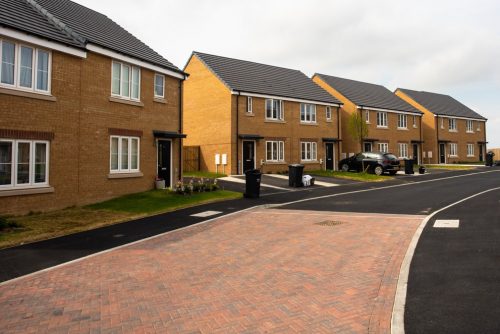
Historic Illingworth
Historic Illingworth

View a 1905 map of Illingworth

Illingworth House


Rear of Crossley's Carpets Cricket pavilion


This Maltese Cross was placed here by previous resident Mr Carter.
Was this the 'White Lion' or the 'Machine Makers Arms'?


 |
 |


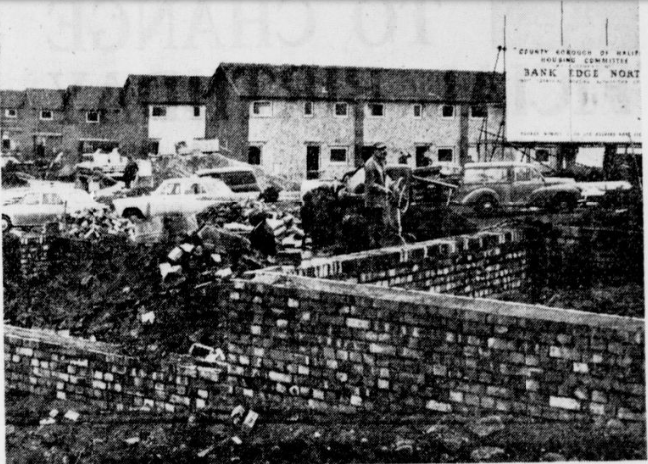
🏘️ Bank Edge North, Illingworth — Building Halifax’s Post‑War Homes
Work is well under way on the new Corporation housing development at Bank Edge North, Illingworth, marking another chapter in Halifax’s post‑war rebuilding story.
The project, undertaken by George Wimpey & Co. Ltd., carries a contract value of £628,634 and includes 213 dwellings — a mix of bungalows, houses, flats, and maisonettes. The site once held temporary prefab homes built just after the war, now replaced by permanent housing designed for modern living.
Like the nearby Needle Row estate, the layout follows the Radburn principle, an innovative planning idea that separates pedestrians from traffic, creating safer and more pleasant neighbourhoods. Paths and green spaces link homes together, leading to a landscaped central area — the visual and social heart of the community.
It’s a design meant not just to house Halifax families, but to inspire pride in where they live — a thoughtful blend of architecture and everyday life.

🏠 Turner Avenue, Illingworth — Halifax’s Tribute to a Hero
This evening’s picture takes us to Turner Avenue, part of the post‑war housing estate at Illingworth. The avenue was named in honour of Sergeant Hanson Victor Turner, the Halifax man awarded the Victoria Cross for his bravery in the Second World War.
In the background stands the mill chimney of Messrs Calvert’s of Illingworth, once a familiar landmark at the heart of the old village. Around it lay the historic centre — the old prison and stocks, close to St Mary’s Church, reminders of a time when Illingworth was still a rural community.
To the left of the chimney, on the skyline, runs Pharaoh Lane, named after Pharaoh Feather, who rests in St Mary’s Churchyard, not far from the village centre.


We read in 'Watson's History of Halifax' that Illingworth Chapel, situated in the township of Ovenden, was built about the year 1525; for Henry Savile, Lord of Ovenden, gave an acre of land there, by deed, bearing the date January 26th, 17th of Henry VIII, to certain feofees, in trust that they should stand feifed thereof to the use of a chapel there, to be built in the honour of the Virgin Mary, paying yearly to the Lord, one red rose.
The chapel was rebuilt in 1777, and during the night of December 4th 1841, the church was badly damaged by a fire which originated, it is said, by the overheating of the furnace under the tower. It is recorded that, on the following day, the Rev. William Gilmour addressed his anguished and sympathising congregation amidst the ruins of the fire. Since that time, many improvements and alterations have been made. One of the most notable events was the reopening after restoration in September 1872.

Apparently the Commercial was built on the site of the Illingworth Cross


  |
 |
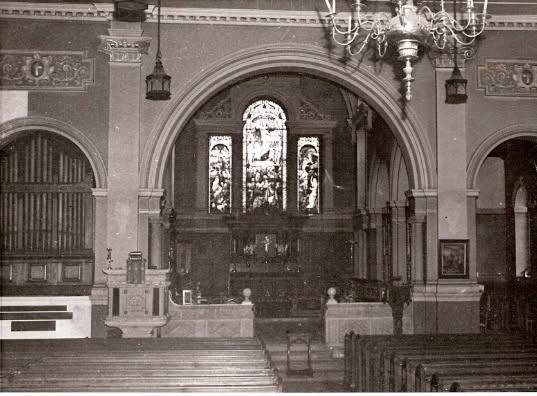
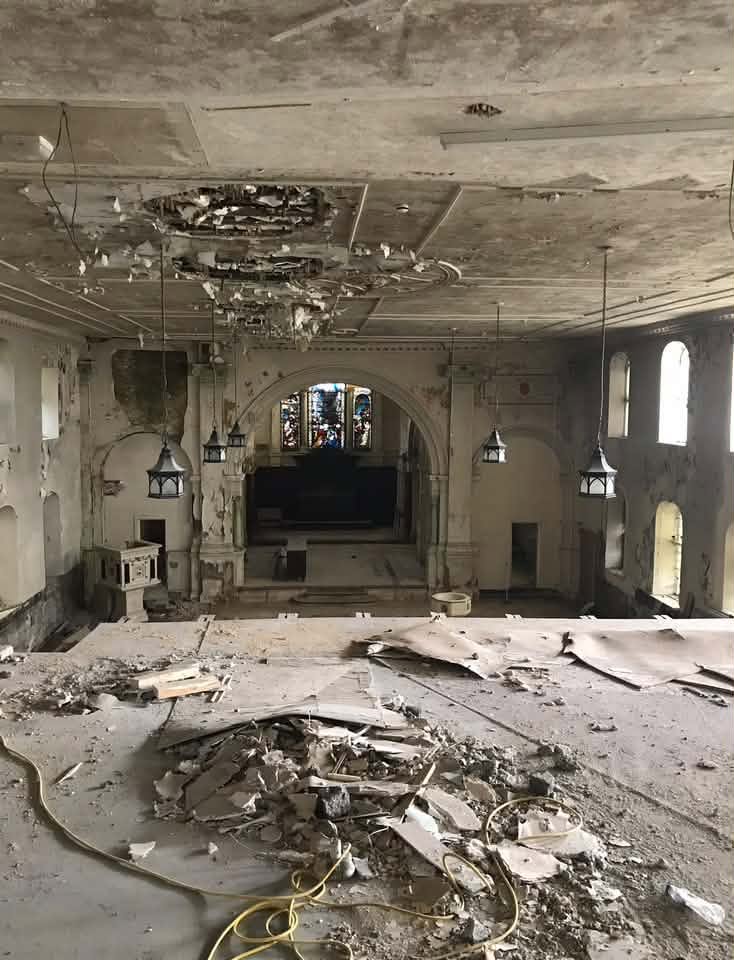
St Annes after it had closed as a church - now housing
  enhanced  enhanced |
 |


'Let him that stole steal no more: but rather let him labour, working with his hands the thing which is good, that he may have to give to him that needeth'. This appropriate Biblical quotation is to be found on the old Illingworth lock-up.
At one time, there were several of these local gaols in the district, and the one at Illingworth, which was built, we believe, early in the 19th century, served the large township of Ovenden. It has not been used as aprison for many years.
An interesting story is told of how the prison was used by silk thieves to hide their spoils. About 150 years ago, there was a gang of silk thieves operating in Ovenden. They broke into the silk mills, a number of which had been established in Ovenden and Wheatley, and, having got their plunder, which at that time was of considerable value, they would make their way to the prison, remove some slates from the back of the roof and stuff in the silk so they could dispose of it. Another hiding place was in one of the tombs in Illingworth churchyard.


Abbey Park, Illingworth – From a New Estate to the Regeneration Plans of 1986
A new beginning in the 1960s
Abbey Park was developed during the 1960s as part of the post-war expansion of housing in the Halifax area. It was a substantial new housing estate at Illingworth, providing homes for hundreds of families at a time when local authorities were seeking to improve housing conditions and meet the demand for modern accommodation.
The estate was made up of houses and flats, arranged in a planned residential neighbourhood. For the families moving in, Abbey Park represented a new start, with modern homes and a purpose-built community on the outskirts of Halifax.
The development was later described as an award-winning housing scheme. It is worth remembering this when looking at the photographs from the 1980s: Abbey Park had begun as a major investment in new housing, rather than as the troubled estate it would later become.Changing fortunes
Over the following years, the estate experienced increasing difficulties. By the 1980s, a number of properties were empty and boarded up, while the condition of parts of the housing and its surroundings had deteriorated.
The problems were serious enough to attract attention from Calderdale Council and the Government. However, the estate was still home to many residents, and there was a determination to find a way to improve conditions rather than simply abandon the area.
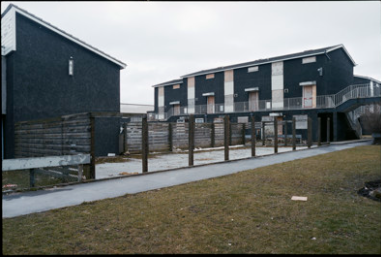
Photographs taken in April 1986 by the Property Services Agency, now held by Historic England, provide an important record of Abbey Park at this time. They show the homes and streets as they appeared during this difficult period, capturing a mixture of occupied housing and properties that had already fallen vacant.

Illingworth Fire Station
The 1986 regeneration initiative
On 20 February 1986, the Government announced its favourable response to a major regeneration package prepared by Calderdale Council in conjunction with the Department of the Environment's Urban Housing Renewal Unit.
The parliamentary announcement described Abbey Park as a run-down estate of approximately 700 dwellings. The proposals were intended to improve housing conditions, strengthen local management and give the estate a better future.
The programme included several important measures:
- A fully staffed estate office had already opened, providing residents with a local housing service.
- Around 450 rented houses and flats were to be modernised and repaired.
- Up to £689,000 in additional government capital funding was agreed in principle for the council's 1986–87 housing programme.
- A community refurbishment scheme was proposed, involving around 120 locally unemployed people in improving the estate environment and the approaches to homes.
- Around 250 empty properties were proposed for transfer to the private sector for refurbishment and subsequent sale.
The overall package involved resources of approximately £1.65 million, including up to £742,000 from the Government's Urban Programme.
The initiative was presented in Parliament as a pioneering partnership between Calderdale Council, private enterprise and central Government. The announcement also acknowledged the involvement of tenants in developing the proposals.

Heathcliffe pub, Abbey Park
A record of Abbey Park in 1986
The Historic England photographs from April 1986 are particularly valuable because they preserve a view of the estate during this period of change. They provide a visual record of the buildings and surroundings at a time when the future of Abbey Park was being actively debated and plans for improvement were being put into effect.
The 1986 initiative shows that there had been a serious attempt to renovate and revive the estate. It was not simply a case of the homes being left to decay: substantial public funding, local management arrangements and a programme of repairs and environmental improvements were all proposed.
These photographs and parliamentary records provide an important starting point for understanding the later history of Abbey Park, before the eventual clearance and redevelopment of much of the original estate.