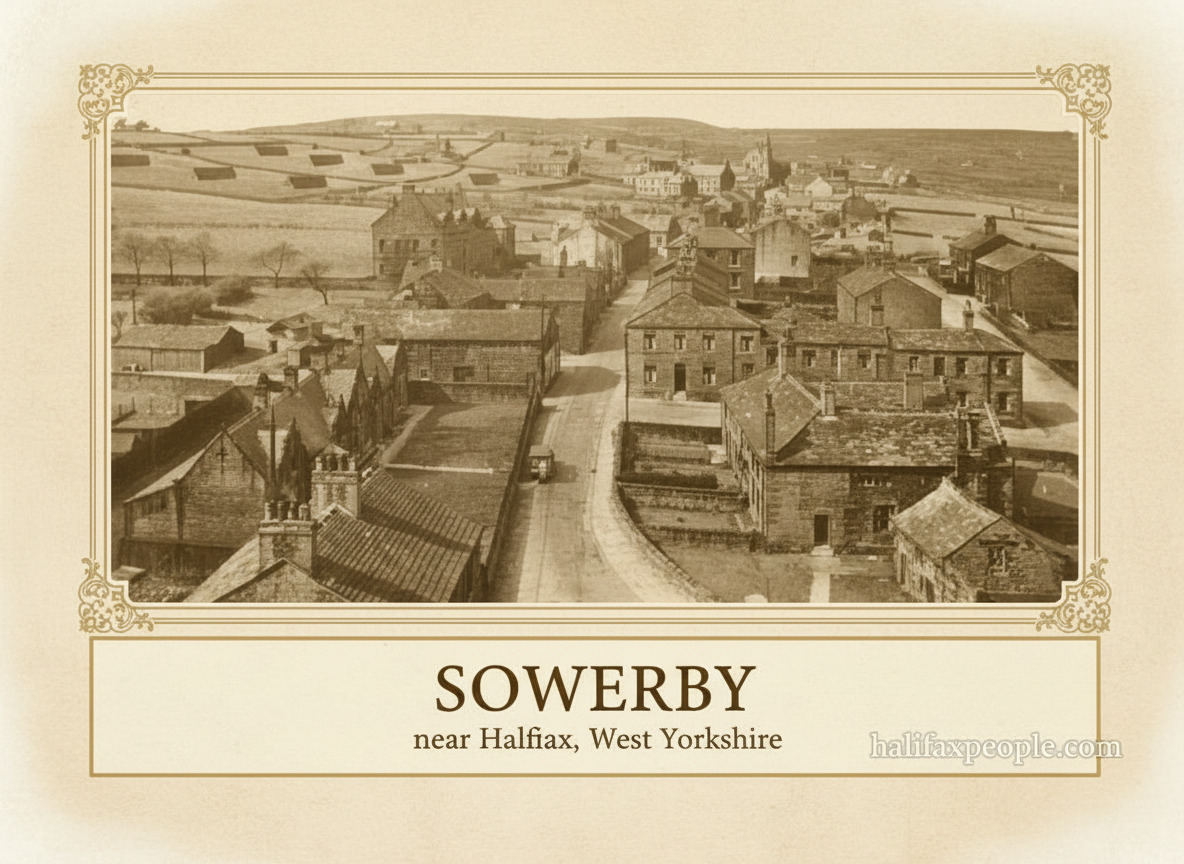
Sowerby

SOWERBY was and still is a hill top village, it was also a township within the ancient parish. Lying south of the river Calder it was bounded on the east by the Ryburn stream and on the west by the Elphin brook. The church of St. Peter dates from C.1650. John Tillotson who was born at Haugh End in Sowerby became Archbishop of Canterbury in 1691.

WundaNumba 777-545 - What's behind your WundaNumba.com
Sowerby, Calderdale — Domesday Origins, St Peter’s Church and Historic Weavers’ Houses
Sowerby is an old hilltop village above Sowerby Bridge, with a history reaching back to the Domesday Book of 1086, where it was recorded as Sorebi. Long before Sowerby Bridge developed into an industrial town in the valley, settlements such as Sowerby grew on higher ground, where farming and sheep rearing supported a thriving domestic woollen-cloth trade. Families worked from their homes and small workshops, spinning, weaving and finishing cloth for markets further afield. The village’s elevated position and historic lanes preserve traces of this earlier rural community, which developed separately from the mills and transport routes along the River Calder and River Ryburn.
One of Sowerby’s most important landmarks is St Peter’s Church, whose origins date to around the mid-seventeenth century. The church stands above the valley and reflects the village’s long-standing role as a local religious centre. Sowerby is also associated with John Tillotson, who was born at Haugh End and later became Archbishop of Canterbury in 1691. Historic houses and former weavers’ cottages reveal how prosperous cloth-making families shaped the village, while buildings such as Wood Lane Hall preserve examples of the region’s distinctive traditional stone architecture.
During the eighteenth and nineteenth centuries, textile production expanded across the wider Calder Valley, but the largest mills and factories tended to cluster down in Sowerby Bridge and along the rivers, where water power and transport links were more readily available. Sowerby itself remained more village-like, gaining modest rows of terraced houses, chapels and a school as the surrounding district grew. Its history is therefore different from that of its industrial neighbour: rather than being dominated by huge mills, Sowerby retains the story of an older farming and weaving settlement, shaped by church life, historic houses and generations of textile workers. Today, the village’s stone buildings and hillside setting offer a glimpse of Calderdale before industrial growth transformed the valley below.
 |
 Random Sowerby |
If you have enjoyed your visit to this website, please spread the word by clicking the 'like' and 'share' buttons below. Thank you