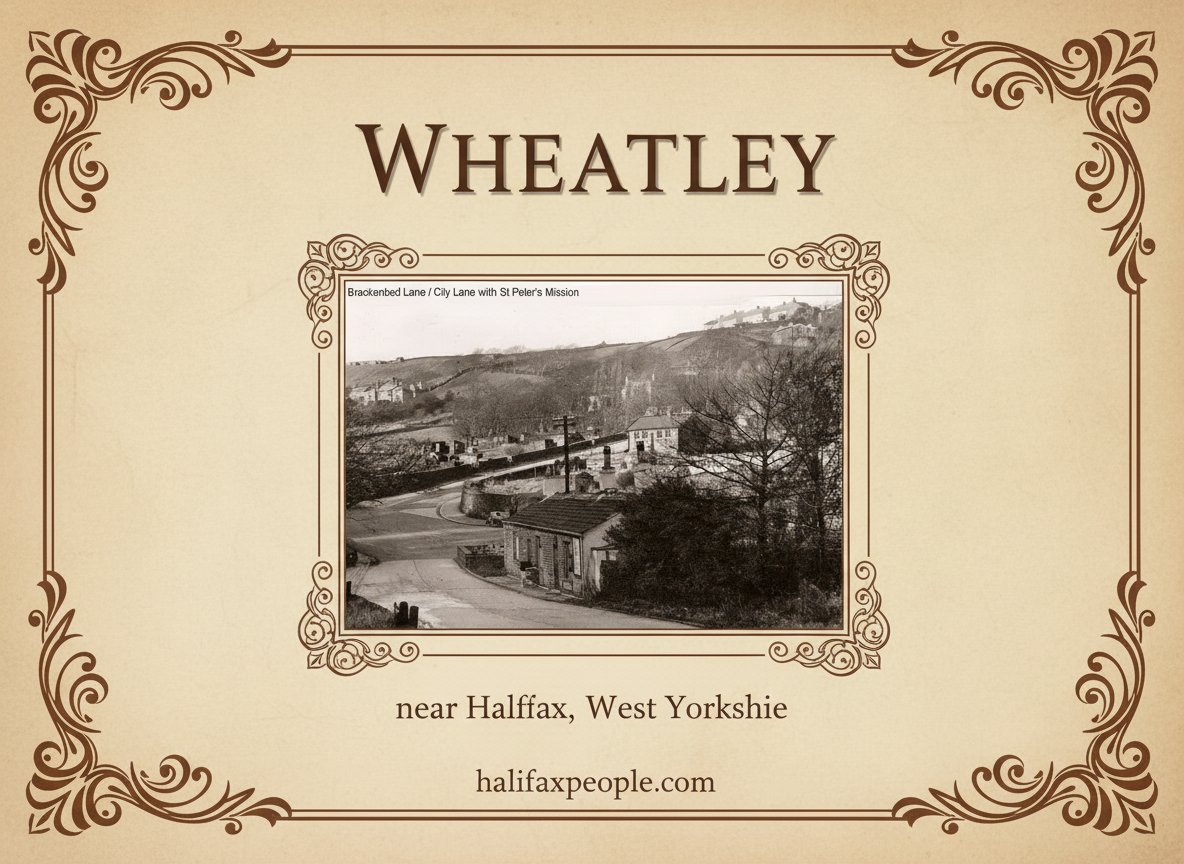
Wheatley

WundaNumba 777-545 - What's behind your WundaNumba.com

Wheatley, Halifax — Historic Mills, Rural Roots and the Great Railway Viaduct
Wheatley lies to the north-west of Halifax, in an area whose development reflects the transformation of Calderdale from scattered farming settlements into an industrial landscape. The place-name is thought to derive from Old English elements associated with a clearing or field where wheat was grown, although alternative interpretations have been suggested. Before the spread of modern housing, Wheatley included farms, older stone houses, streams and mill sites, with textile production gradually reshaping its valleys. As Halifax expanded, Wheatley and neighbouring Ovenden and Illingworth became increasingly urbanised, particularly from the mid-20th century onwards.
Textile manufacturing was a major part of Wheatley’s earlier story. Dapper Mill, on Brackenbed Lane, began as a fulling mill in the 17th century, when woollen cloth was pounded and thickened as part of the finishing process. By the 19th century, the mill had expanded to accommodate frames and steam-powered machinery, and it later became known as Wheatley Dye Works. The area also had Wheatley Corn Mill, a manorial mill associated with the Savile family, illustrating how grain milling and textile manufacture existed alongside one another. These industries relied on streams, water management and, increasingly, steam power to support a growing local workforce.
One of Wheatley’s most striking landmarks is Wheatley Viaduct, built for the Halifax High Level Railway. The curved structure stretches for more than 180 metres across Wheatley Valley and formed part of the line running from Holmfield towards St Paul’s Station in Halifax. Nearby, Wheatley Tunnel, approximately 745 metres long, was completed before the viaduct and opened in 1876. The railway was particularly useful for goods traffic, including coal, but the line eventually closed and was dismantled; the last goods train ran in 1960. Major repair work to the viaduct was completed in 2024 to help preserve the structure, which remains an important reminder of Halifax’s railway past. The viaduct is not open to the public, so it should be admired from a safe, permitted viewpoint.


If you have enjoyed your visit to this website, please spread the word by clicking the 'like' and 'share' buttons below. Thank you