Broad Street and Crossley Street
Broad Street

Broad Street, Halifax: The street that wasn’t always broad
Broad Street has a name that once seemed rather optimistic. For much of its history, the road behind Halifax Town Hall was narrow and crowded with buildings. Its modern width is the result of major road improvements that swept away parts of the old townscape in the mid-twentieth century.
The street was laid out around 1824, following Halifax’s Improvement Act of 1823. Together with Waterhouse Street, it was regarded as one of the town’s handsome new thoroughfares. At first, Broad Street ran between Northgate and Waterhouse Street; it did not yet continue through to St James’s Road and the area known as The City.
A chapel, hotels and old-fashioned shops
One important building stood at the corner of Broad Street and Waterhouse Street: Wesley Chapel, built for Halifax’s Wesleyan Methodists. The first sermon was preached there on 6 November 1829. It later closed in 1949 and was eventually demolished in 1968. The small passage beside the Town Hall still bears the name Wesley Court, preserving a trace of the chapel’s presence.
Broad Street was also lined with shops and hotels. Maude’s Temperance Hotel, established by the 1830s, stood opposite the Town Hall. Nearby businesses included drapers, outfitters, paint and oil merchants, and builders’ hardware suppliers. One long-established business, S. Arthur and Sons, sold boys’ and men’s clothing from premises near the junction with Northgate. It had traded there for around 85 years when the buildings were compulsorily purchased for road widening in the late 1950s.
The widening that changed everything
By the 1950s, increasing traffic made the narrow stretch behind the Town Hall a serious bottleneck. A widening scheme led to the demolition of old buildings, including the block that housed S. Arthur and Sons. Other properties were also cleared, radically changing the street’s appearance. Local historical accounts differ on the exact start date and phases of the scheme, so it is safer to describe the transformation as a process spanning the 1950s and early 1960s.
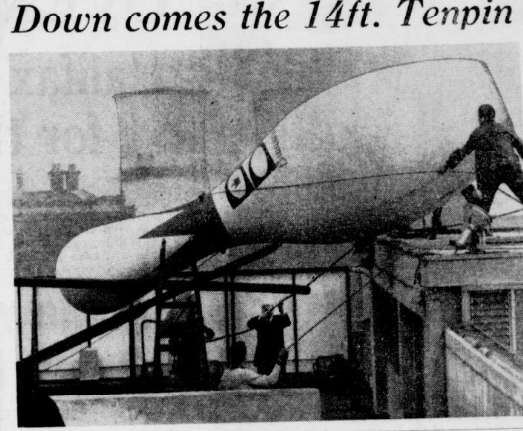
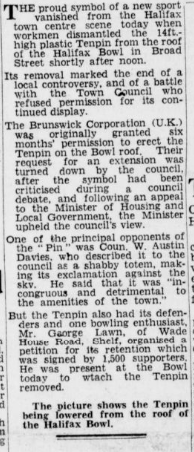
The cleared land opposite the Town Hall then had an unexpected afterlife. A purpose-built 28-lane bowling alley, Halifax Bowl, opened there on 6 February 1964, launched by Coronation Street actress Pat Phoenix. The council reportedly objected to a proposed 14-foot-high bowling pin on the roof, but the giant pin remained for six months. The bowling alley closed in 1969, and the building later became a supermarket before being demolished for redevelopment.
Today, the site forms part of Broad Street Plaza, a leisure and retail development that opened in the early 2010s. The old shops and hotel have gone, but photographs preserve the street’s former, much tighter layout.
Broad Street’s story is a particularly clear example of how twentieth-century traffic planning reshaped Halifax: a handsome nineteenth-century street became a congested road, then a widened traffic route, a bowling destination and, finally, part of a modern leisure complex.

In the late 1950's a plan to make one of Halifax's best known streets live up to its name heralded some sweeping changes to the townscape.


digitised
By 1957 there was a new road past the old Crossfield Bus Station and the Odeon Cinema but the original portion of Broad Street between Waterhouse Street and Northgate, at the rear of the Town Hall, formed a serious bottleneck at Northgate. Considering that this was the main east to west highway through Halifax, in an age of steadily increasing levels of traffic, something had to be done, in the view of the council.
So, the Broad Street widening scheme got underway and many buildings were casualties. By 1958, the draper S. Arthur and Sons was one of Halifax's oldest established retail businesses, having been founded in these premises at the junction between Northgate and Broad Street 85 years previously.
Generations of Halifax people had patronised the firm, which, at the time of its closure, was still in possession of catalogues dating back to the 1870's and showing the latest styles in 'busties and corsets' designed for 16-inch waists. But the block of buildings had to go to enable the road to be widened and it was compulsorily purchased by the council. No new premises were offered.
The property which was occupied by 'Healey's' lasted longer but structural damage, possibly caused by traffic vibration, was discovered and eventually had to be demolished and was replaced by a small carpark.

Looking up Broad Street (a part of The City). The lorry is turning left into Waterhouse Street.
The Odeon Bingo Hall now stands top right of picture.


digitised

enhanced

War-time air raid shelter uncovered during building a subway in 1967


digitised


digitised


enhanced


enhanced
  enhanced |
 |


Orange Street running top left
 |
 |
enhanced
  enhanced Swan Coppice once stood where the Town Hall now stands. It also had a bowling green |
 |
 |
 Halifax Ten Pin Bowling Alleys |

 |
 |


Waterhouse Street to the right and Broad Street down to the left
 |
 |


 |
 enhanced |
 |
 enhanced |
 |
 enhanced |
These 1959 photo proves that Broad Street was not always very broad.
 |
 enhanced J Riley's decorators was later to become the home of Stoddart's |
 |
 |


 |
  |
 |
 |


enhanced
North Parade


North Parade (left) enhanced


enhanced
Broad Street carpark was on the left as you came down


Looking at the shops that were just below the Town Hall


digitised


22 -24 Broad Street - Thomas Smith & Co.Ltd Builders hardware merchant
16-18-20 Broad Street - Maudes Commercial Hotel
14 Broad Street - Longworth, Bannard & Co.Ltd paint manfrs + oil merchants


4-6-8-10 Broad Street - Lyon E W& Son wholesale drapers


2 Broad Street (up to the left) - Arthur S and Sons boys and Gents outfitters
Northgate straight ahead


enhanced
Crossley Street, Halifax: The street built to show the town’s success
Crossley Street is one of the clearest reminders of how Halifax’s industrial wealth reshaped its town centre. Much of the street was created during the major redevelopment of the 1850s and 1860s, when Halifax was becoming a prosperous manufacturing town and wanted public buildings and shopping streets to reflect that success. The street and many of its buildings were designed by the Bradford architectural firm Lockwood and Mawson.
The street was named after the Crossley family, whose carpet-making business at Dean Clough became one of Halifax’s great industrial enterprises. The family’s involvement in the town went beyond manufacturing: they invested in civic improvements, shops and offices, and helped shape the town centre during this period.
The most famous building on the street is Halifax Town Hall, designed by Sir Charles Barry with his son Edward Middleton Barry. It opened in 1863, symbolising the confidence of a town flourishing on the proceeds of the wool and textile industries. Its Italianate Victorian architecture, richly decorated exterior and monumental tower make it one of Halifax’s defining landmarks. The building is Grade II* listed.
A street of halls, banks and grand shopfronts
Crossley Street’s history is also preserved in several other buildings:
- Marlborough Hall began as the Mechanics’ Hall, designed by Lockwood and Mawson. It reflects the Victorian belief that working people should have opportunities for education, lectures and self-improvement.
- Princess Buildings, at the corner of Crossley Street and Princess Street, opened as the headquarters of the Halifax Joint Stock Banking Company in 1858. It later became familiar to generations of residents as council offices where they paid rates and other bills.
- The surviving mid- to late-nineteenth-century shop buildings retain classical sandstone façades, decorative window surrounds, pilasters and prominent cornices. Historic England lists several buildings on the street individually and recognises the wider group’s architectural value.
These buildings were part of a broader programme of town-centre improvement. Halifax had become a municipal borough in 1848, and criticism of its crowded, unhealthy streets helped prompt redevelopment. Crossley Street and neighbouring Princess Street were among the results: wider, more formal streets lined with impressive commercial buildings.
More than a street name
Crossley Street tells a story of industrial prosperity translated into civic ambition. Carpet manufacturing helped make the Crossley family wealthy, and that wealth helped reshape Halifax through buildings, public amenities and philanthropy.
The street’s most enduring feature is the way its architecture still records that period. Look above the modern shopfronts and the stonework reveals the ambition of a town determined to present itself as prosperous, cultured and forward-looking.


digitised


enhanced
 |
 enhanced |
 |
 |


Underneath the cafe was the 'Vodi', a popular video game hideout for rockers and school absconders in the 1980's (above in the 60's). Other hideouts were Talk of the Town at the top of Silver Street, El Toro just above the Lewins and Playland in Broad Street.
If you have enjoyed your visit to this website, please spread the word by clicking the 'like' and 'share' buttons below. Thank you