Brighouse -
King Street - Lawson Road - Mill Lane
King Street

George Hotel on the left, White Swan on the right and Tate's corner on King Street ahead
The White Swan and Old King Street
King Street was one of the important commercial streets in Victorian Brighouse. The older photographs show the White Swan standing opposite the George Hotel, with Tate's corner visible further along the street. Public houses were an important feature of the town's social life, serving workers from the surrounding mills and businesses as well as travellers and local residents. The White Swan was part of this established town-centre landscape. The changing photographs of King Street show how traditional inns, shops and other buildings gradually gave way to modern premises and altered road layouts.


Eastmans - King Street


Lawson Road/Police Street

enhanced

St Pauls Wesleyan Church on the corner of Police Street (Lawson Road) and King Street enhanced

St Pauls Sunday School enhanced
ST PAUL’S METHODIST CHURCH: A NEW ORGAN AND A BUILDING WITH A PAST
Over the past fortnight, masons have been at work at St Paul’s Methodist Church, chipping away the old stones and lettering from the front of the building. The work has removed the last visible traces of the building’s original identity — something that had remained in place for years.
The change comes after a long period of negotiations over the sale of the premises. For some time, the property had been in touch with Messrs. Leslie Fink Ltd., estate agents of Manchester, acting for a Lancashire businessman. The sale has now been completed, and the purchase price is reported to have been £10,000.
Not everyone in the area had been clear about what the premises were intended to be used for. It is understood that the trustees have been informed that there is no intention of using the building as a place of worship again, and that it is to be used as a social club and bowling institute — one of the “one-clubbing” institutions in the district.
The building itself has a long history. It was originally built as King Street Church and Police Street, and later became St Paul’s Wesleyan Church. It is noted that it was built in 1857 and the later chapel in 1885, though the stonework of the main entrance is said to have been placed for Sunday school purposes in 1916. Previous accounts suggest that the Sunday school had been housed under the church, and that it later became a one-clubbing and bowling institute.
The organ installation at Greenhill has also been a notable event. The organ, described as a pleasant surprise, was purchased for use at the church and has been opened and dedicated. The opening ceremony included a motor-coach trip to Sheffield, where the organ was acquired, and a dedication and opening of the new instrument.
Mr J. Rushworth, the organist at St Paul’s, was present, along with members of the church and his deputy. The ceremony included a dedication and an opening service, and it is noted that the first hymn played on the organ in its new home was “Come, Thou Fount of Every Blessing”.
The organ itself is described as being in good condition, and the church expressed appreciation to those who helped make it possible. Although hearts were heavy at the thought of losing the church, it was also recognised that the organ would be a welcome addition while the building continued to serve the community in a new way.

Lawson Road runs from the end of King Street and back towards Bradford Road again forming a triangular area.

Bradford Road continued between Commercial Road and Bethel Street

Tate's corner after 1910

Tate's corner c1905 - previously a doctors surgery


The end of Bradford Road brings Huddersfield Road straight ahead, Bethel Street to the right and Mill Lane to the left.
Bethel Street

   |
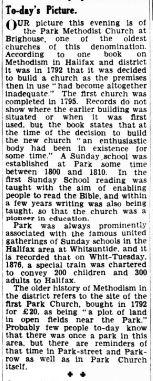 |


Park Street – Shops and Traders of the Past
Park Street was once a busy part of Brighouse's shopping district, with a mixture of independent businesses serving the everyday needs of local people. Among those remembered were Walter Robinson's electrical shop, Stanley Crabtree's decorating materials business, George Mitchell's estate agency and Coombs, the shoe repairer. These shops were more than commercial premises: they were familiar meeting places and part of the everyday life of the town.
The buildings themselves also tell a story of redevelopment. Walter Robinson's business had moved to Park Street after its earlier premises in Bradford Road were demolished to make way for the new bypass. West Park Street, which joins Park Street, was formerly known as Back Bethel Street and provided a connection towards Market Street. Across the road, the former Salvation Army Citadel in Bethel Street later passed into commercial use. The changing shopfronts show how Brighouse's independent high street adapted as businesses and shopping habits changed.


enhanced

enhanced


William Booth and the Early Salvation Army in Brighouse
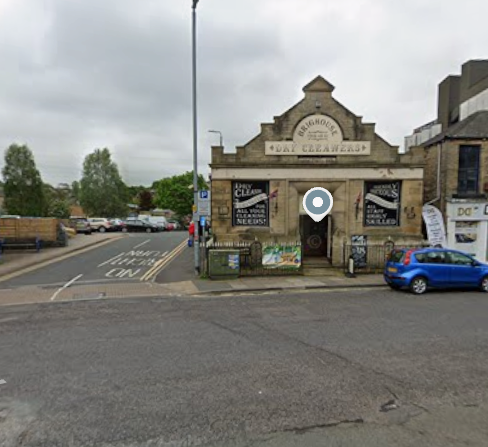
Brighouse has an important place in the early life of William Booth, the founder of the Salvation Army. In 1857, Booth and his wife Catherine came to the town, where he was appointed a preacher at the New Connexion Methodist Chapel in Bethel Street. During their time here, the couple became concerned about the employment of very young children in local mills and campaigned against the use of seven-year-old girls as mill workers. They left Brighouse in 1859, but Booth's connection with the town was remembered long afterwards.
The Salvation Army's own arrival in Brighouse was far from straightforward. Its first members held a meeting at the Oddfellows Hall in 1881, but encountered hostility from a crowd outside, with stones being thrown as they left. Further attempts to establish a presence were made in rooms behind the Black Swan, but opposition continued. A more determined group arrived in 1887 and gradually succeeded in establishing the Brighouse Corps. In April 1888 the organisation received its colours, and later that year General William Booth returned to Brighouse.
The early meetings were held in a small wooden building in Bethel Street known as Central Hall or Stott's Mission. A new Salvation Army citadel was opened nearby in September 1910. It served the town for 85 years, until the Corps moved into the former Magistrates' Court at the end of King Street in 1995.
 Round the back of Bethel Street |
 |
Back Bethel Street now West Park Street


Holroyd Buildings – A Lost Corner of Brighouse
Holroyd Buildings formed a distinctive group of commercial premises near Bethel Street and Thornton Square. The 1877 photograph is particularly valuable because it records the buildings before the substantial changes that transformed this part of Brighouse. The triangular arrangement of the premises reflected the unusual shape of the available plot, with shops and other businesses occupying the frontage. The buildings eventually disappeared as the town centre was modernised. Their photographs help preserve the appearance of a busy commercial corner before the later redevelopment.

enhanced


If you have enjoyed your visit to this website, please spread the word by clicking the 'like' and 'share' buttons below. Thank you