Elland Blog


WundaNumba 777-545 - What's behind your WundaNumba.com
Elland, Halifax — The Market Town That Built an Industrial Legacy
Elland stands beside the River Calder, a few miles south-east of Halifax, where ancient crossing routes helped a small settlement grow into an important market town. The town’s name appears in the Domesday Book of 1086 as Elant. Its position near a river crossing, where routes converged between Halifax, Huddersfield and the wider Calder Valley, helped establish its early importance. In 1317, John de Eland received a charter granting the right to hold a weekly market and two annual fairs, giving Elland commercial privileges at a time when it was an important centre for the surrounding district.
The old town around The Cross
The historic heart of Elland grew around The Cross, a junction beside St Mary the Virgin Church. A stone cross once stood here, close to the market place and the meeting point of the principal routes through town. The church itself dates back to the late twelfth century and is one of Calderdale’s oldest surviving churches. Its medieval core, later additions and historic churchyard preserve traces of Elland’s development from a small settlement into a thriving market centre.
The streets radiating from The Cross—including Northgate, Southgate, Eastgate and Westgate—reflect the old layout of the town. Many of the buildings around the centre were constructed or altered as trade expanded, creating a mixture of historic houses, shops, inns and civic buildings. The steep cobbled route known as Gog Hill is another distinctive feature of Elland’s older street pattern, offering a glimpse of how people once moved between the lower river crossing and the town above.
Cloth, canals and the industrial revolution
Elland’s prosperity was closely tied to textile production. Sheep farming supplied wool for cottage-based weaving, and by the early modern period cloth-making had become central to the local economy. The arrival of turnpike roads in the eighteenth century improved transport, followed by the opening of the Calder and Hebble Navigation in 1770. The canal made it easier to move raw materials and finished goods through the Calder Valley, helping local manufacturers expand their markets.
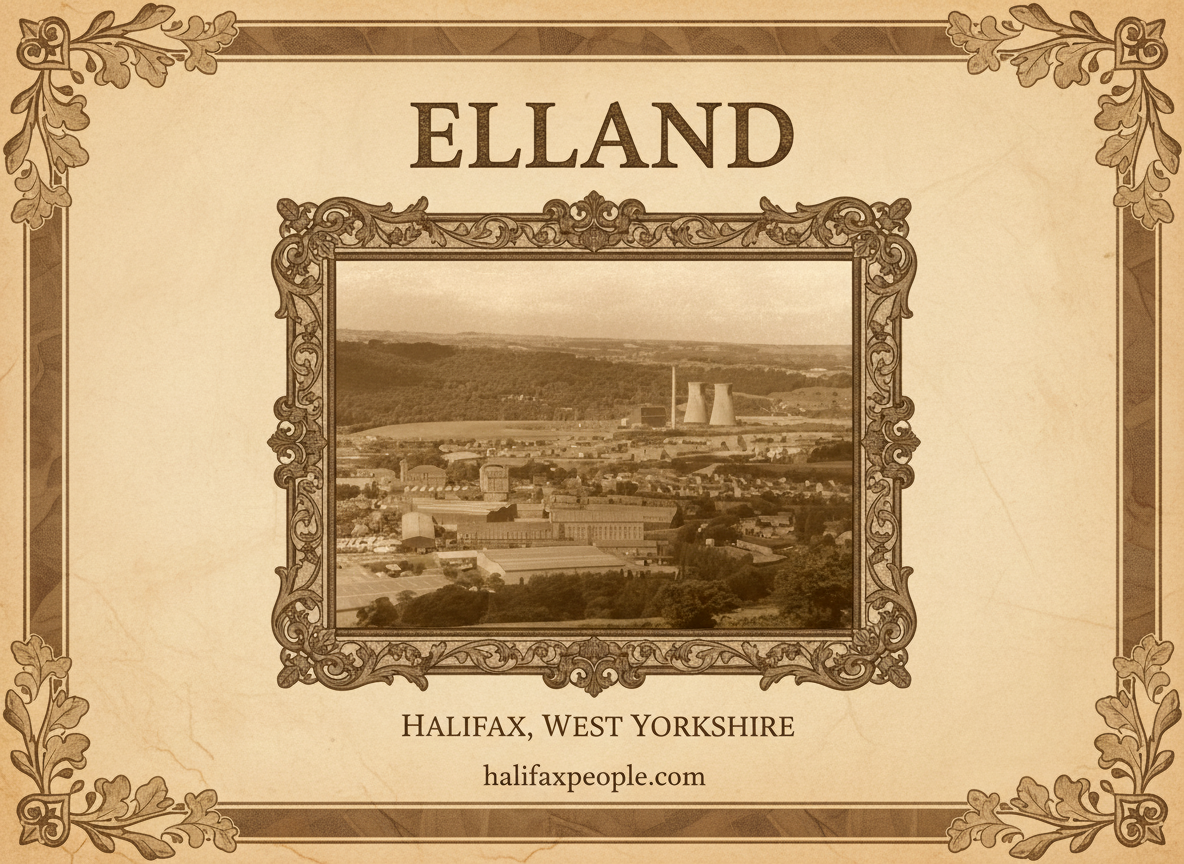
During the nineteenth century, Elland grew into a busy industrial town. Woollen and cotton mills appeared beside the river and canal, while quarrying, coal mining, brickmaking, engineering and chemical production provided additional employment. Mills and chimneys on the edges of the older settlement transformed the landscape, and rows of workers’ housing spread along the routes connecting factories with the town centre. Historic photographs of Elland’s mills, canal-side buildings and terraced streets capture the scale of this change.
The Fleece Inn, Dobson’s sweets and local landmarks
Some of Elland’s best-known buildings preserve a more personal side of the town’s history. The Fleece Inn, on Westgate, occupies buildings dating to around 1610 and was originally associated with Great House Farm. It is a reminder of the old yeoman clothier houses that once stood among the town’s commercial streets. Like many historic inns, it has accumulated stories and local legends over the centuries, although individual tales should be distinguished from documented events.
Elland also became known for Joseph Dobson’s confectionery business, established in 1850. The company’s traditional boiled sweets became part of the town’s industrial identity, showing that Elland’s manufacturing economy extended beyond textiles. The Rex Cinema, another distinctive landmark, is one of Britain’s oldest surviving purpose-built cinemas still in operation. Together with the Town Hall, market and churches, these buildings reflect the varied commercial and social life of the town.
A changing town with a living heritage
Elland’s industrial role declined as textile production changed during the twentieth century, but its historic centre remained an important focus for local life. The former Elland railway station closed in 1962, and the town’s transport connections changed considerably over subsequent decades. More recently, investment in the high street has improved public spaces and pedestrian access, while plans for a new railway station and connecting routes aim to strengthen Elland’s links with neighbouring towns.
The town’s history can still be read in its streets, stone buildings, church, canal and mill remains. Elland is more than a former mill town: it is a place whose market charter, transport links and manufacturing traditions helped shape the wider Calder Valley. Old photographs preserve the details of that story—from busy industrial works and traditional shops to the streets and landmarks that continue to give Elland its character.
 |

|
|
History pages for areas of Elland

|

|

|

|

Still recognisable - Southgate in earlier days.
This photograph was added by Mrs Evans of Elland. Please send us your old photographs with a description(They will be returned to you). Better still - add them yourself using the form at the bottom of this page.
 |
The Great Coram


Whitaker, Tommy
Born at Higgin Chamber, Boulderclough. He became nationally-famous as a ventriloquist, The Great Coram.
At the age of 7, he played the cornet in a band at West Vale. His family moved to Rastrick. He joined Brighouse Borough Band.
His interest was inspired when an uncle gave him a ventriloquist's doll as a birthday present. His first public performance was at a Sunday School concert in Southgate, Elland where he appeared as Professor Whitaker. He subsequently appeared at various seaside resorts. He was offered a trial at The Lyceum in London, and he was retained for another three. He took his stage name from Coram Street, London, where his agent had his offices.
He had several dolls, but the most notable was Jerry Fisher, a the cheeky guardsman. Jerry had moving eyes and mouth, and winked at the audience after cracking some outrageous remark, but Tommy moved his arms, smoked cigarettes and walked off the stage still chatting. The secret was Tommy's engineering skills. He spent hours perfecting a mechanism which allowed the movements to be made by remote control.
Tommy appeared at the Palace Theatre, Halifax on 11th October 1909 and 7th September 1914.
He appeared at the Royal Command Performance [22nd May 1930] and at Buckingham Palace
Calderdale Companion
Have you got something to add to this Topic?
Do you have anything to add to this page?
If you have enjoyed your visit to this website, please spread the word by clicking the 'like' and 'share' buttons below. Thank you