Southowram History 15 - Barker Royd
Southowram History 15 - Barker Royd including St. Annes, Halfpenny Can


 |
 |


Southowram Churches and Chapels >>>>>>


This area by the Malt Shovel was called 'Halfpenny Can'. Apparently, the name came from the fact that there used to be a well at one of the properties and the owners charged a halfpenny for a can full of water.


Barker Royd


Read about William Swinden Barber


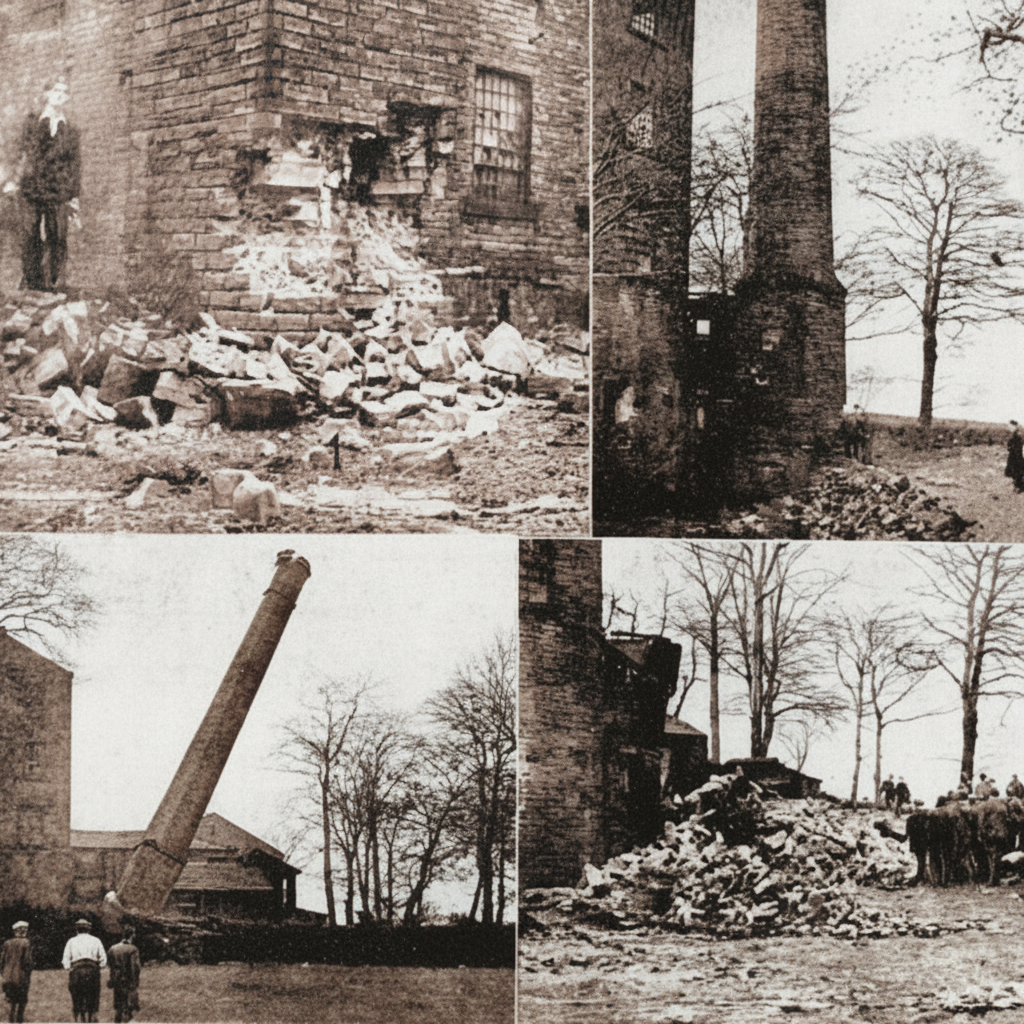

WHEN BARKER ROYD MILL WAS IN ITS POMP
A short history of Barker Royd Mill at Southowram came to light when the old mill chimney was brought down. The chimney, marked with the initials “W.B. 1849”, dated back to 1849 and had stood on the exposed hillside for around a century before it finally fell.
The mill’s story is closely tied to the Barber family. Information linked to the firm of Barber and Jessop (solicitors of Brighouse) suggests that William Barber of the district married about 20 years before 1849, to a Miss Anne Cousens. He was the brother of Joseph Barber, who founded the firm in 1826. William had four sons who went into different occupations and professions.
One of William’s sons became a lawyer and later a Queen’s Counsel. Another became the Venerable Archdeacon Barber of Chester. A third, Fairless Barber, became known for his antiquarian interests. A fourth son, Henry Jocelyn Barber, became chief of the Brighouse Fire Brigade at 18 and later founded the West Yorkshire Fire Brigade Friendly Society.
William, brother of Joseph, had two sons — William and Charleton — who entered the card-manufacturing business at Barker Royd Mill. Charleton had two daughters: one married Dr T. W. Arnison of Rastrick, and the other later received a decoration for nursing service during the First World War and went on to live near Scarborough.
During demolition work on the premises, an unusual discovery was made: small pieces of paper hidden inside a wall. They appeared to have been placed there years earlier by a workman. Some were portions of old letterheads used by the firm, dated July 25th, 1871. The letterheads carried the name “John and William Barber, Card Manufacturers, Southowram, near Halifax,” and also referenced Barker Royd House and the chimney. A smaller slip, described as parchment-like, included a note dated July 1871 mentioning “one thousand eight hundred and seventy-one” and naming people connected with the mill, including James Turner, Thompson Joe Sykes, and Washington Hemingway. Another note simply stated that William and Charleton Barber were the masters of the card mill at that time.
The old papers also give a glimpse of working life. One list, dated July 1871, recorded people employed at the mill, with ages and roles. It mentions that there were four storeys, and refers to jobs such as a “dresser” (about 74), a “miller” (17), and a “filler-up and piler” (about 50). It also notes that one woman employee was described as a “filler-up and piler” aged 50. Another detail recorded the working week: a 62½-hour week, with long days starting early, and set meal breaks. A later note adds that there were 72 machines in the mill.
The mill itself was remembered as a card-making establishment and was said to have closed down around 60 years earlier. Some of the oldest local residents could still remember the employees walking daily to and from work.
The article also comments on the mill’s location. It stood in a spot that some people found unusual, because there were few houses nearby and it was not close to a decent road. It also notes that the nearest coal mine was down in the valley at Water-corn Mill. The site is described as being different from the usual practice of placing mills where water power could be obtained — although it mentions a good spring nearby that was used to supply the dam and boilers.
Finally, after years of decline, the mill was set to begin a new chapter. It had been bought and was being rehabilitated by Messrs. S. Marshall and Sons Ltd., for use as a store.


Return to Southowram History 14 - Caine Lane
Advance to Southowram History 16 - Brookfoot (Top)
If you have enjoyed your visit to this website, please spread the word by clicking the 'like' and 'share' buttons below. Thank you