Horton Street - Wards End

Horton Street - Wards End
Fountain Street, Halifax: The Street Named After a Drinking Trough
Fountain Street has a surprisingly practical origin story. Before it acquired its present name, it was known as Doctor Lane. The change came after a stone drinking trough was installed near Ward’s End, turning a simple street name into a reminder of how water shaped everyday life in old Halifax.
Before Prescott Fountain
Ward’s End was once a more open space than the busy town-centre area we know today. According to a local-history account, an underground stream running from Well Head supplied a small reservoir in the area. A nearby house had numerous troughs built into its wall, making it a useful place for watering animals.
A square stone trough was then built near the centre of the open space. Doctor Lane became known as Fountain Street, apparently because of this trough. The trough was later replaced by an eight-sided version.
It is worth distinguishing these earlier troughs from the decorative fountain that became a landmark at Ward’s End: the name Fountain Street was already in use before Prescott Fountain arrived.
Prescott Fountain arrives
On 12 September 1884, the earlier trough was replaced by Prescott Fountain. The fountain became a familiar feature of Ward’s End and a recognisable meeting point in the town centre.
Its history is a reminder that public water facilities once served a very practical purpose. Before modern water supplies and transport transformed everyday life, a place where animals could drink was an important part of a busy market town.
The tramway starting point
Fountain Street also became associated with Halifax’s tramways. Local historical photographs and accounts identify it as the starting point for tram services travelling to King Cross. Trams connected the town centre with surrounding neighbourhoods, becoming part of the daily routine for workers, shoppers and visitors.
Today, the name survives as a small clue to an older Halifax: a street once called Doctor Lane, a stone trough supplied by local water, a Victorian fountain and a tramway network that helped people travel across the town.


digitised


Although there was no historic evidence of a fountain at this point of town, the area of Wards End was once ta large open space. This was long before Prescott Fountain existed. A house in Wards End had ten or twelve troughs in the wall and would have been very suitable for a drinking fountain. Here was also a small reservoir which was supplied by an under ground stream all the way from Well Head which also supplied water to another small reservoir above the Old Cock Yard.
A stone square trough was then built near the centre of the open space and the road changed it's name from Doctor Lane to Fountain Street. This would also be the reason for the name of the 'Stone Trough Brewery'. This trough was replaced by an eight sided trough and eventually replaced again on September 12th 1884 by Prescott Fountain.
 |
 |
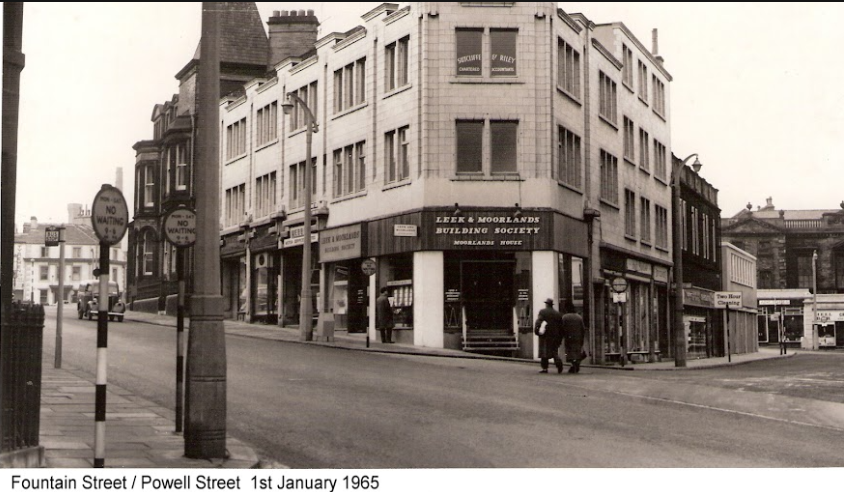
Fountain Street was once the starting point for all tram services travelling to King Cross


  digitised |
 |

Ward’s End, Halifax: Breweries, Theatres and a Lost Entertainment Quarter
Ward’s End was once one of Halifax’s liveliest town-centre districts. Old photographs show tramcars sharing the road with horse-drawn vehicles, while theatres, pubs, shops and breweries stood close together. Some buildings survive, but others disappeared as Halifax rebuilt its commercial centre during the twentieth century.
A brewery beside the town centre
One of Ward’s End’s major businesses was the Stone Trough Brewery, established by Peter Beck in the mid-nineteenth century near a group of springs and wells. Water from the springs flowed downhill towards Horton Street.
The business became Thomas Ramsden & Son Limited in 1881. A new brewery building was constructed at Ward’s End in 1887, designed by Horsfall’s architects. Ramsden’s remained there for more than 80 years before the company was taken over by Joshua Tetley & Sons in 1964. The brewery buildings were demolished in 1968, and the site was redeveloped for the Halifax Building Society’s head office.
The brewery’s story illustrates how an industrial business could occupy a prominent town-centre site before banking and office development changed the landscape.
A district of theatres
Ward’s End was also part of Halifax’s entertainment quarter. The area had several theatres and cinemas, attracting audiences from across the town.
The Palace Theatre and Hippodrome opened in 1903 and was remembered as one of Halifax’s grandest theatres. It was demolished in 1959, and Southgate House was subsequently built on the site.
Another landmark was the Theatre Royal, built in 1904 and designed by architect Richard Horsfall. The building was later converted into a cinema, and its surviving stone frontage remains an important reminder of the district’s theatrical past.
The Regal Cinema, which opened in September 1938, added another chapter to Ward’s End’s entertainment history. Designed by William Riddell Glen, it was a large cinema with an integral row of shops. Its opening reflected the growing popularity of purpose-built cinemas in the years before the Second World War.
A changing streetscape
Ward’s End has changed considerably since the days when trams and brewery wagons moved through the district. Redevelopment removed major buildings, including the Ramsden brewery and the Palace Theatre, while surviving historic structures preserve glimpses of the older street.
The area’s history brings together several sides of Halifax’s past: brewing, live theatre, cinema and the changing uses of valuable town-centre land.

Prescott Fountain >>>>>>>>>>>>>


Purpose-built wool warehouse erected in 1859 for Mr Thomas Greenwood. By 1887 the warehouse was occupied by Thomas Bracken & Son, brown paper manufacturers. In 1936, part of the premises were in use by W.H. Atkinson, wine and spirit merchants, part by the Irish Democratic Club, and the remainder by Raymond Garforth, shopkeeper. Today the ground floor is occupied by three retail units and the upper floors as office accommodation. Photo. April 2017. Info by IHO


Looking down Horton Street

 Looking up Wards End |
 |


End of Clare Road/ top of New Road

Horton Street, Halifax: Fire Engines, Railway Passengers and Edwardian Shops
Horton Street climbs steeply from Halifax railway station towards Ward’s End. It is a familiar route into the town centre, but its history connects the arrival of the railway, Halifax’s early firefighting service and the growth of new commercial buildings.
A street named after a landowner
Horton Street takes its name from Sir Watts Horton, who owned land in the area, including the ground on which Halifax railway station stands. The road’s steep gradient — described in local-history records as roughly a one-in-five incline — made it a distinctive approach between the station and the higher streets of Halifax.
The present railway station building opened on 23 June 1855. Designed by Thomas Butterworth of Manchester, it was built as a joint undertaking involving the Lancashire and Yorkshire Railway and the Leeds, Bradford and Halifax Railway. The station approach was subsequently altered, with the main entrance moved to a higher level in 1885 and the forecourt approach constructed in 1886.
One of Halifax’s early fire-brigade locations
Horton Street also has a place in the history of firefighting in Halifax. The town’s early fire brigade used several headquarters locations, including Horton Street, Westgate and Albion Street. In the early nineteenth century, firefighting relied on hand-drawn engines and teams of men; water had to be brought to fires in buckets until fire plugs were installed in the town-centre water mains in 1846.
A major fire at the works of B. G. Smith & Sons on 2 July 1884 helped prompt the decision to establish a more organised Halifax fire brigade. A purpose-built fire station was eventually constructed at Gibbet Street. The available sources confirm Horton Street’s role as an early headquarters location, but do not establish the exact dates when the brigade was based there.
Shops built for a changing town
Much of the Horton Street commercial frontage familiar from historic photographs dates from around 1903. The buildings at numbers 8–12 and 16–28 were designed as a varied group of shops, workrooms, offices, a café, a bakery and stores. Their decorative stonework, differing rooflines and carefully arranged windows give the row a distinctive Edwardian character.
The buildings reflect a period when Halifax’s expanding textile economy supported new shops and services around the railway station and the town centre. Several of these commercial buildings survive and are Grade II listed.
Horton Street’s story is therefore about more than a steep walk uphill. It links the railway age with the practical work of protecting the town from fire and the architectural ambitions of Edwardian Halifax.


Prince Albert statue at Wards End with Southgate in the background. The statue now stands at the bottom of Heath Road, opposite the old Tram station on Huddersfield Road.


This row of buildings on Horton Street was constructed in c.1903, comprising a cafe, three shops with workroom, a bakery and stores, according to Halifax Corporation Building Plans index. The buildings are contemporary with Nos. 8 to 12 Horton Street which adjoin them to the west, and replaced earlier buildings as the area became less industrial and more commercial in character.


  Summerville House on the right enhanced |
 |
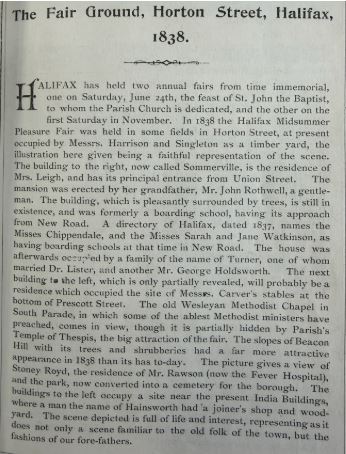


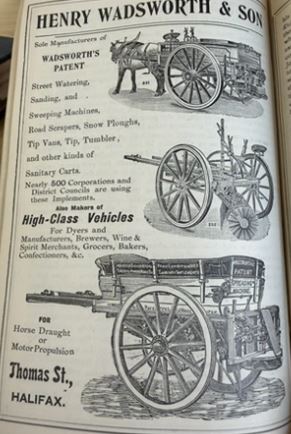
Thomas Street


Read about "A disaster at India Buildings"



Have A Great Story About This Topic?
Do you have a great story about this? Share it!
If you have enjoyed your visit to this website, please spread the word by clicking the 'like' and 'share' buttons below. Thank you